

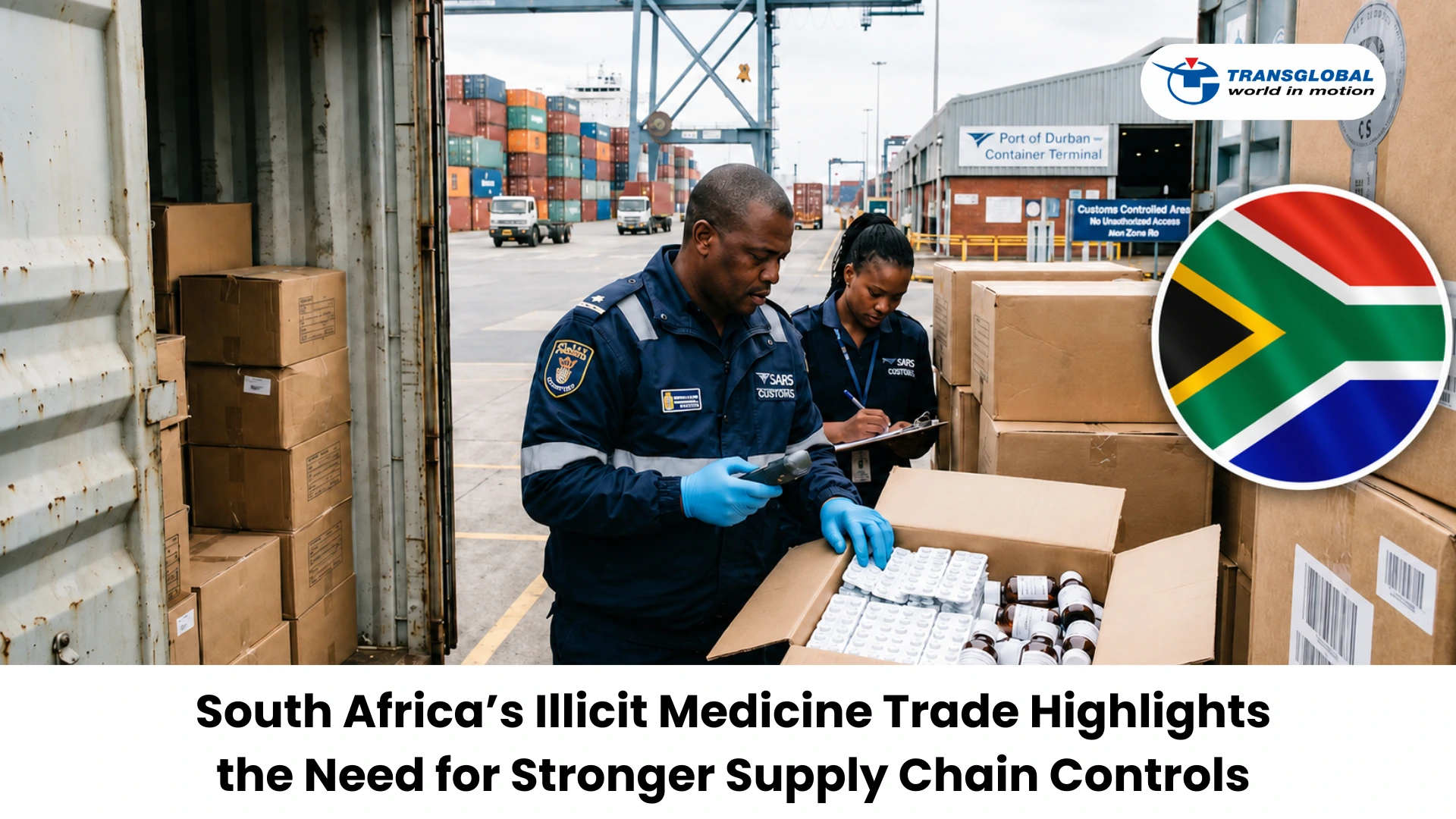
South Africa’s illicit medicine trade is becoming a serious concern for public health, patient safety, and supply chain integrity.
The Pharmaceutical Manufacturers Association of South Africa has called for urgent government intervention to combat the growing illegal trade in medicines.
The concern is no longer limited to counterfeit products entering informal markets.
According to Pharmisa chairperson Stavros Nicolaou, the illegal trade now also involves healthcare practitioners operating outside the law.
This is a worrying development.
Medicines are not ordinary commercial goods. When they are counterfeit, unapproved, unlawfully compounded, poorly stored, or moved through uncontrolled channels, the risk extends far beyond financial loss.
It can affect patients, families, healthcare providers, manufacturers, and the wider public.
The message is clear.
👉 Curbing illicit medicine trade requires more than enforcement. It requires a responsible and compliant supply chain from import to final delivery.
⚠️ Illicit Medicine Trade is Becoming a Bigger Risk
Illicit medicine trade creates serious risks for patients, healthcare systems, manufacturers, and regulators.
Counterfeit medicines can place lives at risk.
Unapproved products can enter the market without proper safety checks.
Unlawful compounding can create products that are distributed beyond what the law allows.
One example highlighted was semaglutide, the active ingredient in Ozempic, which has become widely known because of its use in diabetes treatment and weight loss.
Concerns were raised around counterfeit copies, unapproved imports, and unlawful compounding into injectable products.
This type of activity weakens public trust and creates unfair pressure on compliant manufacturers.
It also shows why stronger control is needed across the full medicine supply chain.
📋 Compliance Must Start Before Cargo Moves
Medicine control does not begin only at the point of sale.
It begins before cargo moves.
Every shipment must be supported by proper product verification, import documentation, regulatory approval, customs declarations, storage requirements, and delivery controls.
When illegal or unapproved products enter circulation, the issue is often connected to gaps across multiple stages of the supply chain.
That is why agencies such as SAHPRA, the South African Pharmacy Council, SARS, the Border Management Authority, SAPS, and the Hawks need coordinated support from responsible private-sector partners.
Credible logistics providers have an important role to play.
They must avoid shortcuts, verify documentation, follow regulatory requirements, and ensure that pharmaceutical cargo moves through controlled and traceable channels.
For regulated goods, customs clearance is not just an administrative step.
It is part of protecting people, markets, and national supply security.
🚚 Logistics Providers Must Be Part of the Solution
Illicit medicine cannot be addressed by authorities alone.
Every business involved in the movement, handling, storage, and delivery of pharmaceutical products has a responsibility.
A compliant logistics provider should know what is being moved, where it is coming from, whether documentation is complete, and whether the cargo requires special handling.
They should also understand when a shipment raises red flags.
That includes unclear product descriptions, missing documentation, unusual routing, poor packaging, unverified suppliers, or pressure to move cargo without proper checks.
Responsible logistics providers help close these gaps.
They support compliance by maintaining shipment visibility, accurate records, proper cargo handling, and clear communication with clients and authorities.
In a market where illegal medicines can harm society, logistics cannot be treated as a neutral service.
It must be part of the control system.
🏭 Local Manufacturing Pressure Adds to the Risk
The warning around illicit medicine trade comes at a time when South Africa’s pharmaceutical manufacturing base is already under pressure.
Contract manufacturing organisations that produced important products such as oral contraceptives and penicillin formulations have either shut down or temporarily suspended operations.
This creates another concern.
When local manufacturing weakens, the country becomes more dependent on imported medicines, active pharmaceutical ingredients, and external supply sources.
That does not mean imports are unsafe.
But it does mean that stronger controls are needed to protect legal supply chains and prevent illicit products from exploiting supply gaps.
During Covid-19, South Africa experienced how vulnerable medical supply chains can become when global restrictions, shortages, and trade disruptions occur.
South Africa cannot afford to ignore that lesson.
🚢 Pharmaceutical Imports Need Stronger Oversight
Even with stronger local production, South Africa will continue to depend on global pharmaceutical supply chains.
Medicines, active ingredients, packaging materials, and healthcare products must therefore move through reliable and compliant logistics channels.
For some products, sea freight remains important because of volume, cost, and international supply flows.
However, moving pharmaceutical cargo requires more than transport capacity.
It requires traceability, documentation accuracy, secure handling, suitable storage, and careful coordination between importers, regulators, customs teams, and logistics providers.
If cargo is misclassified, poorly documented, incorrectly stored, or released without proper checks, the risk increases.
The wider supply chain must therefore support enforcement, not weaken it.
📦 Secure Storage Protects Medicine Integrity
Medicine supply security also depends on what happens after goods arrive.
Pharmaceutical products may require secure storage, stock control, segregation, temperature awareness, access control, and release procedures.
This is where warehousing becomes part of the wider compliance process.
If medicines are stored poorly, mixed with unsuitable cargo, released without checks, or exposed to uncontrolled conditions, product integrity may be affected.
Secure warehousing is not only about available space.
It supports accountability, traceability, cargo protection, and safer distribution.
For pharmaceutical supply chains, every handover point matters.
⚖️ Regulated Cargo Needs Specialist Control
Pharmaceutical products are not all handled in the same way.
Some may move as standard commercial cargo.
Others may require permits, temperature controls, special documentation, security measures, or regulatory oversight.
The principle is similar across many controlled cargo categories.
When products are sensitive, high-value, hazardous, or compliance-heavy, basic transport planning is not enough.
Understanding the rules for DG cargo and dangerous goods also shows why proper classification and documentation matter across high-risk supply chains.
Pharmaceutical logistics requires the same discipline.
Every movement must protect safety, legality, and supply continuity.
🚚 Conclusion: Illicit Medicine Needs a Supply Chain Response
South Africa’s illicit medicine trade is a serious warning.
It shows that public health protection depends on more than enforcement after illegal products are found.
It depends on preventing counterfeit, unsafe, unapproved, or unlawfully compounded medicines from moving through the supply chain in the first place.
Authorities have a critical role to play.
But compliant and credible logistics providers must also be part of the solution.
Working with the leading freight forwarders helps businesses manage regulated cargo, customs requirements, secure handling, documentation, and supply chain risk with greater confidence.
Because medicines are not ordinary goods.
👉 They must move through supply chains that protect compliance, safety, and public health.
Comments