
Moving Complex Project Cargo with Certified Freight Expertise
Planning a Heavy Lift? We Align the Route, Rigging and Site.
Every project load tells us how it must move. We define its transport envelope, lifting needs and delivery conditions first. That intelligence shapes the route assessment, equipment configuration and handling method before mobilisation can begin. We define every requirement before the cargo moves:
Confirmed Before Every Movement
-
 Cargo Assessment: Supplier drawings, dimensions, weight and lifting requirements establish the complete cargo envelope.
-
 Route & Site Feasibility: Bridge ratings, clearances, turning radii, hardstand and offloading conditions are assessed.
-
 Method & Permit Plan: The transport method, required equipment, permit schedule and delivery sequence are confirmed before movement.
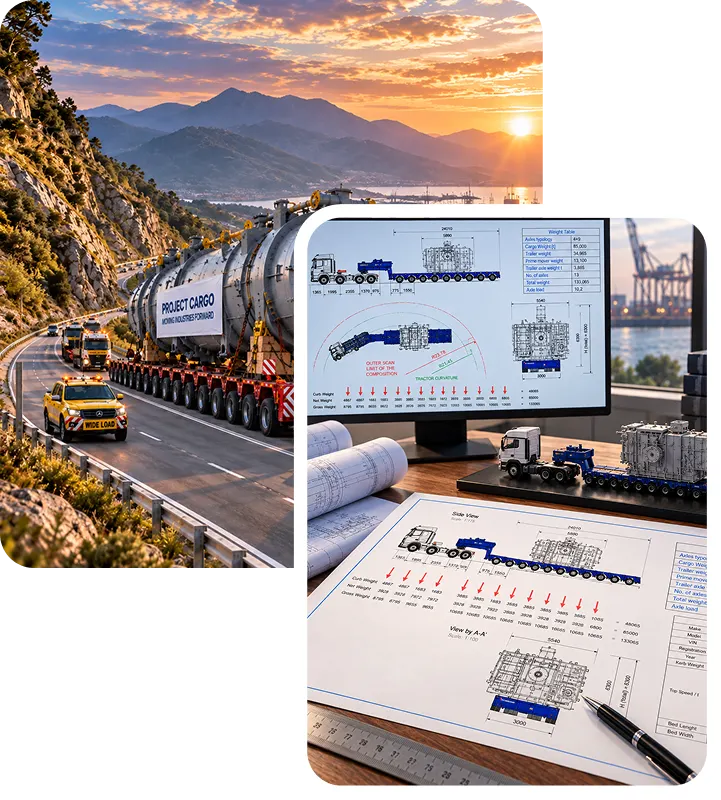
Oversized Cargo Moves Right When
Everything is Planned Right

Planned with Precision
Supplier drawings and dimensions are reviewed early to identify access, handling and equipment conflicts.

Customs Under Control
Tariff classifications, permits and border requirements are confirmed before dispatch, preventing avoidable clearance holds.

Weighed at Source
Container mass is verified before port delivery, preventing VGM discrepancies from blocking terminal acceptance.
Different Types of Project Cargo Require Different Transport Planning
Project cargo can include anything from a single heavy unit to multiple components moving as part of a wider project. Weight, dimensions, lifting points, configuration and site access influence how each load must be planned, transported and delivered.
Heavy Machinery
Industrial machinery and production equipment are planned around unit weight, lifting points, load distribution and access at origin and destination.
Oversized Equipment
Cargo exceeding standard transport dimensions requires suitable equipment, route assessment and loading arrangements matched to its actual size and configuration.
Plant & Construction Equipment
Cranes, excavators and construction machinery are coordinated around operating condition, dimensions, axle loads and access to the delivery site.
Mining Equipment
Heavy mining units, components and processing equipment require careful planning around road access, lifting capability and remote-site delivery conditions.
Energy & Power Equipment
Transformers, generators and power-system components are coordinated around concentrated weight, lifting requirements and access to the installation point.
Industrial Components
Large fabricated sections, tanks, vessels and structural components require transport methods suited to irregular dimensions and non-standard loading points.
Infrastructure Cargo
Equipment and materials for infrastructure projects are coordinated around construction schedules, site readiness and the sequence in which units are required.
Multi-Piece Project Cargo
Projects involving multiple units require shipment sequencing and coordinated delivery so individual components arrive in line with the wider project programme.

How Our Planning Takes Your Project Cargo from Assessment to Handover
Assigned project manager takes responsibility for the movement of shipments from the initial technical review throughout the final handover. Suppliers, transport partners and the receiving site are coordinated against one agreed plan throughout the project.
- Technical Review: Drawings, dimensions, weight, lifting points and site conditions
- Route & Method: Feasible route, suitable equipment, permits and delivery sequence
- Movement Execution: Supervised loading, monitored transit, offloading and site handover
Why Shippers Choose Transglobal for Specialist Oversized Transport Coordination

Cargo Profile Sets the Transport Method
Every project cargo consignment has a unique transport envelope, weight, centre of gravity, lifting points and support requirements that determine equipment and handling methods.

Route Assessment Confirms Feasibility
Route surveys assess bridge capacity, axle-load limits, overhead clearances, turning radii, gradients, road width and site access before trailer configuration is approved for mobilisation.

Permit Sequencing Protects the Schedule
Abnormal-load permits, cross-border permissions, terminal slots, escort requirements and municipal approvals are sequenced against authority lead times to keep the confirmed departure date achievable.

Single-Point Oversight Connects Every Interface
A named project manager aligns method statements, hauliers, loading crews, escorts, terminal windows and receiving-site readiness through one controlled schedule and accountable reporting line.
Credentials Behind Every
Project Cargo Move

ISO 9001:2015
Quality Management Certified
SARS AEO
Customs Compliance Accredited
SAMSA Mobile Weighing
Authorised VGM Verification
FIATA
Global Freight AffiliationA Message From Our CEO
At Transglobal Cargo, successful project cargo begins with understanding the load before it moves. Every drawing, dimension, route and site condition matters. Our responsibility is to bring these elements together in one practical plan that protects the cargo, the schedule and the client's wider project.
Project cargo is never simply a transport booking. It demands technical preparation, trusted partners and clear accountability from origin to final site delivery. That is why we approach every movement with careful planning, open communication and one team committed to getting every critical stage right.

 100% Trusted Freight Forwarder
100% Trusted Freight Forwarder
100% Trusted Freight Forwarder
100% Trusted Freight Forwarder
100% Trusted Freight Forwarder
100% Trusted Freight Forwarder
100% Trusted Freight Forwarder
Answers to your
Project Cargo questions
Project cargo refers to heavy, oversized, high-value or technically complex equipment requiring transport planning beyond standard freight. It may involve specialised equipment, route assessments, permits, lifting arrangements and supervised delivery.
Transglobal coordinates heavy machinery, mining and construction plant, transformers, generators, modular units, tanks, pressure vessels, renewable energy components and other oversized equipment requiring carefully planned movement.
Planning begins with supplier drawings, dimensions, weight, lifting points and site conditions. The route, transport method, equipment, permits, loading arrangements and delivery sequence are then coordinated through one movement plan.
Requirements depend on the cargo, transport mode, route and destination. Transglobal coordinates applicable abnormal-load permits, cross-border documents, customs formalities, terminal approvals, escorts and municipal permissions where required.
Yes. Transglobal coordinates domestic movements across South Africa, cross-border deliveries into SADC and international project cargo shipments, including cargo destined for remote or developing sites, subject to route and site feasibility.