

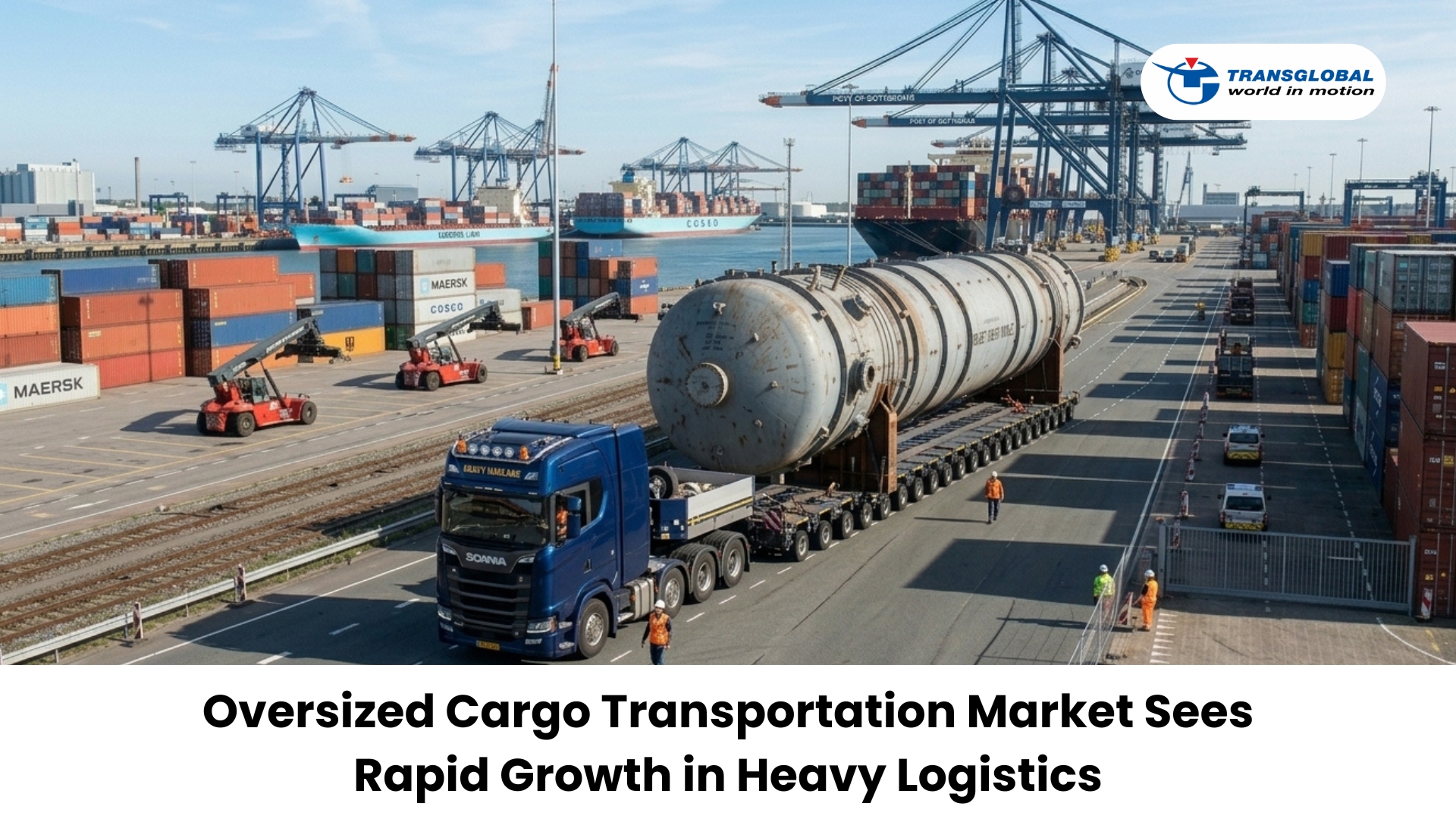
From renewable energy projects and mining developments to petrochemical plants, infrastructure megaprojects, and industrial manufacturing facilities, the movement of oversized and heavy-lift cargo is becoming increasingly critical to global economic growth.
According to recent market forecasts, the global oversized cargo transportation market is expected to grow from US$226.77 billion in 2026 to US$298.42 billion by 2032, reflecting steady expansion across industries that depend on the safe movement of large, heavy, and complex cargo.
While standard freight remains the backbone of global trade, oversized cargo is rapidly becoming one of the most strategic segments in modern logistics.
The reason is simple:
👉 When a project depends on a single turbine, transformer, reactor vessel, mining machine, or prefabricated module arriving on time, logistics becomes far more than transportation, it becomes project success.
🌍 Why Demand for Oversized Cargo Transportation is Rising?
Around the world, governments and private investors are spending heavily on infrastructure, energy, manufacturing, and industrial expansion.
These projects require the movement of cargo that often exceeds conventional transport dimensions and weight limits.
Examples include:
- ⚙️ Industrial machinery
- 🏗️ Bridge sections and infrastructure modules
- ⚡ Wind turbine components
- ⛽ Petrochemical equipment
- ⛏️ Mining machinery
- 🏭 Factory and processing plant equipment
Unlike conventional freight, these shipments cannot simply be loaded into standard containers and moved through normal transport networks.
Every movement requires detailed planning, route engineering, permit approvals, specialized equipment, and coordination across multiple stakeholders.
As industrial activity continues to expand globally, demand for these specialized logistics services is rising alongside it.
🚛 Why Road Transport Still Dominate the Market?
Although oversized cargo often involves sea, rail, and multimodal transport solutions, road transportation continues to dominate the sector.
The reason is practical.
No matter where cargo arrives, it ultimately needs to reach its final destination, whether that is a construction site, mining operation, manufacturing facility, or energy project.
Road transport offers:
- Greater route flexibility
- Access to remote locations
- Last-mile project delivery capability
- Better control over scheduling
However, moving oversized cargo by road is rarely straightforward.
Challenges often include:
- Bridge load limitations
- Narrow road infrastructure
- Utility line clearances
- Traffic management requirements
- Regulatory approvals
This is why specialized heavy-haul expertise is becoming increasingly valuable.
⚠️ The Challenges are Growing Alongside the Opportunities
The oversized cargo market may be expanding, but it is also becoming more complex.
Many of today’s projects involve larger and heavier components than ever before. At the same time, logistics operators must navigate:
- Rising fuel costs
- Infrastructure constraints
- Permit complexities
- Environmental regulations
- Cross-border compliance requirements
Recent disruptions across major global trade corridors have added further pressure.
Geopolitical tensions, shipping rerouting, port congestion, and capacity shortages continue to impact project schedules worldwide.
For project owners, delays in moving critical cargo can lead to significant financial consequences.
A delayed transformer, turbine, or reactor vessel can potentially postpone entire construction timelines.
This makes logistics planning a strategic business function rather than simply a transportation service.
🤖 Technology is Reshaping Heavy Logistics
One of the biggest changes happening in oversized cargo transportation is the growing role of technology.
Historically, project cargo planning relied heavily on manual route surveys and operational experience.
Today, advanced technologies are improving decision-making across the entire process.
Modern logistics providers increasingly use:
- 📡 Real-time cargo tracking
- 🤖 AI-powered route optimization
- 📊 Predictive risk analysis
- 🗺️ Digital route simulation
- 📋 Automated permitting workflows
These tools help operators identify potential obstacles before cargo begins moving, reducing delays and improving safety.
In an industry where even minor disruptions can have major consequences, technology is becoming a critical competitive advantage.
🚢 Project Cargo is Becoming More Strategic
Perhaps the most important trend is the changing perception of project cargo itself.
In the past, oversized cargo was often viewed as a niche logistics segment.
Today, it is increasingly recognized as a critical enabler of economic development.
Whether supporting renewable energy installations, mining projects, industrial expansion, defence infrastructure, or petrochemical facilities, oversized cargo logistics now sits at the centre of some of the world’s most important investments.
Success depends not only on transportation capacity but also on:
- Route engineering
- Regulatory expertise
- Risk management
- Multimodal coordination
- Stakeholder communication
The companies that master these capabilities will be best positioned to support the next generation of global infrastructure and industrial growth.
🔮 Looking Ahead: Bigger Projects, Greater Complexity
The outlook for oversized cargo transportation remains strong.
As governments continue investing in infrastructure and industries expand globally, demand for specialized heavy-haul logistics is expected to grow steadily over the coming years.
At the same time, customers are demanding greater visibility, tighter project timelines, and more sustainable logistics solutions.
This means future success will increasingly depend on a combination of:
- Operational expertise
- Advanced technology
- Strategic planning
- Flexible transport networks
Oversized cargo is no longer simply about moving large equipment.
👉 It is about enabling entire industries to move forward.
🚚 Conclusion: Experience Matters When the Cargo Cannot Fail
Oversized cargo projects leave very little room for error.
Every route, permit, lifting plan, and transport decision can directly influence project timelines, costs, and operational success.
That is why working with the best freight forwarder is critical when handling project cargo, heavy lift shipments, industrial equipment, hazardous materials, or specialized logistics requirements.
Because when the cargo is larger, heavier, and more complex than standard freight, logistics expertise becomes more than a service, it becomes a competitive advantage.

Comments