

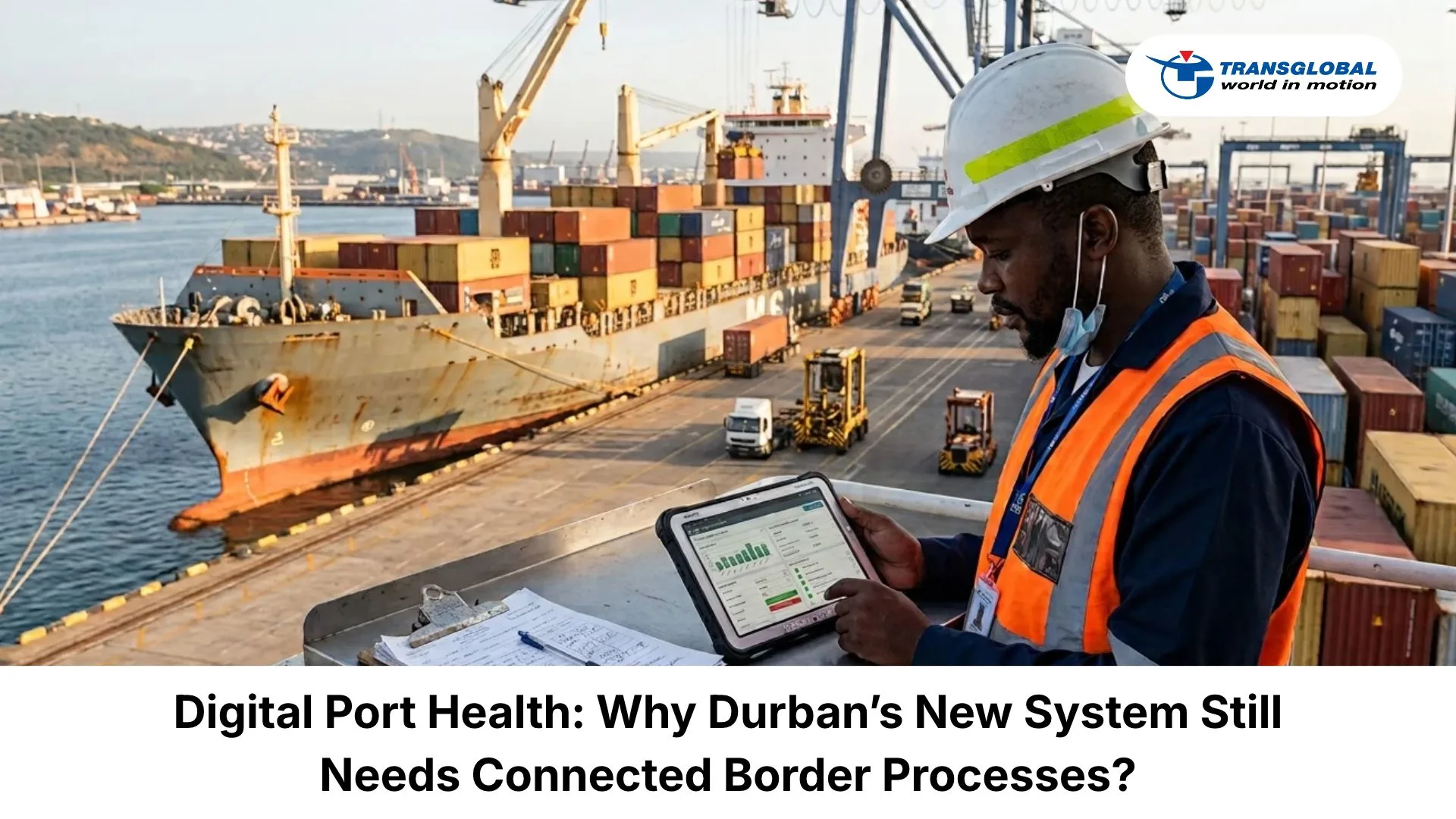
Port health processing at Durban is moving further into the digital space.
The Border Management Authority has launched its new Port Health Management System at the Port of Durban, where shipping agents and other authorised maritime stakeholders are expected to use the platform for services such as free pratique and extensions of ship sanitation certificates.
Durban is the first implementation site.
The system is expected to be extended to other relevant ports in due course, although wider rollout dates have not yet been confirmed.
For shipping agents, freight forwarders, clearing agents and cargo owners, the move is important because port health processes form part of the wider clearance environment around vessels, cargo and port operations.
But the industry response is also practical.
The move to online processing has been welcomed, but the Durban pilot is still being evaluated. Stakeholders do not expect immediate trade facilitation improvements while integration with other government systems remains under development.
The message is clear.
👉 Digital border systems can improve processing, but real efficiency comes when port health, customs and other government platforms work together.
⚓ Durban Becomes the First Port to Move Health Processing Online
The Port of Durban has become the first site for the BMA’s Port Health Management System.
The system is currently focused on port health functions, including online processing for free pratique and ship sanitation certificate extensions.
Free pratique is an important port health clearance that allows a vessel to enter port after meeting the required health conditions.
Ship sanitation certificates also form part of vessel health compliance, confirming sanitation-related requirements for ships calling at port.
Moving these processes online is a positive step.
It can reduce paper handling, support clearer submission processes and create a more structured way for authorised maritime users to engage with port health services.
For a busy port like Durban, any improvement in documentation flow matters.
📄 A Live System Still Needs Real-World Testing
Although the system has gone live, industry stakeholders have made it clear that it is still in an initial design and testing phase.
Feedback from freight forwarders and clearing agents is being submitted to the BMA every two weeks through Project ACME, a public-private initiative involving the BMA and the South African Association of Freight Forwarders.
Industry representatives are also engaging with BMA officials at the port daily.
This matters because digital systems must work in real operating conditions.
A platform may be live, but its real value depends on how well it supports the people using it every day.
Shipping agents, clearing agents, freight forwarders and port stakeholders need systems that reduce friction, not create another layer of administration.
🌐 Digital Progress should not Create Another Standalone Step
One of the main industry concerns is that the Port Health Management System must not become a standalone platform that sits separately from existing government systems.
That concern is important.
If users need to submit information into multiple systems without proper integration, digitalisation can create duplication instead of efficiency.
Industry representatives have therefore called for seamless interfacing between existing and new digitised solutions, including the PHMS.
The BMA has confirmed that work has begun to integrate the system with relevant government platforms, including SARS, but the technical and operational arrangements are still under discussion.
This is where the wider trade facilitation value will be decided.
A digital port health system is useful.
A connected border processing environment is far more valuable.
🚢 Cargo Flow Depends on More Than One Approval
Cargo movement depends on more than one approval point.
A vessel may need port health clearance. Cargo may need customs processing. Certain products may require veterinary, agricultural or other specialised controls.
If these functions are not connected, cargo owners and logistics teams may still face delays, repeated submissions and uncertainty.
This is why port health digitisation should be viewed as part of the wider clearance chain, not as a separate administrative improvement.
For importers and exporters, efficient customs clearance depends on accurate documentation, coordinated government processes and timely communication between all parties involved.
The same applies to sea freight, where vessel schedules, port processes, documentation and cargo release all need to align.
When one part of the chain is digital and another remains disconnected, the full benefit may not yet be felt.
📦 Specialised Cargo Still Needs Wider Government Integration
Industry stakeholders have also called for further digitisation of specialised government functions, especially state veterinary and agricultural processes.
This is important because many shipments require more than standard customs processing.
Food products, animal products, agricultural cargo and certain controlled goods may need additional checks, permits or approvals before they can move.
If those processes remain separate or manual, cargo flow can still be affected even when one part of the system becomes digital.
Understanding how sea freight flows through South Africa’s ports shows why coordination across port health, customs, carriers, agents and terminals is critical.
Trade facilitation is not achieved by one system alone.
It is achieved when the full process becomes easier to manage.
🤝 Agents See Promise, but Scale Will Prove the Value
Shipping agents expect the online process to improve processing times, but the benefits still need to be demonstrated at scale.
The wider operating environment has already seen some improvement, including arrangements that allow agents to request services outside normal operating hours through an overtime process.
Communication between agents and BMA officials is also reported to be working well as the industry adapts to the digital transition.
That is a positive sign.
But the long-term value of the platform will depend on how effectively it connects with SARS, the planned National Single Window and other government functions.
For freight teams, this is the key point.
Digital tools are useful only when they make the movement easier, faster and more predictable. Strong logistics coordination is still needed to keep documentation, compliance and authority requirements aligned.
🚚 Conclusion: Digital Clearance Works Best When Systems Connect
The BMA’s Port Health Management System at Durban is a positive step towards more digital port processing.
It gives shipping agents and authorised maritime users a platform for port health services such as free pratique and ship sanitation certificate extensions.
But the Durban pilot also shows that digitalisation must be carefully connected to the wider border environment.
SARS, port health, veterinary controls, agricultural processes, shipping agents, clearing agents and freight forwarders all form part of the same operating chain.
For businesses moving cargo through South African ports, working with a leading freight forwarder helps keep port, customs and clearance requirements aligned.
Because digital systems are useful when they do more than replace paper.
👉 They must help the whole border process work as one.
Comments