

For decades, global supply chains were built on one core assumption: stability. Trade routes were predictable, costs could be optimized, and disruptions were treated as temporary setbacks.
That assumption no longer holds true.
Today, global logistics operates within a tightly interconnected system where a handful of critical chokepoints control the movement of goods, energy, and industrial inputs. When instability affects even one of these nodes, the consequences are not local, they are global.
For freight forwarders and logistics professionals, this is no longer just a strategic discussion. It is an operational reality that directly impacts how shipments are planned, routed, and delivered.
🌐 The World’s Critical Chokepoints: Small Nodes, Massive Impact
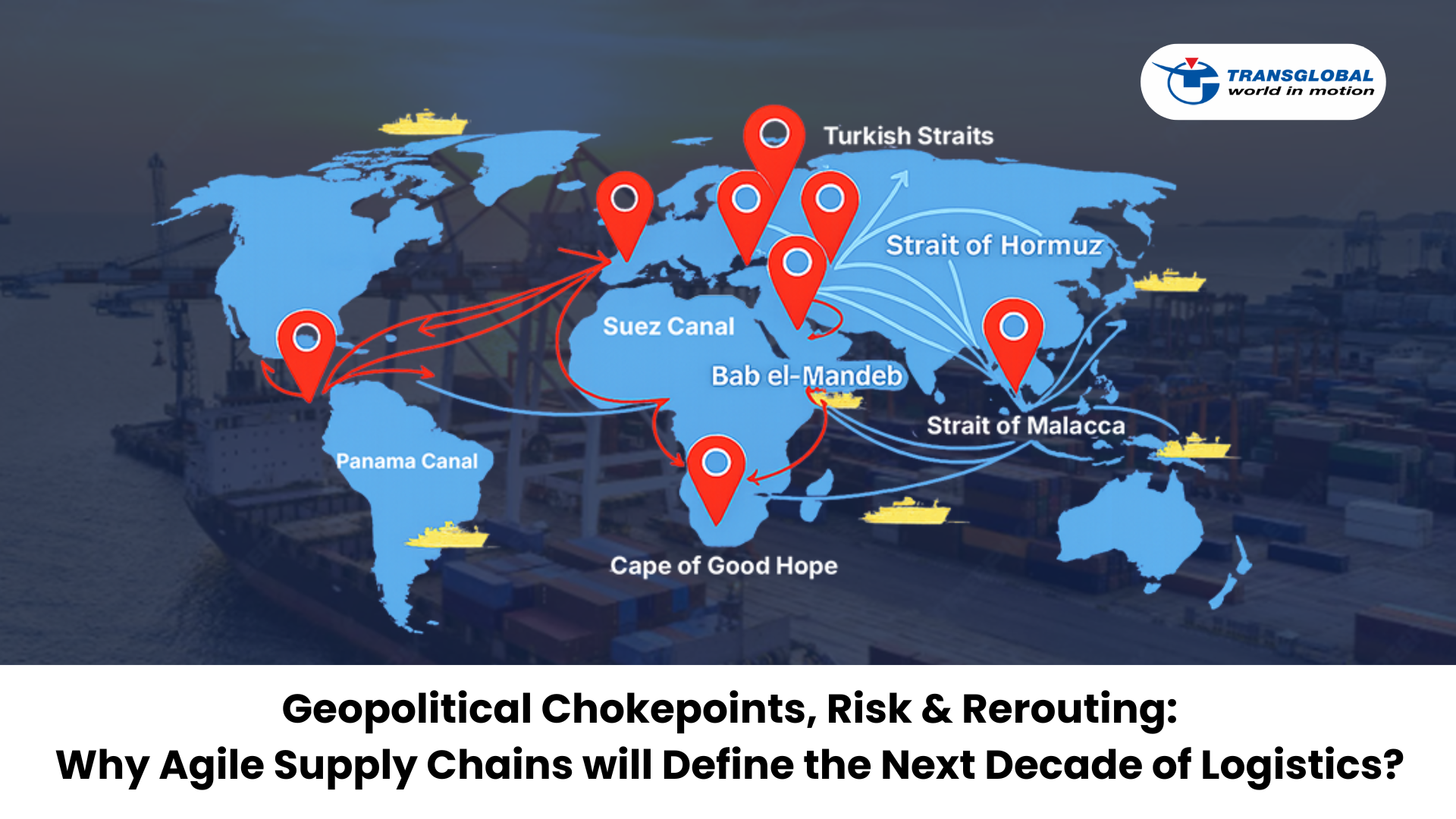
Modern trade depends heavily on a limited number of strategic corridors. These are not just routes, they are single points of failure in the global supply chain.
⚓ Strait of Hormuz
Nearly a quarter of the world’s seaborne oil flows through this narrow passage. Any disruption here directly impacts fuel prices, which in turn affects freight costs across all transport modes.
🚢 Suez Canal & Bab el-Mandeb
This corridor is one of the most important links between Asia and Europe. Recent security concerns have already forced vessels to reroute via the Cape of Good Hope, adding 10–15 days to transit times and significantly increasing operational costs.
🌏 Strait of Malacca
A vital artery connecting Asian manufacturing hubs with global markets. Any instability here can disrupt large volumes of container traffic.
🌊 South China Sea
Roughly one-third of global maritime trade flows through this region, making it one of the most strategically sensitive areas in global logistics.
💻 Taiwan’s Semiconductor Ecosystem
Unlike physical routes, this represents an industrial chokepoint. The global dependence on advanced semiconductor production means disruptions here can halt manufacturing across multiple industries.
Each of these chokepoints highlights the same reality: global trade is highly concentrated, and therefore highly vulnerable.
🚢 Rerouting is No Longer an Exception, It’s Becoming Routine
When disruptions occur at these chokepoints, logistics networks do not stop, they adapt. But that adaptation comes at a cost.
Recent rerouting of vessels around the Cape of Good Hope instead of the Suez route demonstrates how quickly global shipping patterns can shift.
These changes create multiple downstream effects:
- ⛽ Increased fuel consumption due to longer sailing distances
- 📦 Extended delivery timelines impacting customer commitments
- 📈 Higher freight rates as operational costs rise
- ⚓ Increased pressure on alternative ports and shipping schedules
What was once considered a contingency plan is now becoming a regular part of logistics strategy.
📊 The Ripple Effect Across Global Trade
The impact of chokepoint disruptions is rarely isolated. It spreads across the entire supply chain ecosystem.
Even before physical disruptions occur:
- 📈 Freight markets begin adjusting prices based on perceived risk
- ⛽ Energy price fluctuations affect transport costs globally
- 📦 Supply-demand imbalances emerge due to delayed shipments
- 📊 Planning cycles become shorter and less predictable
This means logistics professionals must respond not only to actual disruptions but also to anticipated risks.
🔄 From Efficiency to Agility: A Fundamental Shift
The traditional model of supply chains focused on minimizing cost and maximizing efficiency. However, repeated disruptions, from geopolitical tensions to route blockages, have exposed the limitations of this approach.
The new model is built on agility.
Agility in supply chains is defined by three key capabilities:
👀 1. Anticipation Over Reaction
Businesses must continuously monitor geopolitical developments, trade policies, and regional risks. Waiting until a disruption occurs is no longer viable when rerouting and sourcing decisions take time.
🌍 2. Diversification of Routes and Suppliers
Relying on a single trade lane or production hub increases vulnerability. Forward-thinking companies are exploring alternative corridors, regional sourcing strategies, and multi-route planning.
🤝 3. Strong Logistics Partnerships and Visibility
Freight forwarders are now strategic partners. Real-time tracking, predictive insights, and scenario planning tools help businesses stay ahead of disruptions rather than react to them.
🔍 The New Reality: Risk Is Now a Constant
Geopolitical risk is no longer an occasional disruption, it is a permanent factor in global trade.
The key takeaway for logistics professionals is clear:
- Stability can no longer be assumed
- Trade routes can change rapidly
- Costs are increasingly influenced by risk, not just distance
- Planning must include flexibility as a core component
This shift is redefining how supply chains are designed and managed.
🚚 Conclusion
In today’s environment, the companies that succeed will not be those with the lowest logistics costs. They will be the ones who can anticipate disruptions, adapt quickly, and keep cargo moving under any conditions.
As global chokepoints continue to shape trade flows, working with the best freight forwarder becomes essential. The right partner brings not only operational capability but also strategic insight to navigate uncertainty.
Because in modern logistics, the real advantage is not efficiency alone, it is resilience, agility, and the ability to move forward no matter what changes are ahead.
Comments