

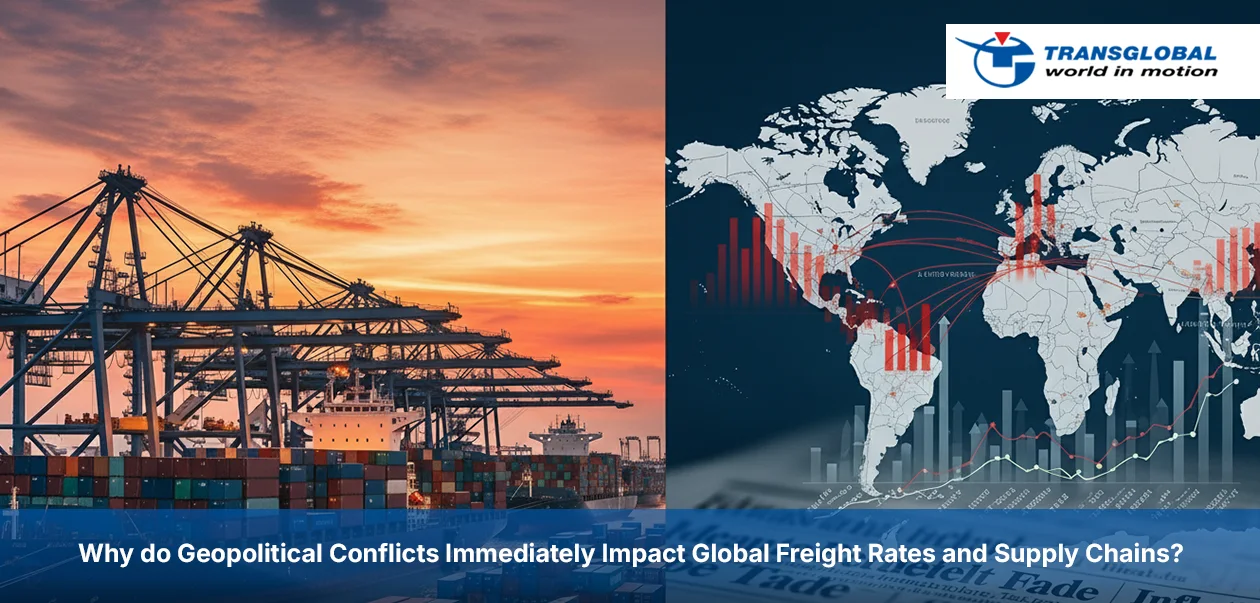
When missiles fly, freight rates move.
That statement may sound dramatic, but for logistics professionals, it reflects a simple reality. Global trade depends heavily on stability, confidence, and predictable shipping routes. The moment geopolitical tensions escalate, especially in strategically important regions like the Middle East, the ripple effects travel quickly through supply chains, freight markets, insurance costs, and commodity pricing.
While governments debate political consequences and international law, businesses and logistics planners focus on something more immediate: What does this mean for trade stability and supply chain reliability?
For exporters, freight forwarders, and global supply chain managers, geopolitical risk is no longer theoretical. It is a direct operational and financial factor influencing freight costs, routing decisions, and procurement strategies.
How Geopolitical Tensions Translate into Logistics Disruption?
When tensions rise between major powers or regional actors, such as Iran, the United States, Israel, or other key geopolitical players, global trade routes immediately feel the pressure.
Even before a physical disruption occurs, the market begins adjusting to perceived risk.
The first indicators usually appear in critical maritime chokepoints and strategic shipping corridors, such as:
- The Strait of Hormuz is responsible for a large portion of global oil shipments
- The Red Sea shipping corridor connecting Asia to Europe
- The Suez Canal, one of the world’s most important trade routes
When tensions escalate in or around these areas, shipping markets react almost instantly.
This reaction triggers several operational consequences across the logistics ecosystem.
The First Impact: Energy Flows and Fuel Costs
Energy markets are often the earliest indicator of geopolitical disruption.
The Strait of Hormuz alone carries roughly 20% of global oil shipments, making it one of the most strategically sensitive waterways on the planet. Any threat to this corridor immediately raises concerns about supply continuity.
The result is rapid fuel price volatility.
For logistics companies, this has direct implications:
- Higher bunker fuel costs for shipping lines
- Increased airline fuel surcharges
- Rising trucking fuel expenses
- Overall freight rate increases
Fuel is one of the highest operational costs in logistics. Even small increases can quickly affect global shipping rates.
Marine War-Risk Premiums and Insurance Surges
Insurance markets also react quickly to geopolitical instability.
When military tensions escalate in key maritime regions, insurers adjust risk assessments and apply war-risk premiums for vessels transiting those areas.
These premiums may include:
- Additional marine insurance charges
- Higher war-risk surcharges
- Increased cargo insurance premiums
- Restricted insurance coverage for certain routes
Shipping lines typically pass these costs directly to shippers and freight forwarders.
Even if cargo moves safely, the perception of risk alone can increase operational expenses across the entire supply chain.
How Shipping Lines and Carriers React?
Shipping companies constantly monitor geopolitical developments. Their operational decisions often shift long before physical disruptions occur.
Typical responses include:
- Adjusting freight rates to reflect risk exposure
- Rerouting vessels away from high-risk areas
- Increasing buffer times in schedules
- Implementing war-risk surcharges
- Revising port rotation strategies
For example, disruptions in the Red Sea corridor have previously forced vessels to reroute around the Cape of Good Hope, adding thousands of nautical miles and significantly increasing transit time and fuel costs.
These adjustments quickly influence freight pricing across global markets.
The Hidden Impact: Currency Volatility and Trade Confidence
Geopolitical instability not only affects physical logistics. It also influences financial markets.
Currency volatility often increases during geopolitical crises. When exchange rates fluctuate unpredictably, international trade contracts become more difficult to price accurately.
Businesses may face:
- Changing import and export costs
- Increased hedging expenses
- Delayed purchasing decisions
- Reduced investment confidence
For exporters and freight forwarders, this uncertainty creates additional operational pressure.
Trade relies on confidence. When confidence drops, supply chains slow.
From Cost-Optimized to Risk-Optimized Supply Chains
For decades, global supply chains focused primarily on cost efficiency.
Manufacturing shifted to regions with lower labour costs. Logistics networks optimized for speed and price. Companies minimized inventory and relied heavily on just-in-time supply models.
Today, that approach is evolving.
Businesses increasingly recognize that geopolitical uncertainty requires a different strategy, one focused on resilience rather than pure cost reduction.
As a result, many organizations are now implementing:
- Nearshoring strategies, bringing production closer to end markets
- Friendshoring, sourcing from politically aligned regions
- Dual sourcing, using multiple suppliers to reduce dependency
- Strategic stockpiling, maintaining larger inventory buffers
- Diversified logistics routing, avoiding single-point vulnerabilities
This shift reflects a broader structural change in global trade.
Supply chains are no longer designed only for efficiency. They are being redesigned for risk management.
Why Freight Forwarders Must Adapt?
For freight forwarders and logistics planners, geopolitical risk has become part of everyday decision-making.
The modern freight professional must now consider:
- Alternative routing options
- Insurance implications
- Compliance with sanctions and export controls
- Real-time trade policy changes
- Regional security developments
This requires deeper expertise, stronger carrier relationships, and proactive communication with customers.
Forwarders who can interpret geopolitical risk and translate it into practical logistics strategies will become increasingly valuable.
Logistics is Now a Strategic Risk Interface
In the past, logistics was often treated as a back-end operational function.
Today, it sits at the intersection of trade policy, geopolitical strategy, and global commerce.
When tensions rise, logistics becomes the mechanism through which geopolitical decisions translate into real-world costs:
- Higher freight rates
- Delayed shipments
- Increased insurance costs
- Supply chain restructuring
Understanding this relationship allows businesses to respond more effectively.
The question for modern supply chain leaders is no longer simply “How cheaply can we ship?”
It is “How resilient is our logistics strategy?”
Conclusion
Global trade has always been influenced by geopolitics, but today the connection is more immediate and visible than ever.
Conflicts, sanctions, and regional instability can affect freight markets within hours. Shipping routes shift, insurance premiums rise, and supply chains adjust.
For businesses operating internationally, the key is not predicting every geopolitical event. It is building logistics strategies that can adapt when those events occur.
Working with the best freight forwarder ensures your cargo moves with resilience, compliance, and strategic oversight, even in volatile environments.
If your business depends on reliable global logistics solutions, contact us today. Our team is ready to help you navigate complex trade environments and keep your supply chains moving confidently.
Frequently Asked Questions
Why do geopolitical conflicts affect freight rates so quickly?
Because shipping routes, energy supply chains, and insurance markets react immediately to perceived risk. Even without physical disruptions, market expectations can drive freight rate increases.
Which shipping routes are most sensitive to geopolitical tension?
Critical chokepoints such as the Strait of Hormuz, Red Sea corridor, Suez Canal, and major energy transport routes often experience immediate market reactions during geopolitical crises.
How can companies protect their supply chains from geopolitical disruptions?
Businesses can improve resilience by diversifying suppliers, using multiple transport routes, maintaining strategic inventory, and working with experienced freight forwarders who monitor geopolitical risks closely.
Comments