

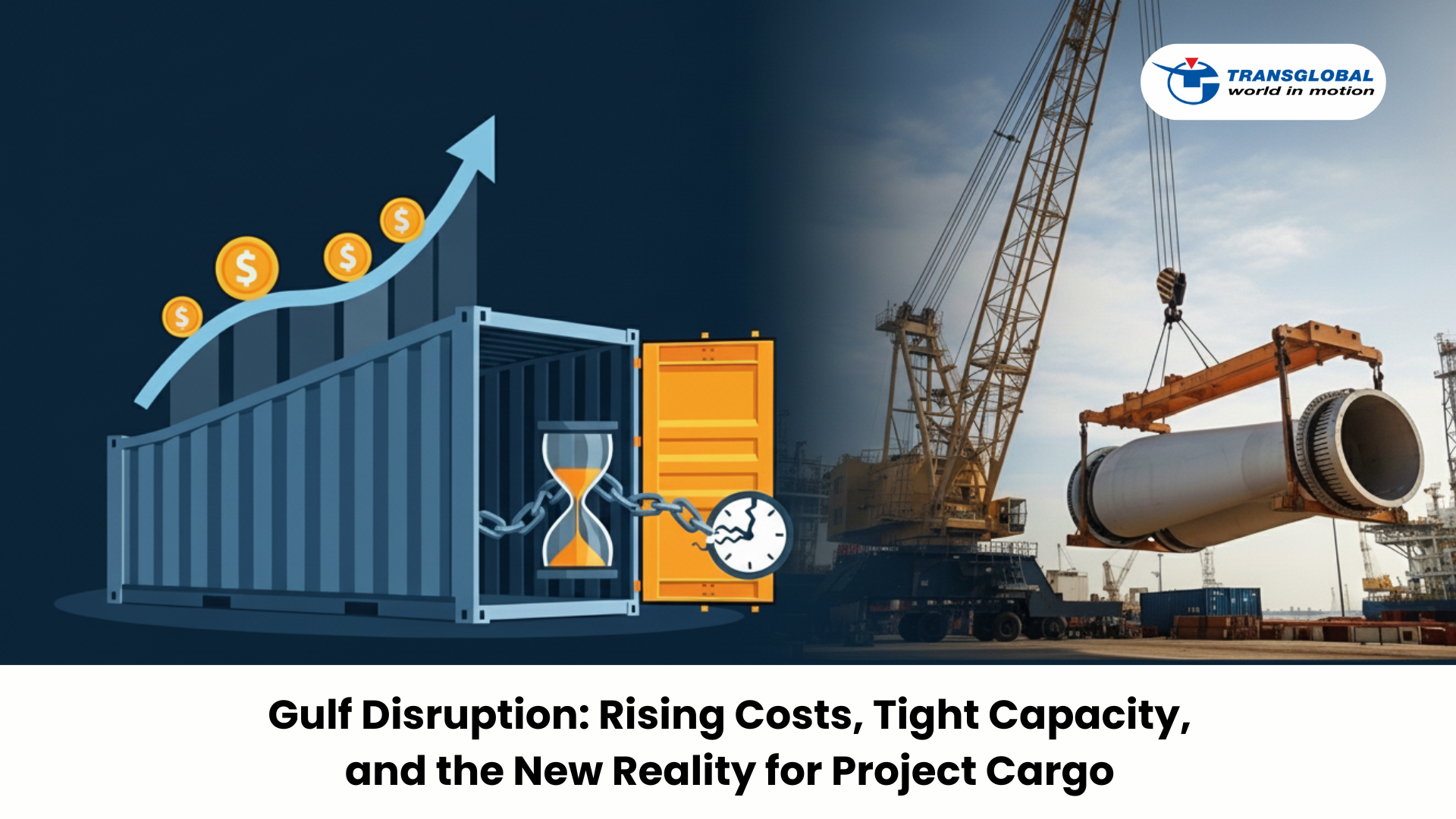
Over the past few weeks, the Middle East has once again become a focal point of disruption in global logistics. What initially appeared as regional instability has now evolved into a wider operational challenge, particularly for project cargo movements.
Large-scale shipments, especially in sectors like energy, infrastructure, and defence, are facing increasing pressure. Costs are rising, capacity is tightening, and planning has become more uncertain than ever before.
So the real question logistics teams are now asking is:
How do you maintain delivery timelines when both cost and capacity are working against you?
🌍 A Market Under Pressure: What’s Changing in the Gulf?
Recent insights from industry players highlight a key concern, the heavy lift segment is particularly vulnerable in this environment. Unlike container shipping, project cargo relies on a smaller pool of specialized vessels that operate on long and fixed cycles.
This creates a structural limitation. When disruption occurs, vessels cannot simply be rerouted or replaced quickly. Repositioning assets is both time-consuming and expensive, which directly impacts availability.
In practical terms, this means that even minor disruptions in the Gulf region can trigger a chain reaction across global project cargo operations. Shipping schedules become less reliable, and securing vessel space becomes significantly more challenging.
⚠️ Why are Costs Climbing Rapidly?
One of the most immediate and visible impacts of the current disruption is the rise in logistics costs. However, this increase is not driven by a single factor, it is the result of multiple pressures converging at once.
Fuel price volatility continues to play a major role. As vessels take longer routes to avoid high-risk zones, fuel consumption increases, pushing freight rates higher. At the same time, route diversions are adding days or even weeks to transit schedules, increasing operational costs further.
Another important factor is the nature of project cargo itself. These shipments require specialized handling equipment such as heavy cranes, engineered lifting systems, and custom transport solutions. These resources are limited and cannot be scaled quickly.
In many cases, logistics providers are reporting cost increases ranging between 15% to 40%, depending on the route, cargo type, and urgency of delivery. For large-scale projects, this can significantly impact overall project budgets.
🚢 Capacity Constraints are Becoming a Critical Challenge
While rising costs are a concern, capacity constraints are proving to be an even more complex issue. Heavy lift and project cargo vessels are not widely available, and their schedules are typically planned months in advance.
This means that when disruption occurs, there is very little flexibility to adjust quickly. Even if companies are willing to absorb higher costs, securing vessel space is not guaranteed.
Unlike container shipping, where capacity can sometimes be managed through additional sailings, project cargo operates within a far more rigid structure. Each vessel is designed for specific types of cargo, and availability is limited.
As a result, logistics teams are increasingly facing a difficult reality, it is not just about paying more, but about whether capacity exists at all.
🔍 Why Project Cargo Feels the Impact More?
Project cargo is inherently more exposed to disruption because of its complexity. These shipments are often oversized, high-value, and tied directly to project timelines.
Unlike standard freight, project cargo cannot be easily split, delayed, or rerouted without significant consequences. Delivery schedules are closely linked to construction timelines, installation phases, and operational deadlines.
Key challenges include:
- Limited port infrastructure capable of handling oversized cargo
- Strict regulatory and documentation requirements
- High dependency on coordinated logistics planning
- Minimal flexibility in delivery windows
Because of these factors, even small delays can escalate into major operational setbacks.
🌐 The Broader Impact on Global Supply Chains
The Gulf region plays a strategic role in global trade, acting as a key corridor connecting Asia, Europe, and Africa. Disruptions in this region do not remain isolated, they ripple across multiple trade lanes.
As vessels are rerouted or delayed, congestion begins to build in alternative ports. Transit times increase, and global vessel availability becomes strained.
This creates a cascading effect. Even shipments that are not directly linked to the Middle East can experience delays, increased costs, and scheduling challenges.
In essence, what happens in one region quickly becomes a global logistics issue.
🔄 How Businesses are Responding to the Challenge?
In response to these disruptions, logistics strategies are evolving. Companies are moving away from rigid planning models and adopting more flexible, data-driven approaches.
There is a growing emphasis on real-time visibility. Businesses are investing in tools that allow them to monitor shipments continuously and respond quickly to changes.
Routing strategies are also becoming more dynamic. Instead of relying on a single plan, logistics teams are preparing multiple alternatives to ensure continuity.
Another key shift is the importance of strong partnerships. Working with experienced freight forwarders who understand regional complexities has become essential.
In practical terms, successful companies are focusing on:
- Proactive planning rather than reactive adjustments
- Continuous monitoring instead of periodic updates
- Strategic partnerships instead of transactional logistics
🔮 Looking Ahead: A More Complex Operating Environment
The current disruption is not an isolated event, it reflects a broader trend in global logistics. Geopolitical uncertainty, environmental regulations, and capacity constraints are becoming ongoing challenges.
For project cargo operations, this means that volatility will remain a constant factor. Freight rates may fluctuate, capacity may tighten, and planning will require greater flexibility.
The companies that will succeed are not necessarily those with the lowest logistics costs. Instead, they will be those who can adapt quickly, manage risk effectively, and maintain operational continuity despite disruption.
🚚 Conclusion
In today’s environment, moving project cargo is no longer just about transportation. It is about managing complexity, mitigating risk, and ensuring that operations continue without disruption.
Working with the best freight forwarder provides the expertise, coordination, and strategic support needed to navigate these challenges. Because when costs rise and capacity tightens, success depends on more than just moving cargo, it depends on keeping your supply chain moving, no matter the disruption.
Comments