

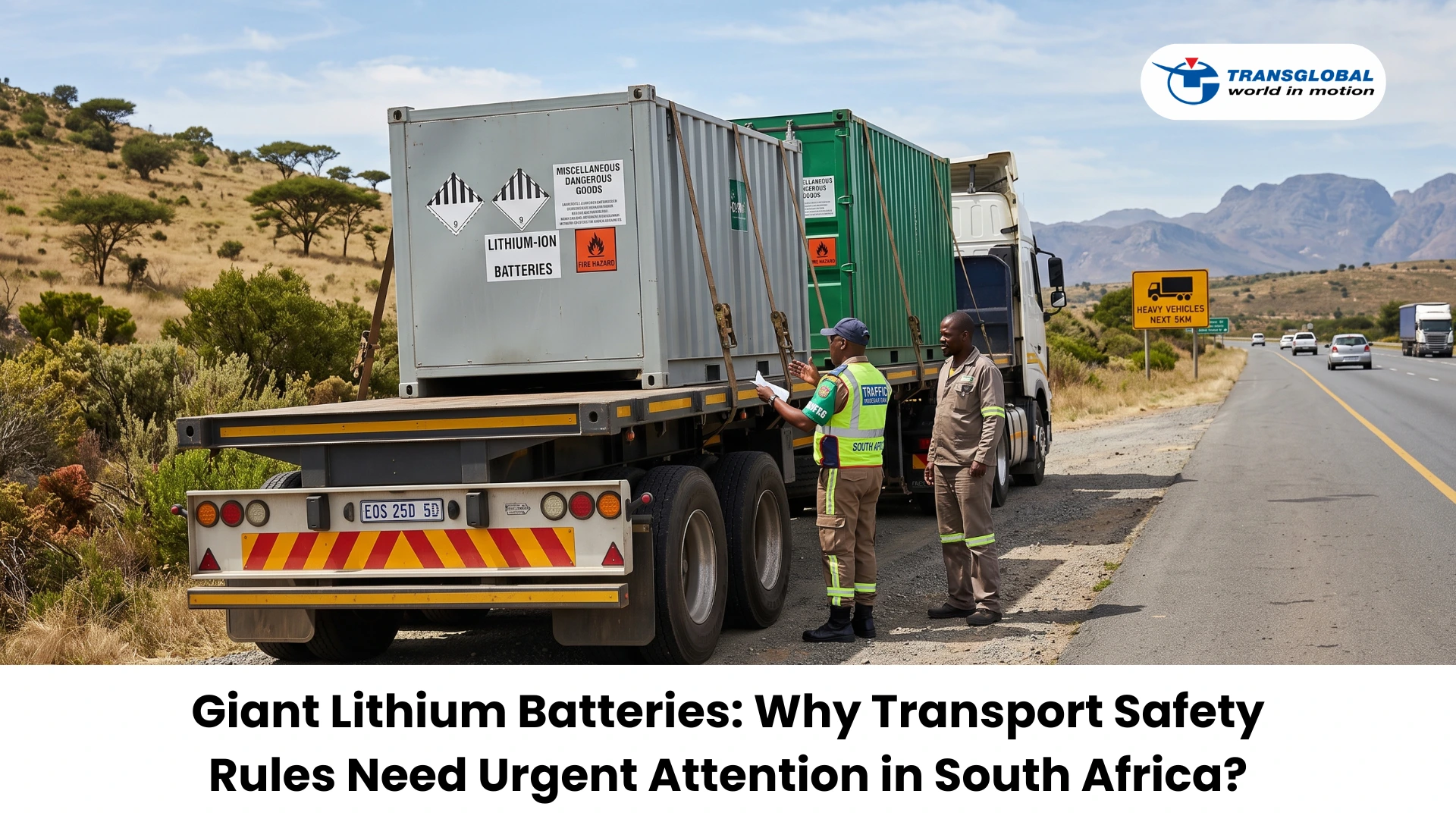
South Africa’s renewable energy growth is creating a new logistics challenge.
Large lithium battery arrays are being installed across solar and wind projects to support grid stability and improve energy resilience.
These batteries are essential to the country’s energy future.
However, moving them safely is becoming a serious transport concern.
Recent industry concerns have highlighted lithium battery shipments moving in containers weighing between 35 and 43 tons each, with large volumes required for projects across the country.
That creates a complex risk.
These shipments are not only heavy project cargo. They are also regulated hazardous materials that require the right vehicles, documentation, securing methods, emergency planning, and compliance controls.
👉 When a battery shipment is both abnormal in weight and hazardous by classification, standard transport planning is no longer enough.
⚠️ Why Lithium Batteries Need Careful Handling?
In South Africa, lithium-ion batteries are classified as Class 9 hazardous materials under SANS 10228.
Class 9 covers dangerous goods that do not fit neatly into other categories but still present serious transport risks.
Lithium batteries fall into this category because they carry chemical and energetic hazards.
If damaged, incorrectly secured, exposed to impact, or handled without the right controls, they can become dangerous.
The concern is not only that a battery can catch fire.
The larger concern is that lithium battery fires are difficult to control once they begin, especially when large units are involved.
This is why dangerous goods transport must involve correct classification, labelling, documentation, packaging, handling, and emergency response planning from the beginning.
🚛 Why Heavy Battery Cargo Creates a Bigger Problem in Transportation?
The movement of grid-scale lithium batteries is different from moving smaller batteries used in consumer products.
These are large, heavy, high-value cargo units.
Some may require abnormal-load capability because of their weight, while also requiring hazardous cargo compliance because of their classification.
That creates a difficult operational gap.
Concerns have been raised that abnormal vehicles capable of carrying this weight may not always be registered as hazardous vehicles.
At the same time, vehicles registered for hazardous cargo may not be suitable for abnormal or overweight loads.
This creates uncertainty around vehicle suitability, road compliance, insurance exposure, and responsibility if something goes wrong.
When a 43-ton battery is loaded onto equipment not designed for that load, the risk becomes a safety issue for drivers, road users, ports, storage yards, and project sites.
📋 Why Documentation Alone is not Enough?
Lithium battery transport cannot be treated as a paperwork exercise.
Correct documentation is important, but it is only one part of the process.
The full movement must consider:
- Cargo classification
- Vehicle registration
- Trailer capacity
- Load securing
- Route planning
- Port handling
- Driver awareness
- Emergency response
For heavy battery units, secure loading is especially important.
Twist locks, suitable trailers, correct tie-down systems, lifting plans, and verified load capacity all influence whether the cargo can move safely.
The same principle applies to hazardous materials labelling and documentation, where the purpose is not only compliance but safer movement throughout the supply chain.
🏗️ Why Renewable Energy Projects Depend on Safer Logistics?
Battery energy storage systems are becoming an important part of South Africa’s renewable energy expansion.
Solar and wind projects depend on these systems to store power and support stable energy supply.
However, the logistics behind these projects must match the scale of the infrastructure being built.
If battery cargo is delayed, damaged, misdeclared, or moved using unsuitable equipment, the impact can reach far beyond transport.
Project schedules can be affected.
Insurance claims can become complicated.
Site readiness can be delayed.
This makes battery movement part of wider project cargo logistics, where planning, compliance, equipment selection, and risk control need to work together.
🌐 The Port and Vessel Handling Concern
The risk does not begin only on the road.
Many lithium battery containers arrive through South African ports by sea freight, where vessel selection, lifting equipment, crane reliability, discharge planning, and temporary storage must be carefully managed.
If heavy battery containers are handled with unreliable equipment or poor procedures, risk increases before the cargo reaches inland transport.
Ports and logistics operators therefore need clear processes for receiving, storing, and releasing battery cargo safely.
This is especially important when cargo is heavy, hazardous, and difficult to manage in an emergency.
📈 What Needs to Change?
The growing movement of grid-scale lithium batteries shows that regulation and logistics practice must evolve together.
Authorities, hauliers, project owners, port operators, and freight partners need clearer alignment between abnormal-load rules, hazardous goods requirements, vehicle registration systems, insurance conditions, and emergency response planning.
The objective is not to slow renewable energy development.
The objective is to ensure that the cargo supporting that development moves safely, legally, and responsibly.
🚚 Conclusion: Battery Transport Cannot Be Treated as Routine
Giant lithium batteries are helping power South Africa’s renewable energy future.
But moving them without the right planning, equipment, registration, securing methods, documentation, and safety controls creates risks that should not be ignored.
Working with the best freight forwarders helps businesses manage abnormal loads, hazardous cargo, port handling, route planning, documentation, and risk control with greater confidence.
Because when battery cargo weighs more than a standard trailer was built to carry, logistics cannot be treated as routine.
👉 It must be planned with the same seriousness as the energy projects it supports.
Comments