

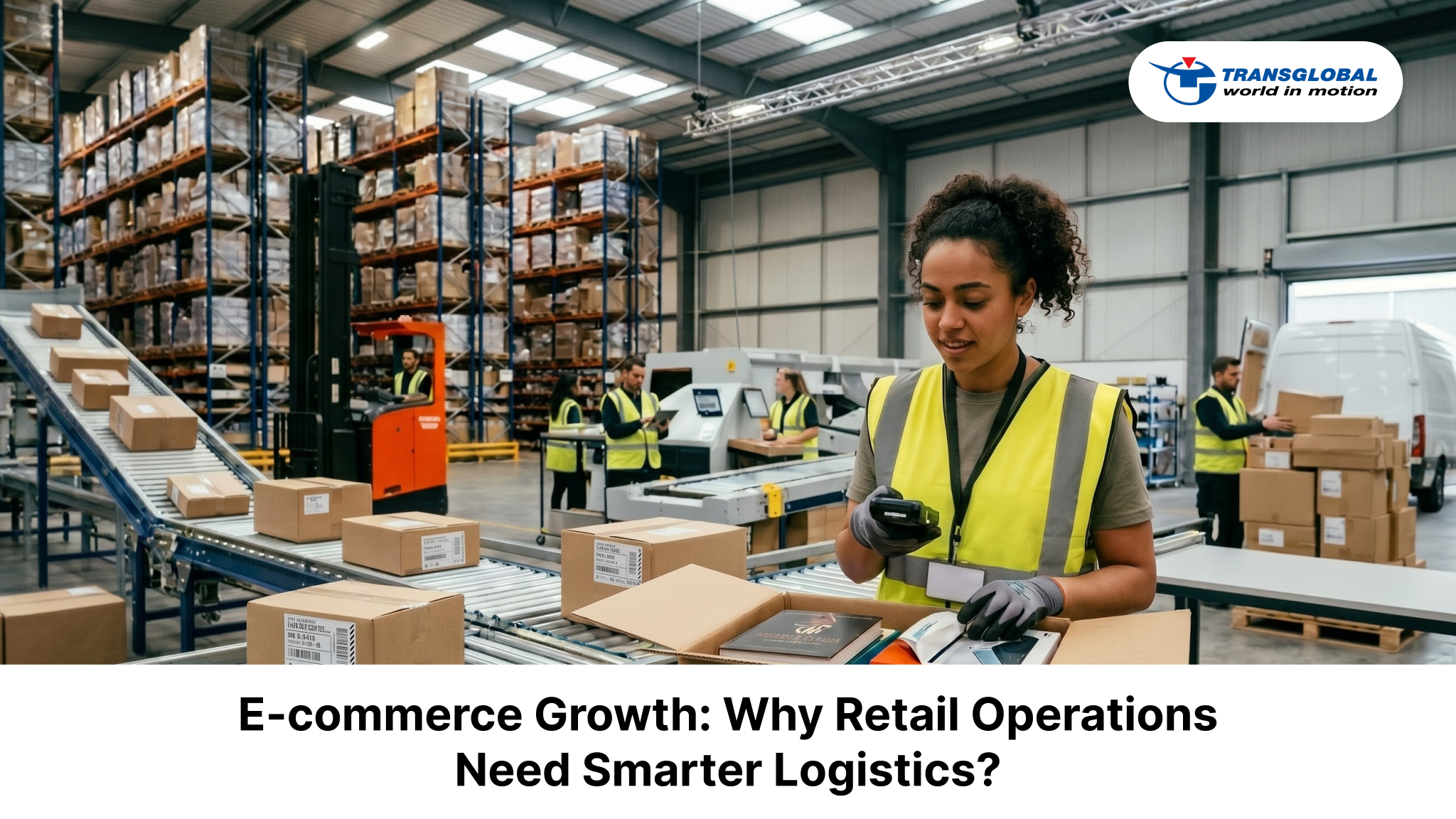
E-commerce is no longer changing only how customers buy.
It is changing how retail operations are planned, managed, and delivered.
Global online sales continue to grow at scale, and the pressure behind that growth is becoming more visible across supply chains, fulfillment networks, delivery operations, and compliance teams.
Retailers are no longer competing only on product range, pricing, and online experience.
They are now competing on stock visibility, fulfilment speed, delivery reliability, platform performance, customer communication, and supply chain control.
Recent developments across the retail sector show how quickly the operating model is changing.
Artificial intelligence is being used for supply chain compliance. Social commerce platforms are testing managed service models. Store-level fulfilment systems are being adjusted. Last-mile delivery technology is becoming more important, especially for bulky and high-value goods.
The real question is no longer whether e-commerce will continue to grow.
👉 The question is whether retail operations can keep up with the speed of digital commerce.
🌍 E-commerce Growth is Creating Operational Pressure
E-commerce growth brings opportunity, but it also creates pressure across the full supply chain.
Every online order triggers a series of operational steps.
The product must be available, picked, packed, cleared, transported, delivered, tracked, and sometimes returned.
If one part of that process fails, the customer experience is affected.
For enterprise retailers, this creates pressure across departments that were not always designed to work at digital-commerce speed.
Warehouses need better stock accuracy.
Transport teams need tighter delivery planning.
Customer service teams need real-time updates.
Compliance teams need stronger visibility across suppliers and markets.
E-commerce has therefore moved beyond being a sales channel.
It has become a test of operational readiness.
🤖 AI is Moving Into Supply Chain Compliance
One of the biggest changes happening in retail is the growing use of AI in supply chain compliance.
Retailers, especially in apparel and consumer goods, are facing increasing pressure around sourcing, sustainability, supplier transparency, and regulatory reporting.
These requirements often involve multiple supplier tiers, countries, materials, documents, and product records.
Manual processes are becoming difficult to manage at that scale.
AI tools can help identify missing information, flag inconsistencies, compare supplier data, and support audit readiness.
However, technology does not remove the need for strong logistics control.
For goods moving across borders, accurate customs brokerage, correct documentation, and reliable shipment records remain essential.
AI may improve visibility, but the physical movement still depends on disciplined supply chain execution.
📱 Platform Commerce is Changing Brand Control
The rise of platform-managed commerce is also changing how retailers operate.
Social commerce platforms are no longer only advertising channels.
They are becoming places where products are promoted, sold, fulfilled, reviewed, and scaled.
TikTok Shop’s managed-services testing shows how platforms may begin taking a bigger role in creator hiring, content production, and commerce execution.
For brands, this creates both opportunity and risk.
The opportunity is faster access to audiences and stronger product discovery.
The risk is reduced control over brand presentation, content quality, customer expectations, and operational promises.
When a product is sold through a platform, the logistics promise still needs to be fulfilled.
If delivery fails, stock is unavailable, or communication breaks down, the customer does not separate the platform from the brand.
That is why platform commerce still depends on strong fulfillment and logistics planning behind the scenes.
🚛 Last-Mile Delivery is Becoming a Bigger Challenge
Last-mile delivery remains one of the most difficult parts of e-commerce.
For small parcels, customers expect speed, visibility, and convenience.
For bulky goods such as furniture, appliances, and specialist products, the challenge becomes even greater.
Failed deliveries can create extra transport costs, customer complaints, returns, rescheduling, and operational pressure.
This is why last-mile delivery is becoming a major focus for retailers and direct-to-consumer brands.
AI-driven delivery tools are now being used to improve routing, customer updates, and delivery coordination.
The goal is simple:
Reduce failed deliveries
Improve customer communication
Increase delivery reliability
Control operating costs
In e-commerce, the sale is not complete when payment is made.
It is complete when the product reaches the customer successfully.
📦 Store Fulfilment is Being Reworked
Retailers are also learning that technology can create new problems while solving old ones.
Stores that were redesigned for online pickup and digital fulfillment are now being adjusted again to reduce friction for workers.
Delivery apps and fulfilment tools can also slow down operations when system changes do not match real working conditions.
This is an important lesson.
Digital retail does not succeed only because a new system is introduced.
It succeeds when that system improves the physical movement of goods.
Stock visibility, picking accuracy, packing speed, route planning, returns handling, and warehousing all need to work together.
A retailer can have strong online demand, but if fulfillment cannot keep pace, customer confidence will quickly decline.
🌐 Smaller Brands are Finding New Routes to Market
E-commerce is also creating new opportunities for smaller brands.
Retail platforms and membership-based retailers are helping niche and local suppliers reach larger customer bases without building full national distribution networks on their own.
This can help smaller brands scale faster.
However, growth brings operational responsibility.
A business may gain access to a larger platform, but it still needs reliable stock availability, compliant documentation, packaging control, fulfilment capacity, and delivery planning.
This is where road freight, warehousing, customs, and delivery coordination become important.
Retail growth depends not only on reaching customers.
It depends on serving them consistently after the order is placed.
🚚 Conclusion: Digital Commerce Needs Stronger Logistics
E-commerce is reshaping retail operations at speed.
AI compliance, platform-managed commerce, last-mile delivery tools, store fulfilment changes, and new distribution channels are all changing how businesses operate.
But behind every digital transaction, there is still a physical supply chain.
Products must move from supplier to warehouse, from warehouse to customer, and sometimes back again through returns.
Understanding e-commerce logistics is becoming essential for businesses that want to grow in a digital-first market.
Working with the leading freight forwarders helps businesses manage customs, warehousing, transport, delivery planning, and supply chain complexity with greater confidence.
Because in modern retail, success is no longer measured only by online sales.
👉 It is measured by whether the operation behind the order can deliver.
Comments