

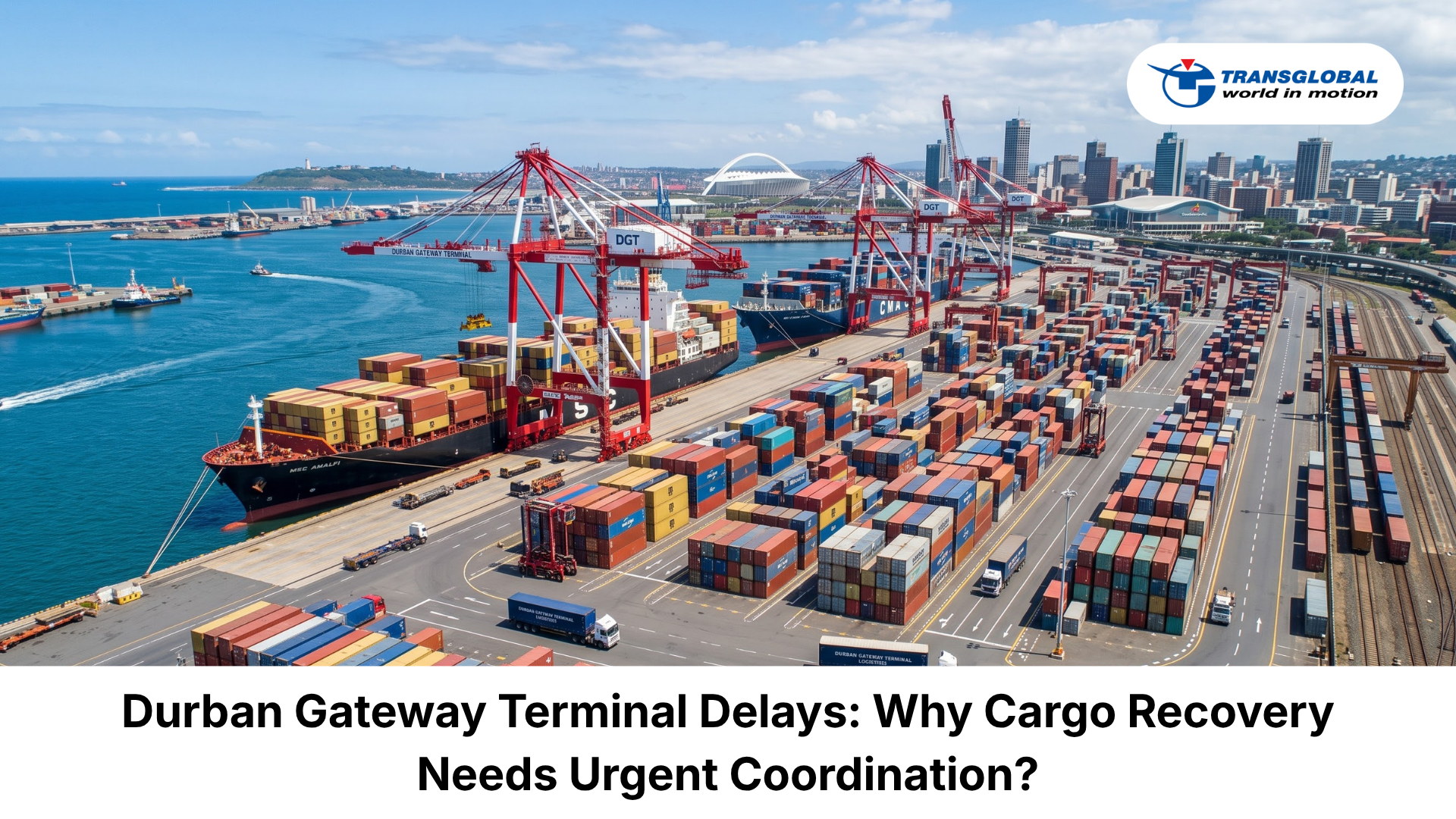
South Africa’s busiest container gateway is facing renewed pressure.
Operational delays at Durban Gateway Terminal have worsened, creating concern across the freight, forwarding, and road transport sectors.
Vessels are spending longer at anchorage. Berth times have increased. Yard congestion, equipment constraints, truck booking delays, and landside bottlenecks are affecting the movement of cargo through one of the country’s most important trade gateways.
Durban Gateway Terminal, formerly Durban Container Terminal Pier 2, handles more than 40% of South Africa’s container traffic.
That means disruption at this terminal does not remain a port problem.
It moves quickly into supply chains, affecting importers, exporters, manufacturers, transporters, retailers, and ultimately consumers.
The message is clear.
👉 When Durban slows down, the impact is felt far beyond the harbour.
🚢 Durban’s Vessel Delays are Rising Again
The current disruption has placed Durban’s port performance back under scrutiny.
According to industry reports, vessels calling at Durban Gateway Terminal were waiting an average of around 80 hours at anchorage in July, followed by 106 hours at berth.
By early August, anchorage delays had reportedly increased to 166 hours, or nearly seven days, while vessels were spending a further 116 hours at berth.
Independent monitoring also suggested that the average Durban port call, including waiting and berth time, increased from less than five days in late June to more than 12 days by late August.
For shipping lines, this affects schedules and vessel rotation.
For cargo owners, it affects delivery planning, inventory availability, and cost control.
For freight forwarders, it creates pressure across documentation, container release, transport coordination, and customer communication.
💻 The Navis N4 Rollout Added Pressure
The disruption followed the rollout of the Navis N4 terminal operating system in mid-August.
The system is used to manage container movement, vessel operations, truck appointments, and terminal activity.
Durban Gateway Terminal had warned customers before the go-live that the transition would involve temporary suspension of vessel and landside operations while data was extracted, migrated, validated, and tested.
The terminal has since said the system is stable and supported by a dedicated hypercare team.
However, industry bodies have made it clear that the problem is not only about the system migration.
The Navis transition appears to have intensified existing operational issues rather than creating all of them.
⚠️ The Real Problem is Wider than Technology
The current backlog reflects several connected challenges.
These include limited equipment availability, straddle carrier reliability, yard congestion, truck access delays, landside evacuation constraints, and coordination gaps across the terminal interface.
DGT also acknowledged that the backlog carried into the post-implementation period had not yet been cleared.
The terminal said its immediate priority was to evacuate import cargo and reduce yard congestion.
Measures include reviewing truck slot capacity every four hours, restoring a 24-hour release window for appointments, prioritising equipment for import evacuation, and working with Transnet Freight Rail for additional train movements.
This shows the scale of the challenge.
Port recovery is not only about fixing one system.
It requires alignment between vessels, cranes, yards, trucks, rail, gates, booking slots, and cargo owners.
🚛 Trucking and Landside Movement are Under Strain
The port crisis is also being felt strongly on the road.
Transporters rely on truck appointment slots to collect and deliver containers.
When slots are limited, cancelled, or delayed, vehicles stand idle while fixed costs continue.
Drivers wait. Trucks queue. Equipment sits unproductive. Delivery commitments become harder to meet.
Journey times around the port precinct and Bayhead Road have also increased, adding further pressure to road transport operations.
For logistics businesses, every standing hour has a cost.
Those costs eventually move through the supply chain.
That is why efficient truck access and predictable terminal handling are critical to keeping cargo moving.
Understanding road freight challenges also shows why port access, truck flow, and inland delivery cannot be separated.
📦 Costs are Moving Through the Supply Chain
The delays are not only creating operational frustration.
They are also increasing costs.
When containers cannot be collected on time, cargo owners may face storage, demurrage, and detention charges.
In some cases, these costs arise even when delays are linked to terminal congestion or booking constraints outside the control of importers, exporters, and freight forwarders.
Manufacturers waiting for components or raw materials may also be forced to delay production or use expensive alternatives such as air freight.
For cargo that is time-sensitive, high-value, or linked to production schedules, the impact can be significant.
This is why container planning, documentation, and communication become even more important during port disruption.
📊 A Recovery Plan Needs Shared Accountability
Freight and road transport associations are calling for a coordinated recovery plan.
The proposed approach includes a daily recovery structure involving the terminal operator, Transnet, eThekwini Municipality, shipping lines, transporters, organised labour, and industry associations.
The focus is on measurable targets.
These include vessel waiting times, berth productivity, crane performance, equipment availability, yard utilisation, container dwell times, truck turnaround, and rail evacuation.
This is important because cargo owners do not experience the port as separate institutions.
They experience one chain.
If systems, equipment, gates, roads, rail, or booking slots do not align, cargo stops.
A single recovery plan, clear ownership, daily performance data, and shared accountability can help rebuild confidence in the terminal.
🌐 Why Durban’s Performance Matters for South African Trade?
Durban is a strategic gateway for South Africa and the wider region.
Its performance affects imports, exports, manufacturing, retail supply chains, automotive cargo, industrial goods, and regional movement into neighbouring markets.
The Transnet-ICTSI partnership was designed to improve Pier 2 capacity, productivity, and vessel turnaround times over the long term.
That objective remains important.
But immediate recovery is now critical.
The way sea freight flows through Durban directly affects schedules, container availability, cargo release, and wider supply chain reliability.
When port delays continue, they can also create freight rate pressure across routes, schedules, and shipping decisions.
South Africa’s logistics reforms cannot afford to lose momentum, especially when port performance influences trade confidence, freight costs, and business continuity.
🚚 Conclusion: Cargo Recovery Needs One Coordinated Chain
The Durban Gateway Terminal disruption is a reminder that port performance depends on more than berth space or digital systems.
It depends on the full logistics chain working together.
Vessels, yards, equipment, trucks, rail, booking systems, shipping lines, freight forwarders, and cargo owners all need reliable coordination.
For importers and exporters, the priority is clear.
Cargo must move, and it must keep moving.
For importers and exporters, working with the leading freight forwarders becomes important when port disruption affects customs, transport planning, documentation, and delivery commitments.
Because when a port gateway slows down, the impact does not stop at the terminal.
👉 It moves through every business waiting for cargo to arrive.
Comments