

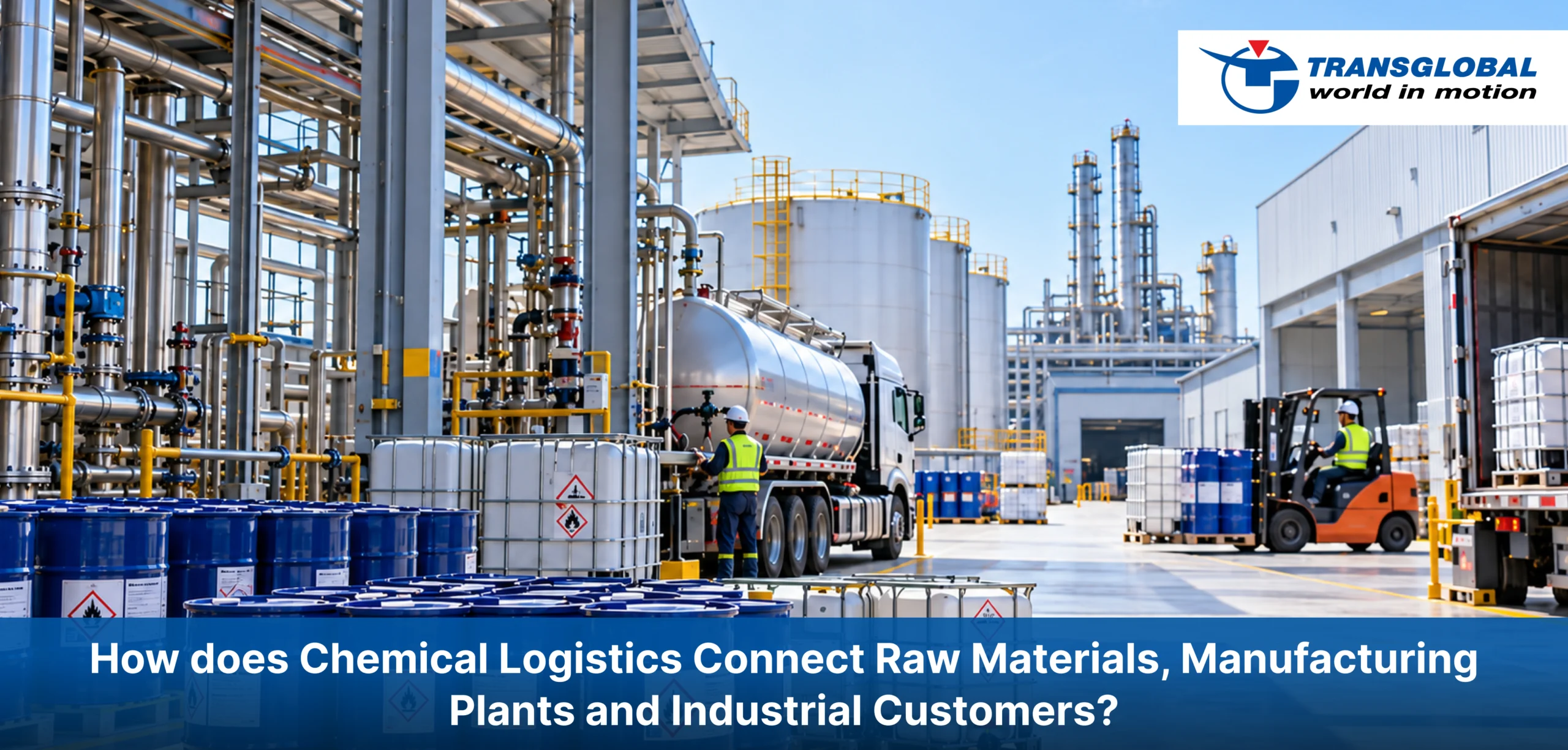
Chemical logistics connects more than one shipment.
It connects the materials that enter production, the manufacturing plants that depend on them, and the industrial customers waiting for finished products.
A plant may have workers scheduled, machines ready, production slots planned, and customer orders confirmed.
But if the right chemical does not arrive in the right quantity, condition, classification, or time window, the production plan can change quickly.
The same applies after manufacturing.
Finished chemical products must move from the plant to distributors, mines, factories, construction sites, laboratories, energy facilities, agricultural users, or export customers without losing control of safety, compliance, or timing.
That is why chemical logistics sits between supply, production, and customer delivery.
It helps raw materials reach the plant, supports manufacturing continuity, manages regulated cargo requirements, and keeps finished chemical products moving to the next point in the supply chain.
Why Chemical Logistics Starts Before the Material Reaches the Plant?
Chemical logistics begins before the cargo arrives at the factory gate.
The plant needs to know what is coming, how it is packed, how it is classified, when it will arrive, and whether it can be safely received.
A raw material shipment may include solvents, additives, resins, acids, gases, powders, industrial compounds, cleaning agents, or production chemicals.
Each product can carry different handling requirements.
Some materials may be flammable. Some may be corrosive. Some may be temperature-sensitive. Some may need segregation from other substances. Some may require Safety Data Sheets, hazard labels, permits, placards, or emergency response information.
This is why chemical and industrial manufacturing logistics must be planned around the product, the production schedule, and the receiving site.
Before collection, the logistics team should understand the chemical identity, package type, quantity, hazard class where applicable, loading method, unloading access, and delivery window.
This preparation helps the plant avoid receiving cargo it cannot safely handle, store, or use.
Chemical logistics protects production before the material enters the facility.
How Chemical Supply Chains Keep Production Moving?
Manufacturing plants do not only need chemical materials delivered.
They need them available at the right stage of production.
A chemical may feed a blending line, coating process, cleaning operation, treatment stage, packaging process, mining supply programme, or industrial formulation.
If the material is late, short, damaged, incorrectly labelled, or held for documentation review, the plant may need to slow production, adjust batches, delay dispatch, or revise customer delivery commitments.
That is why chemical supply chain planning must connect supplier readiness with plant demand.
The logistics team should understand:
- what material is required,
- how much stock is available,
- when the plant needs replenishment,
- what packaging format is required,
- whether partial delivery can protect production,
- what transport mode is suitable, and
- whether the receiving site is ready.
For manufacturers moving materials across South Africa and neighbouring markets, cross-border logistics helps align cargo details, routing, border documentation, and onward delivery before the shipment reaches a delay point.
Chemical logistics works best when it prevents production pressure, not only when it reacts to it.
Why Classification and Documents Shape Chemical Transport?
Chemical cargo must be described accurately.
A vague product name is not enough when the substance has safety, storage, handling, or transport requirements.
The shipment file may need the correct product description, UN number, hazard class, packing group, quantity, packaging type, Safety Data Sheet, emergency information, invoice, packing list, permit details, and consignee instructions where applicable.
For regulated chemical cargo, dangerous goods transport depends on the classification, documents, packaging, and border requirements being aligned before movement begins.
This is where many chemical shipments become vulnerable.
The physical cargo may be ready, but the movement can still stop if the paperwork does not match the product.
A small mismatch can create questions at collection, warehouse intake, port handling, border control, customs review, or delivery.
For chemical cargo moving by air or sea, DG cargo rules also matter because each transport mode has its own acceptance, documentation, segregation, and handling requirements.
Chemical logistics must therefore control the shipment record as carefully as the cargo itself.
The documents tell every party how the material must be treated.
How Industrial Logistics Connects Plants with Customers?
After manufacturing, chemical logistics continues into customer delivery.
Finished chemical products may move to industrial buyers, mining operations, construction suppliers, agricultural distributors, energy companies, laboratories, retailers, or export markets.
At this stage, the focus shifts from production supply to customer fulfilment.
The shipment must leave the plant in the correct packaging, with the correct labels, documents, handling instructions, and delivery plan.
An industrial customer may need the chemical for its own production process, site operation, maintenance schedule, treatment programme, or project timeline.
That means the delivery plan must consider both sides.
The sending plant must be ready to dispatch the cargo correctly, and the receiving site must be ready to accept it safely.
The receiver may need lifting equipment, approved storage, safety controls, trained staff, delivery slots, offloading access, or site entry approval.
For plant-to-customer movement, road freight can support domestic and regional distribution when the vehicle, route, driver, load plan, and delivery requirements are matched to the cargo.
The delivery is not complete just because the goods reach the address.
The chemical must reach a receiver that is prepared to handle it.
Why Must Route Planning Match the Chemical and the Site?
Chemical transport cannot be planned only by choosing the shortest route.
The route should match the chemical, vehicle, packaging, risk level, destination, and receiving conditions.
Some chemicals may need route restrictions. Some may require trained drivers. Some may need separation from incompatible cargo. Some may need emergency response planning if there is a leak, spill, fire, or accident.
Route planning should consider:
- product classification,
- vehicle suitability,
- driver training,
- route restrictions,
- border or port requirements,
- emergency response details,
- safe stopping points,
- site access, and
- receiver readiness.
For hazardous materials and regulated industrial products, hazardous cargo planning helps explain why safety, compliance, packaging, and transport provider capability matter beyond the quoting stage.
This is especially important when chemical cargo moves to mines, refineries, manufacturing plants, farms, laboratories, or construction projects where access and safety rules may be stricter than a standard warehouse.
In chemical transport, the best route is not always the fastest route.
It is the route that keeps the cargo compliant, controlled, and suitable for the receiving site.
Why Chemical Logistics Needs Visibility from Supplier to Receiver?
Chemical logistics works best when every party can see what matters.
The supplier needs to know when the cargo will be collected. The plant needs to know when raw materials will arrive. The warehouse needs to know what it is receiving. The carrier needs correct handling instructions. The customer needs a reliable delivery update.
Visibility helps prevent avoidable pressure.
If a shipment is delayed, the plant can adjust production. If a border hold appears, the customer can be updated. If documents need correction, the team can act before the cargo reaches the next checkpoint.
This is not only shipment tracking.
It is knowing whether the cargo, documents, route, receiving site, and delivery timing are still aligned.
That control is what keeps chemical supply chains reliable.
Without it, one late or unclear movement can affect production, storage, dispatch, and customer delivery at the same time.
Conclusion: Chemical Logistics Keeps Industrial Supply Chains Connected
Chemical logistics connects raw material supply, manufacturing activity, regulated transport, and industrial customer delivery.
It helps plants receive the materials they need, keep production moving, dispatch finished products safely, and serve customers that depend on chemical inputs for their own operations.
That makes chemical logistics different from ordinary cargo movement.
The process must account for product classification, packaging, Safety Data Sheets, permits, vehicle suitability, route planning, storage, customs, delivery access, and receiver readiness.
When these elements are managed together, chemical supply chains become more predictable.
Raw materials reach the plant with fewer disruptions. Manufacturing teams can plan with more confidence. Finished products move to customers with better control.
Planning chemical transport, industrial supply movement, or manufacturing logistics? Contact us to review the cargo details, classification, documents, route, handling requirements, and delivery plan before dispatch.
Move chemical cargo with leading freight forwarders who understand chemical logistics, industrial logistics, chemical transport, and manufacturing supply chain control.
Frequently Asked Questions
What is chemical logistics?
Chemical logistics is the specialised movement of chemical raw materials and finished chemical products between suppliers, manufacturing plants, storage points, and industrial customers. It focuses on safe handling, correct documentation, compliant transport, and reliable delivery.
Why are Safety Data Sheets important in chemical logistics?
Safety Data Sheets help logistics teams understand how a chemical must be handled, packed, stored, transported, and responded to in an emergency. They support safer movement before the cargo is collected or delivered.
How does chemical logistics support manufacturing plants?
Chemical logistics helps manufacturing plants receive the right materials at the right time, in the right quantity and condition. This supports production continuity and reduces delays caused by late, unclear, or non-compliant chemical deliveries.
Comments