

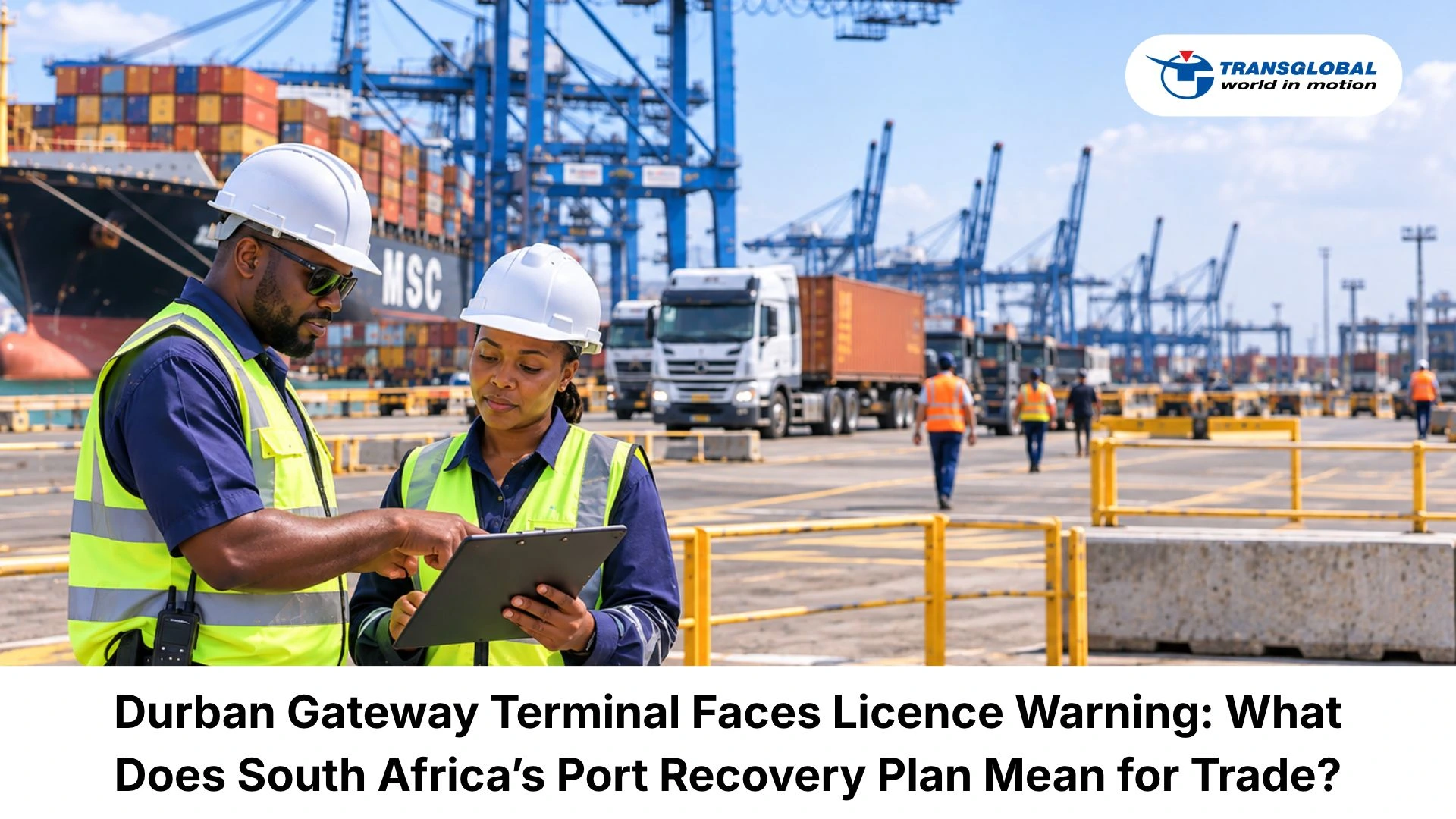
South Africa’s Port of Durban is entering an important phase of operational recovery after the government warned Durban Gateway Terminal (DGT) that continued shipping delays could put its operating licence at risk.
Transport Minister Barbara Creecy has given International Container Terminal Services Inc. (ICTSI), the terminal’s operating partner, three months to improve performance. The warning follows vessel waiting times of up to 20 days, with the disruption affecting importers, manufacturers and exporters.
In response, Transnet announced emergency measures on 18 November 2026 to increase cargo-handling capacity, divert selected vessels and prioritise essential imports. DGT has also outlined additional equipment deliveries extending into 2027.
The licence has not been withdrawn. The immediate focus is on improving terminal operations while maintaining the movement of goods through South Africa’s busiest container port.
👉 The latest development is not simply about clearing a shipping backlog. It is an important test of how government intervention, private-sector investment and terminal operations can work together to restore reliable trade movement.
⚓ Why has Durban Gateway Terminal Received a Licence Warning?
Durban Gateway Terminal operates the former Durban Container Terminal Pier 2, one of South Africa’s most important facilities for containerised trade.
ICTSI assumed operational management in January 2026 as part of a public-private partnership intended to improve terminal performance through investment, equipment renewal and operational expertise.
However, continuing vessel delays have prompted government intervention.
The three-month warning places greater emphasis on measurable improvements in vessel handling, container movement and overall terminal reliability.
For South African businesses, this development matters because Durban connects international shipping services with major manufacturing, retail and distribution centres.
A vessel may arrive in South African waters on schedule, but the cargo cannot enter the domestic supply chain until the terminal completes the necessary handling processes.
This is why reliable sea freight operations depend on both shipping schedules and the efficiency of the terminals receiving the cargo.
🏗️ What is Causing the Operational Difficulties?
The condition and availability of cargo-handling equipment have become central to the discussion.
ICTSI has attributed some of the difficulties to years of underinvestment and inadequate maintenance before its management began.
Transnet responded on 21 November, disputing suggestions that the operator inherited an entirely run-down facility. It pointed to an equipment-renewal programme undertaken before the management handover.
Equipment availability is only one part of container terminal performance.
Ship-to-shore cranes transfer containers between vessels and the quay, while straddle carriers and other handling equipment move containers through the terminal yard. Operating systems coordinate these movements and manage container information.
A shortage or interruption at any stage can affect how quickly cargo moves through the facility.
Understanding how cargo moves through ports helps explain why improvements must involve equipment, systems and operational coordination rather than a single intervention.
🚢 What Does Transnet’s Emergency Recovery Plan Include?
Transnet’s recovery measures involve several parts of the Port of Durban and alternative handling arrangements.
Berth 102 has been made available for geared vessels, which use onboard equipment to handle cargo.
Suitable vessels are also being diverted to Ngqura Container Terminal in the Eastern Cape, with arrangements for onward movement of affected containers.
At Durban Container Terminal Pier 1, Transnet scheduled the return of the final refurbished ship-to-shore crane to operations on 21 November, bringing all six cranes into operational availability.
This additional capacity is at Pier 1, not six newly installed cranes at DGT Pier 2.
Transnet Freight Rail has also made trains available to support the movement of import containers destined for Gauteng.
Meanwhile, DGT expects 16 additional reach stackers and empty-container handlers by the end of November 2026. Another 26 second-hand straddle carriers are expected in two batches by the end of the first quarter of 2027.
These equipment deliveries represent planned improvements. Their effect on terminal performance will become clearer as they are introduced into operations.
📦 Why are Essential Imports Receiving Priority?
The government has identified automotive components and pharmaceutical products as priority cargo during the recovery effort.
These products illustrate how port operations connect directly with other sectors of South Africa’s economy.
Automotive manufacturers depend on imported parts arriving in time to support production schedules. Even when the goods are already aboard a vessel near Durban, they remain unavailable to manufacturers until they are discharged and transported inland.
Pharmaceutical shipments require equally careful coordination because hospitals, healthcare providers and distributors depend on the timely availability of medical products.
Transnet has therefore been working to identify and prioritise essential shipments as part of its response.
However, priority handling does not eliminate the remaining steps required to release and deliver cargo.
Import documentation, customs clearance, terminal release and final transport still need to be coordinated.
The situation highlights an important point for importers: cargo availability depends on a complete logistics process, not simply confirmation that a vessel has reached port.
🚛 What Should Importers and Exporters Understand About the Recovery?
The recovery measures introduce additional options for cargo movement, but they also require businesses to monitor changes to their original shipping arrangements.
A vessel redirected to another port may affect the location of discharge, collection arrangements and inland transport planning.
Importers should confirm their cargo’s actual discharge terminal, release status and onward delivery requirements rather than relying solely on the original vessel schedule.
Exporters should similarly monitor confirmed booking arrangements, terminal acceptance procedures and revised vessel schedules.
For freight forwarders, this creates a need for consistent communication between shipping lines, terminal operators, clearing agents and road transport providers.
Our article on clearing and forwarding in Durban explains how these activities fit together when moving cargo through the port.
The coming months will also provide an indication of how effectively the recovery programme supports South Africa’s wider port reform objectives.
The key measures of progress will be improved vessel turnaround, dependable container handling and more predictable cargo availability.
🚚 Conclusion: Reliable Port Operations Support Reliable Trade
Durban Gateway Terminal’s licence warning represents a significant development in South Africa’s efforts to improve port performance.
The combination of government oversight, Transnet’s emergency measures and DGT’s planned equipment investment reflects a broader effort to strengthen container-handling operations.
For businesses that rely on Durban, the value of these interventions will ultimately depend on whether they produce consistent improvements across the cargo movement process.
As experienced freight forwarders, Transglobal Cargo recognises the importance of coordinating shipping, documentation and inland delivery when port operating conditions change.
👉 South Africa’s port recovery will be measured not only by how quickly vessels are handled, but by how reliably cargo reaches the businesses and industries waiting for it.

Comments