

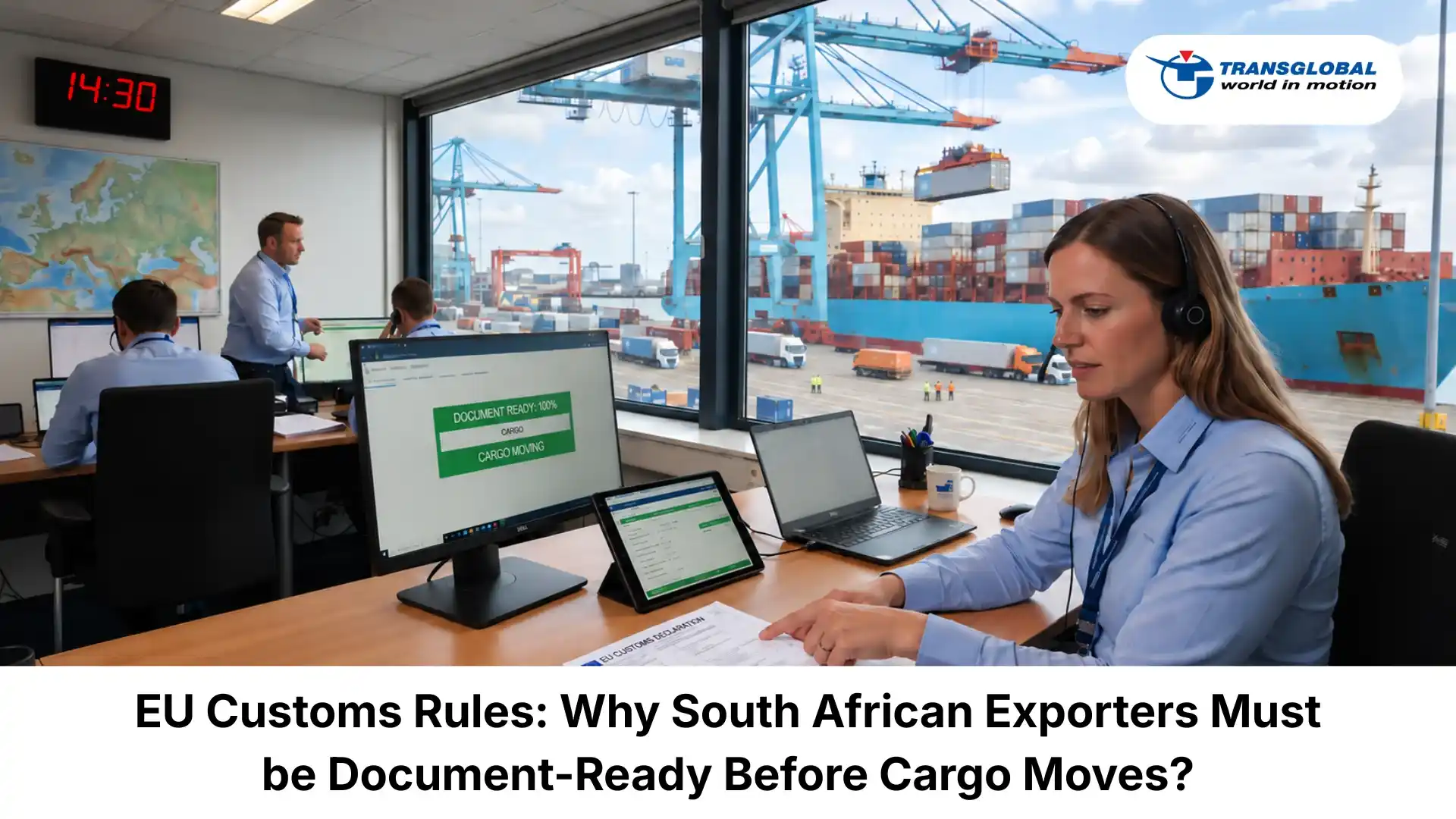
South African exporters moving goods to the European Union, or routing cargo through the EU, now need to treat shipment data as part of cargo readiness.
The update is linked to the EU’s Import Control System 2, known as ICS2.
Under ICS2, advance safety and security information must be submitted through an Entry Summary Declaration before goods arrive in, or transit through, the European Union.
Once the declaration is accepted by EU Customs, a Movement Reference Number, or MRN, is issued.
Maersk has confirmed that from September 30, affected cargo requiring an ICS2 declaration will not be loaded without a valid MRN.
For South African exporters, freight forwarders, clearing agents, and cargo owners, the message is clear.
A container may be packed. A booking may be confirmed. A vessel may be scheduled.
But if the required customs reference is missing, rejected, or submitted too late, the cargo may be excluded from the load list and rolled to a later sailing.
👉 EU-bound or EU-transiting cargo must now be documentation-ready before it is load-ready.
📄 Export Documentation is Now Part of Cargo Readiness
Cargo readiness has often been understood in physical terms.
Is the cargo packed?
Is the container ready?
Is the booking confirmed?
Has the cargo reached the terminal before cut-off?
Those questions still matter.
But for South African exporters shipping to Europe, export readiness now depends just as much on customs data and documentation.
For cargo requiring an ICS2 declaration, a valid MRN must be obtained before the cargo can be confirmed for loading.
The MRN confirms that the declaration has been accepted by EU Customs.
Without it, the shipment may be excluded from the vessel’s load list.
This can lead to missed sailings, revised delivery timelines, storage costs, demurrage, and disruption to customer commitments.
⚓ Why the MRN Matters Before Loading?
The Movement Reference Number is more than a reference code.
It is proof that the required customs safety and security declaration has been accepted.
Under Maersk’s “No MRN, No Load” requirement, the valid MRN must be received at least 24 hours before the vessel arrives at the applicable loading port.
If it is not received in time, affected cargo will not be loaded.
Rejected customs filings must also be corrected and accepted before the cargo can be treated as compliant.
This creates a clear operational deadline for exporters, forwarders, and consolidators.
Customs preparation cannot wait until the last stage of shipment planning.
Accurate customs clearance must begin early enough to support vessel loading, not only cargo release.
🚢 EU-Bound Sea Freight Leaves Little Room for Late Data
Sea freight depends on fixed vessel schedules, terminal cut-offs, documentation deadlines, and carrier load planning.
When a shipment misses one requirement, the impact can move quickly.
The cargo may be rolled to another vessel.
Storage charges may increase.
Delivery timelines may shift.
Production schedules may be affected.
Customers may need revised updates.
For South African exporters supplying buyers in Europe, these delays can create commercial pressure.
For cargo moving into or through the EU, ICS2 adds another layer of pre-arrival control.
EU customs authorities use advance data to assess the safety and security risk of consignments before they arrive.
Understanding how sea freight flows through major ports shows why timing, accuracy, and coordination matter at every stage.
🧾 Poor Cargo Descriptions can Stop Legitimate Shipments
One of the most important parts of the update is the requirement for complete and accurate shipping instructions.
Each cargo item must have a valid six-digit Harmonised System code.
The HS code must accurately reflect the goods being shipped.
Cargo descriptions must also be clear and specific.
Broad descriptions such as “parts,” “accessories,” “apparel,” “auto,” or “equipment” may not be enough if they do not identify the actual commodity.
Customs authorities need to understand what the goods are before they reach Europe.
Vague descriptions can create customs validation failures, rejected filings, rejected manifests, additional intervention, and shipment delays.
For regulated cargo, this becomes even more important because product details, supporting documents, and classification accuracy can directly affect movement.
🌐 Freight Forwarders Must Identify the Filing Role Clearly
The policy also places responsibility on freight forwarders and direct customers submitting shipping instructions through electronic systems.
Those using electronic data interchange or the Inttra portal must clearly identify the capacity in which they are acting.
Where required, a valid Economic Operators Registration and Identification number must also be provided for the party responsible for submitting part of the declaration.
Buyer, seller, and house bill of lading information must be supplied in clearly separated fields.
This matters because ICS2 reporting depends on accurate party information and structured data.
If the roles are unclear or the data is incomplete, the filing may fail validation.
Although carriers and freight forwarders may submit declarations, exporters remain responsible for supplying accurate commercial and shipment information on time.
🚛 Documentation Timing Affects the Full Transport Chain
A missing MRN does not only affect the vessel.
It affects the full shipment plan before the container is loaded.
Transporters, depots, warehouses, clearing agents, shipping lines, terminals, exporters, and consignees all work against time-sensitive cut-offs.
When documents are delayed, cargo planning becomes uncertain.
The container may be ready for collection.
The truck may be booked.
The sailing may be confirmed.
But if the customs reference is not available within the required time, the shipment can still be stopped from moving forward.
The same principle applies at border crossings, where documentation readiness can influence inspection, release, and onward movement.
In modern logistics, paperwork is not separate from cargo movement.
It is part of the movement itself.
⚖️ Compliance Must Start Earlier
The “No MRN, No Load” requirement shows a wider shift in global freight and customs operations.
Compliance is moving earlier in the shipment cycle.
South African exporters can no longer wait until cargo is packed or close to loading before checking whether the customs data is complete.
The process should begin when the shipment is being planned.
That includes checking the commodity, buyer details, seller details, HS code, cargo description, EORI requirements, house bill details, shipping instructions, documentation deadlines, and carrier requirements.
When this is done early, the shipment has a better chance of moving without avoidable disruption.
When it is left late, the risk increases.
📦 Clean Cargo Needs Clean Data
For exporters, the practical lesson is clear.
Clean cargo needs clean data.
Before goods move, shipment details should be reviewed carefully.
HS codes must match the cargo.
Descriptions must be specific.
Commercial documents must align.
Buyer and seller details must be accurate.
House bill information must be correctly separated.
EORI details must be available where required.
Customs filings must be accepted before the carrier’s deadline.
The more accurate the data, the easier it becomes for carriers and customs authorities to validate the shipment.
This is where choosing the right logistics partner becomes important, because export success depends on coordination long before the container reaches the port.
🚚 Conclusion: Cargo Cannot Move Without the Right Paperwork
Maersk’s “No MRN, No Load” policy is a reminder that documentation is now a critical part of cargo movement for South African exporters serving European trade lanes.
A shipment is not truly ready just because the container is packed.
It is ready when the cargo, customs data, shipping instructions, carrier requirements, and loading timeline are all aligned.
For exporters and cargo owners moving goods into or through the European Union, this means planning earlier, checking details carefully, and avoiding last-minute documentation gaps.
Working with the leading freight forwarders helps businesses manage export documentation, customs requirements, sea freight planning, and shipment readiness with greater confidence.
Because in export logistics, incomplete data can now stop cargo before the journey even begins.
👉 The container may be ready, but without the right customs reference, it may not be allowed to move.
Comments