

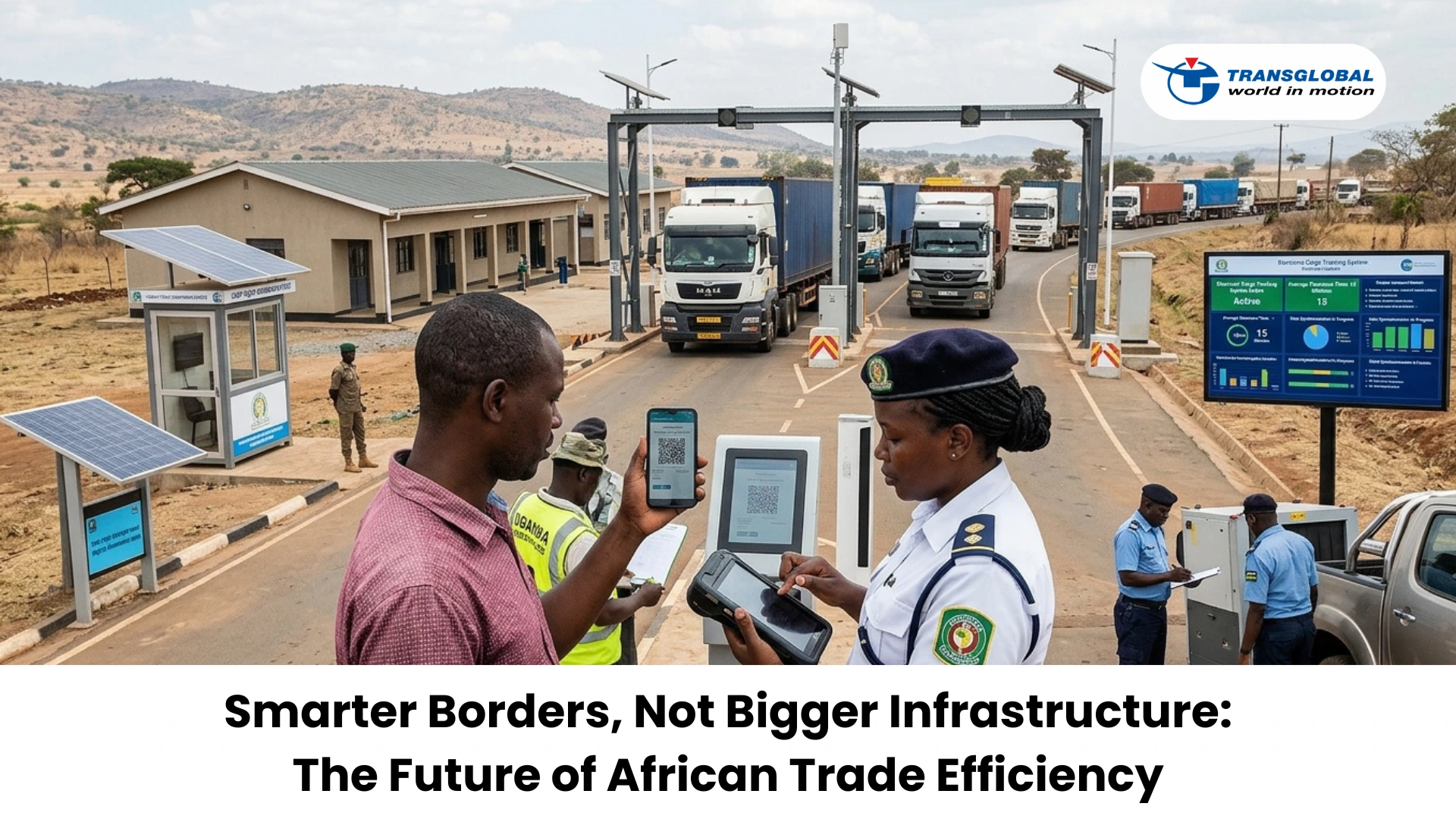
Africa is entering a decisive moment in trade development. While major investments continue to flow into roads, ports, rail corridors, and border facilities, industry leaders like the South African Association of Freight Forwarders (SAAFF) are increasingly pointing out a critical reality: infrastructure alone will not solve Africa’s trade inefficiencies.
The real constraint is not only physical capacity, but also how borders are managed, how systems communicate, and how efficiently cargo information moves across agencies and countries.
With intra-African trade under the African Continental Free Trade Area (AfCFTA) projected to exceed R3.8 trillion, the pressure on border systems is rising fast. But despite this opportunity, inefficiencies such as delays, duplicated checks, and inconsistent customs procedures continue to slow down regional supply chains and increase logistics costs.
In simple terms, Africa is building faster roads, but still processing cargo with slow systems.
🌍 Trade is Growing, but Friction Still Defines the Journey
AfCFTA is designed to transform Africa into a single integrated trading bloc by reducing tariffs, harmonizing trade rules, and strengthening regional value chains. It is supported by initiatives such as the Pan-African Payment and Settlement System (PAPSS), which aims to reduce cross-border payment friction and currency conversion delays.
However, SAAFF highlights that while policy momentum is strong, operational execution remains uneven across many trade corridors.
Across multiple African borders, businesses still face:
- ⏱️ Long and unpredictable clearance delays
- 📄 Repeated submission of the same documentation
- ⚖️ Different customs interpretations between countries
- 🚛 Inefficient freight lane prioritization
- 🔍 Weak integration between border agencies
This creates a situation where cargo movement is often determined not by transport capacity, but by administrative efficiency at border posts.
And in logistics, delays at the border don’t just slow trade, they disrupt entire supply chains.
🚧 Infrastructure Alone is not Enough Anymore
South Africa’s R12.5 billion border modernization programme is one of the most significant investments in regional trade facilitation in decades. It includes upgrades to key land ports that handle the majority of SADC cross-border cargo movement.
But SAAFF and industry stakeholders emphasize an important point:
👉 New infrastructure does not automatically create faster trade.
Without process reform, digital integration, and coordinated systems, even modern border posts can remain congested.
The real transformation must come from:
- 🔗 One-Stop Border Post implementation
- 💻 Fully integrated digital customs systems
- 🧠 Advanced risk profiling and targeting systems
- 🚛 Efficient freight lane and truck flow management
- 🤝 Coordinated multi-agency inspection frameworks
This shift is about moving from fragmented control points to unified trade processing environments.
⚙️ The Real Breakthrough: Interoperability Between Agencies
One of the strongest messages from SAAFF is the need for interoperability, meaning systems across customs, immigration, agriculture, and security authorities must communicate seamlessly.
Currently, many African borders operate with overlapping responsibilities, where different agencies may inspect the same cargo separately.
The future model aims to change that by enabling:
- 🔗 Shared data between border agencies
- 📊 Real-time risk information exchange
- 📄 Single documentation submission systems
- 🚛 Coordinated inspection scheduling
- ⚡ Faster clearance for compliant cargo
From a logistics perspective, this means cargo would no longer be stopped multiple times for the same verification processes.
Instead, information moves digitally while cargo moves physically, reducing friction across the entire system.
🚛 What this Means for Importers, Exporters, and Freight Forwarders?
For logistics operators, these changes represent both opportunity and responsibility.
As border systems modernize, companies will need to adapt to a more data-driven and compliance-sensitive environment.
Key operational impacts include:
- 📦 Faster clearance for fully compliant shipments
- 📉 Reduced delays in efficient trade corridors
- 📊 Increased reliance on digital documentation systems
- ⚠️ Higher penalties for incorrect or incomplete data submissions
- 🔄 Greater need for real-time cargo visibility and tracking
In this environment, freight forwarders are evolving from transport coordinators into trade compliance and information managers, ensuring cargo aligns with digital border systems before it even reaches the checkpoint.
Because in modern logistics, delays are increasingly caused by data errors, not transport capacity.
🏭 SEZs: From Industrial Zones to Trade Acceleration Hubs
Special Economic Zones (SEZs) are expected to play a more strategic role in Africa’s trade transformation.
Successful SEZs such as Coega, Dube TradePort, and Tshwane Automotive SEZ show a clear pattern of what works:
- 📍 Strong proximity to ports or trade corridors
- 🏭 Focused industrial specialization
- ⚙️ Efficient governance and administration
- 🚛 Integrated logistics and transport connectivity
However, SAAFF notes that many SEZs across the continent still underperform due to weak integration with transport networks and inconsistent logistics efficiency.
The next phase of SEZ development is expected to reposition them as:
👉 Fully integrated logistics and manufacturing ecosystems, not isolated industrial zones.
📊 Proof that Process Reform Works
Africa already has successful examples demonstrating the impact of smarter border management.
According to TradeMark Africa, One-Stop Border Posts in East Africa have reduced crossing times by up to 70% in certain corridors.
This improvement was not driven by infrastructure expansion alone, but by:
- 💻 Digital customs systems
- 🤝 Cross-border institutional cooperation
- 🔗 Integrated IT platforms between agencies
- 📋 Standardized trade documentation processes
The lesson is clear:
👉 Efficiency improves when systems are connected, not duplicated.
⚠️ The Core Challenge: Hybrid Systems Slowing Trade
Despite progress, many African borders still operate in hybrid environments where digital systems exist alongside manual processes.
This creates structural inefficiencies such as:
- Duplicate data entry across systems
- Slower cargo clearance cycles
- Higher operational costs for traders
- Increased compliance uncertainty
- Reduced competitiveness in global trade
As global logistics moves toward real-time digital trade ecosystems, these inefficiencies are becoming more visible and more costly.
The gap between modern infrastructure and outdated processes is now one of Africa’s biggest trade challenges.
🌐 The Future of African Trade is System-Led, Not Infrastructure-Led
The next phase of Africa’s logistics evolution will not be defined by how many roads, ports, or border posts are built.
It will be defined by how well those systems are connected.
The future priorities include:
- 💡 Digital-first border processing
- 🔗 Integrated cross-agency platforms
- 📊 Real-time trade data exchange
- ⚙️ Unified inspection and clearance systems
- 🚛 Predictable and harmonized trade corridors
In this environment, competitiveness will depend less on geography and more on operational intelligence.
🚚 Conclusion: The Real Trade Advantage is Efficiency, Not Infrastructure
Africa is investing heavily in infrastructure, but the real breakthrough will come from smarter systems, not just bigger facilities.
As AfCFTA expands and cross-border trade accelerates, countries that prioritize digital integration, interoperability, and process reform will lead the next phase of continental trade growth.
For businesses operating across African corridors, success will depend on how well they adapt to this shift toward system-driven trade.
Working with the best freight forwarder ensures cargo moves not only across borders, but also through increasingly digital, coordinated, and compliance-driven trade environments.
Because in modern logistics, the strongest supply chains are not the ones built on infrastructure alone, they are the ones built on intelligent systems.
Comments