

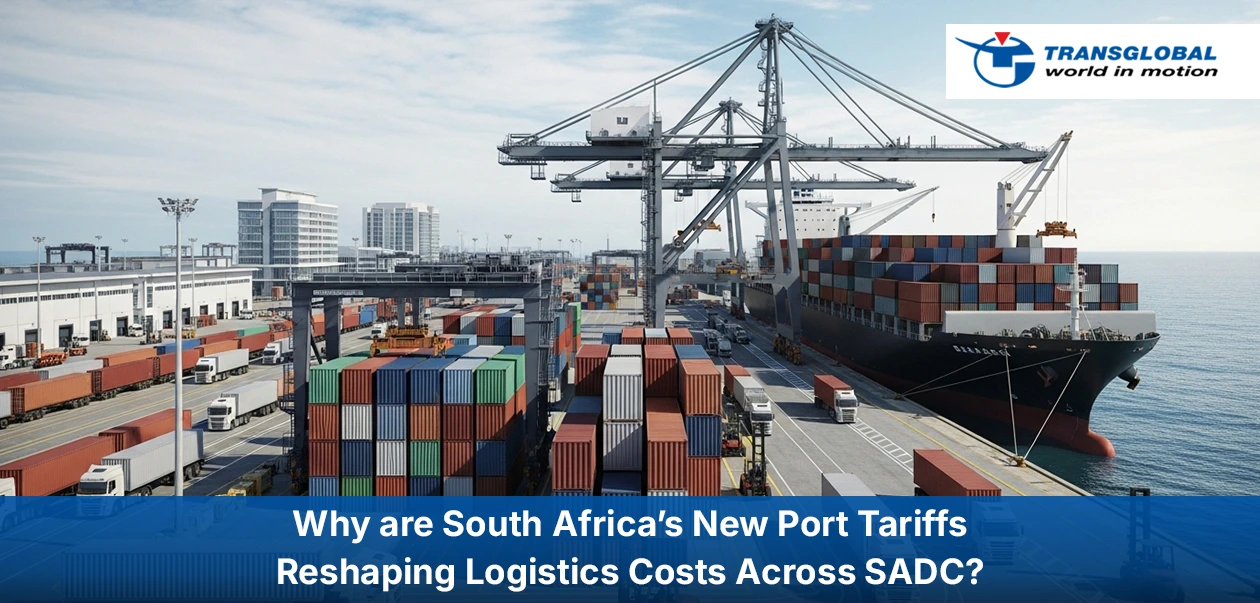
A container lands at port, everything looks on track, and then the invoice arrives.
Not slightly higher. Not marginally adjusted. But layered, with new charges, revised fees, and unexpected additions that were never part of the original freight estimate.
This is exactly what many importers and exporters across Southern Africa began experiencing from April 2026.
South Africa’s latest port tariff adjustments have done more than increase costs. They have changed how logistics pricing behaves across the region. And for businesses operating across SADC corridors, this is not just a port issue, it is a supply chain reality that needs immediate attention.
What Changed in April 2026?
From 1 April 2026, the Transnet National Ports Authority (TNPA) implemented its revised tariff schedule across South Africa’s key container ports, Durban, Cape Town, Gqeberha (Port Elizabeth), and East London.
These ports collectively handle over 5 million TEUs annually, with Durban alone accounting for nearly 60% of total container volumes. This makes any tariff adjustment highly impactful across regional trade.
The changes introduced:
- Revised cargo dues across all major terminals
- New cost structures affecting vessel and cargo handling
- Direct cost increases are passed through to carriers to customers
But what made this adjustment more significant was not just the tariff itself, it was what followed.
The Cascading Effect of Carrier Surcharges
Once port tariffs increase, carriers respond.
Almost immediately after the TNPA revision, major shipping lines introduced additional surcharges to recover increased port costs. These included:
- Cargo Dues Recovery Fees (FIO/FID)
- Revised Destination Handling Charges (DHC)
- Reefer monitoring and plug-in fee increases
- Higher late gate service charges
This created a multi-layered cost impact, where importers and exporters were no longer dealing with a single increase but multiple overlapping charges.
For many businesses, this meant:
- Freight invoices no longer match the original quotes
- Increased landed costs per container
- Budget misalignment for ongoing shipments
This is what makes the April 2026 adjustment particularly important, it is not a one-time change, but a structural shift in pricing.
Why does this Matter for SADC Importers and Exporters?
South Africa acts as a key gateway for inland SADC countries such as Botswana, Zimbabwe, Zambia, Lesotho, and Eswatini.
For these markets, cargo often moves on a Store Door (SD) basis, where carriers manage inland transport and recover all related costs.
With the new tariff structure:
- Cost increases are passed directly to customers
- Inland shipments become more expensive
- Pricing transparency becomes more complex
For exporters, especially those dealing with bulk or high-volume shipments, even small increases per container can significantly impact margins.
For importers, particularly those handling consumer goods or industrial inputs, these changes directly affect product pricing and competitiveness.
The Impact on Temperature-Controlled and Time-Sensitive Cargo
The effect is even more pronounced for reefer cargo.
Industries such as:
- Fresh produce (citrus, fruits, vegetables)
- Seafood exports
- Pharmaceutical shipments
are now facing additional pressure due to revised reefer monitoring and plug-in fees.
These shipments are already sensitive to delays, temperature variations, and transit risks. With added cost layers:
- Margins become tighter
- Operational risks increase
- Delivery timelines become more critical
Combined with external factors like diesel price increases and currency fluctuations, the pressure on cold chain logistics is growing rapidly.
The Bigger Picture: A Long-Term Cost Trend
The April 2026 tariff adjustment is not an isolated event. It is part of a broader infrastructure investment strategy.
Transnet’s ongoing capital programs, including terminal upgrades and private sector participation, require long-term cost recovery.
This means:
- Port tariffs are likely to continue increasing through 2027 and 2028
- Cost volatility will remain a constant factor
- Logistics planning must shift from reactive to proactive
For businesses, this signals a need to rethink how logistics costs are managed and forecasted.
What Businesses Should do Now?
In this new environment, waiting until invoices arrive is no longer a viable approach.
Businesses need to take immediate and strategic action.
Conduct a Cost-Per-Container Audit
Every shipment moving after April 2026 should be reviewed against updated tariff structures and carrier surcharges.
Reassess Existing Rate Agreements
Contracts signed before April may no longer reflect actual costs. These need to be renegotiated or adjusted.
Improve Cost Visibility
Understanding every cost component, from port charges to inland delivery, is essential to avoid surprises.
Plan for Cost Fluctuations
Logistics budgets should now include buffers for tariff and surcharge changes.
Strengthen Logistics Partnerships
Working with experienced freight forwarders helps navigate pricing complexity and ensures better planning.
The Role of Compliance and Certifications in Cost Control
While cost is a major concern, compliance remains equally critical.
Handling cargo through South African ports and across SADC corridors requires adherence to:
- Customs regulations and documentation standards
- Dangerous goods handling protocols (IMDG, IATA where applicable)
- Port authority requirements
- Carrier-specific operational guidelines
Non-compliance can lead to:
- Delays and cargo holds
- Additional penalties and charges
- Increased operational risk
Certified and experienced logistics providers ensure that shipments are processed correctly, reducing unnecessary costs caused by errors or delays.
Transglobal Cargo: Helping You Navigate Cost Complexity
At Transglobal Cargo, we understand that today’s logistics challenges are not just operational, they are financial and strategic.
We support our clients across the Middle East, Europe, and Africa by providing:
- Proactive cost analysis and shipment planning
- Real-time visibility into charges and logistics movements
- Strategic routing and carrier selection
- Advisory on contract terms and cost exposure
- Full compliance with international regulations and regional requirements
Our approach is built on clarity, transparency, and control, ensuring that our clients are never caught off guard by unexpected costs.
We do not just move cargo. We help you manage your logistics decisions with confidence.
Conclusion
South Africa’s April 2026 port tariff changes have redefined logistics costs across the SADC region.
What was once predictable is now layered, dynamic, and more complex.
For importers and exporters, the key is not just to absorb these changes, but to adapt to them. This requires better planning, stronger partnerships, and a clear understanding of cost structures.
Working with a trusted freight forwarder ensures that your supply chain remains efficient, compliant, and financially controlled, even in a changing cost environment.
If you want to stay ahead of rising logistics costs and avoid unexpected financial risks, contact us today. Our team is ready to support your business with smarter, more transparent logistics solutions.
Frequently Asked Questions
Why have logistics costs increased in South Africa from April 2026?
Due to TNPA tariff revisions and additional carrier surcharges, such as DHC and cargo dues recovery fees, leading to higher overall shipping costs.
How do these changes affect SADC countries?
Since many SADC shipments move through South African ports, increased costs are passed along the supply chain, impacting inland logistics and pricing.
What can businesses do to manage these cost increases?
Conduct cost audits, review contracts, improve visibility, and work with experienced freight forwarders to plan and control logistics expenses.


Comments