

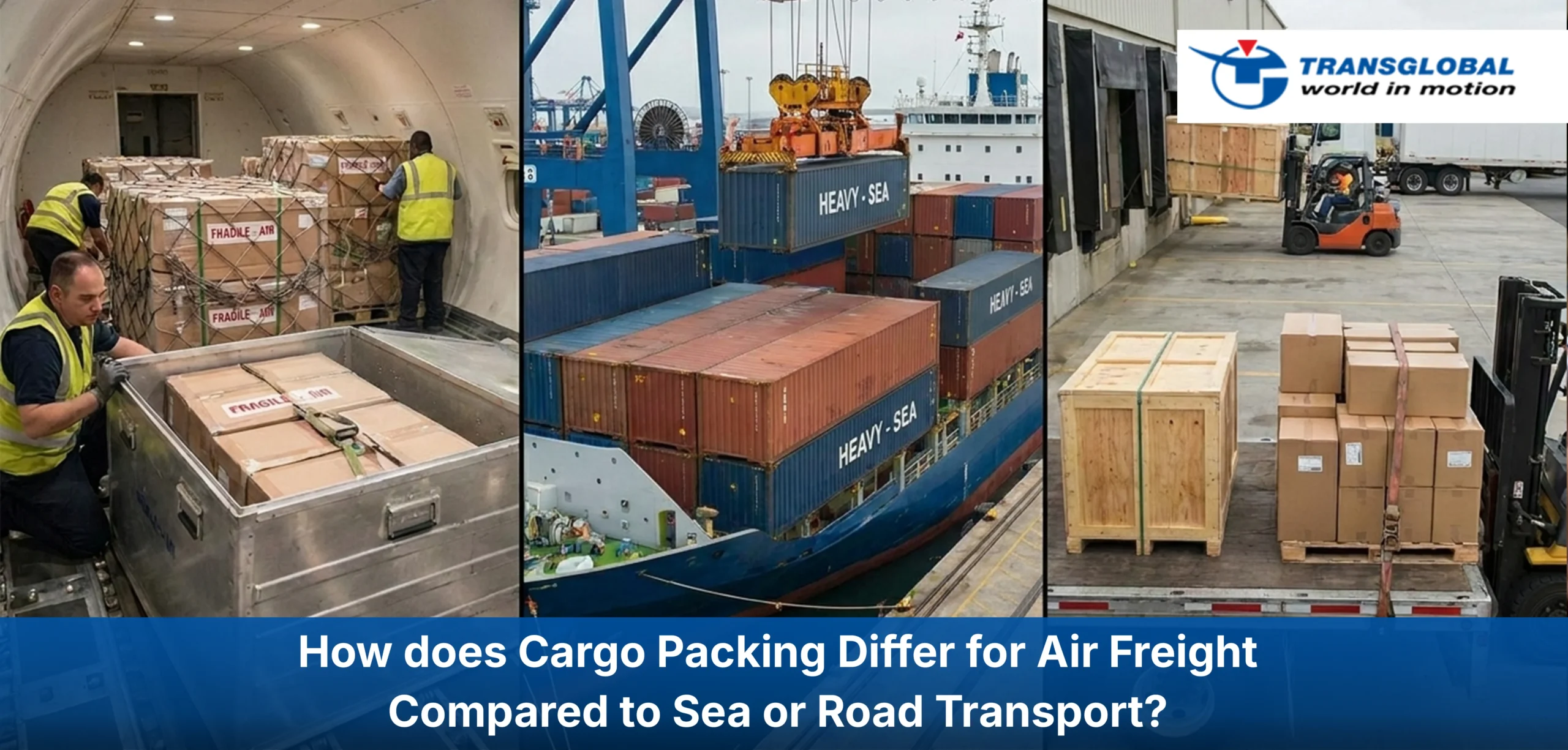
A shipment packed perfectly for one mode of transport can fail completely in another.
That’s something many businesses realize only after facing damage, delays, or unexpected costs. The truth is, cargo packing is not a one-size-fits-all process. What works for sea freight may not survive air turbulence, and what’s ideal for road transport may not meet airline safety standards.
In today’s logistics environment, where speed, safety, and compliance are all under pressure, understanding how packing differs across transport modes is critical. Because the way your cargo is packed directly affects cost, transit time, risk, and even whether your shipment is accepted at all.
Why Cargo Packing Matters More than Ever?
Global supply chains are becoming more complex, and shipments are moving through multiple touchpoints before reaching their destination. Along the way, cargo is exposed to handling, environmental changes, and regulatory checks.
Improper packing is one of the leading causes of:
- Cargo damage
- Shipment rejection
- Increased freight costs
- Compliance issues
Today, logistics is not just about moving goods, it’s about protecting them throughout the journey. And that starts with packing.
What Makes Air Freight Packing Different?
Air freight is all about speed, but it comes with strict limitations and requirements.
The most important factor in air cargo packing is weight and space optimization. Airlines charge based on volumetric weight, which means bulky packaging can significantly increase costs. Businesses need to pack cargo as compactly as possible without compromising safety.
Another key factor is security and compliance. Air freight is subject to stringent aviation safety regulations. Packaging must meet airline standards, especially for sensitive cargo such as dangerous goods or hazardous materials, which require specific labeling, documentation, and certified packing.
Air cargo is also exposed to pressure and temperature variations. At high altitudes, changes in air pressure can affect packaging integrity, especially for liquids or sealed containers. This requires secure sealing and pressure-resistant packaging.
Handling in air freight is generally faster but more frequent, meaning cargo must be durable enough to withstand multiple touchpoints in a short time.
How Sea Freight Packing Differs from Air Transport?
Sea freight operates in a completely different environment. Unlike air transport, where speed is the priority, sea freight focuses on volume and endurance.
Cargo shipped by sea often spends weeks in transit, exposed to humidity, salt air, and temperature fluctuations. This makes moisture protection a critical aspect of packing. Materials such as desiccants, vacuum sealing, and waterproof packaging are commonly used to prevent damage.
Another key consideration is container loading. Cargo must be packed in a way that maximizes container space while ensuring stability. Improper weight distribution can lead to cargo shifting during transit, causing damage.
Sea freight also involves longer handling cycles, including loading, unloading, and possible transshipment. Packaging must be strong enough to withstand these extended operations.
Compared to air freight, packaging for sea transport is often heavier and more robust, prioritizing protection over weight reduction.
What About Road Freight Packing Requirements?
Road freight sits somewhere between air and sea in terms of packing requirements. It offers flexibility but comes with its own challenges.
The biggest factor in road transport is movement and vibration. Cargo is exposed to continuous motion, uneven roads, and braking forces. This makes secure fastening and cushioning essential.
Unlike air freight, road transport is less restrictive in terms of weight and dimensions, but cargo still needs to be packed efficiently to optimize truck space and reduce costs.
Road freight also requires attention to route conditions. Long-distance transport across regions may expose cargo to varying climates, requiring adaptable packaging solutions.
For high-risk cargo such as explosives, dangerous goods, or hazardous materials, road transport requires strict compliance with safety regulations, including proper labeling, segregation, and secure containment.
Key Differences Between Air, Sea, and Road Packing
The differences in cargo packing across these modes come down to priorities.
Air freight prioritizes speed, weight efficiency, and strict compliance. Packaging must be lightweight, compact, and secure.
Sea freight focuses on durability and environmental protection. Packaging must withstand long transit times and harsh conditions.
Road freight emphasizes stability and flexibility. Packaging must handle movement, vibration, and varying routes.
Understanding these differences helps businesses choose the right packing strategy for each shipment, reducing risk and improving efficiency.
Common Packing Mistakes Businesses Should Avoid
One of the most common mistakes is using the same packing method for all transport modes. This often leads to damage or increased costs.
Another issue is underestimating environmental factors. For example, failing to protect cargo from moisture in sea freight can result in significant losses.
Incorrect labeling and documentation, especially for dangerous goods, can lead to shipment rejection or compliance issues.
Overpacking is also a problem, particularly in air freight, where excessive packaging increases volumetric weight and costs.
Avoiding these mistakes requires a clear understanding of transport-specific requirements.
Transglobal’s Role Goes Beyond Moving Cargo
Cargo packing is not just a preparation step, it is a critical part of logistics execution.
At Transglobal, packing is approached strategically, based on the mode of transport, cargo type, and destination requirements. Whether it is air freight, sea freight, or road freight, every shipment is planned with precision.
For standard cargo, the focus is on efficiency and protection. For specialized shipments such as dangerous goods, hazardous materials, explosives, and project cargo, packing is handled with strict compliance and safety standards.
With experience in military logistics, defence cargo, and armaments transport, Transglobal ensures that even the most sensitive shipments are packed securely and in line with regulatory requirements.
The team considers every factor, from environmental conditions to handling processes, ensuring that cargo is protected throughout its journey.
This level of expertise reduces risk, prevents damage, and ensures that shipments move smoothly across global supply chains.
Why the Right Packing Strategy Improves Business Performance?
Packing is often seen as a basic task, but in reality, it plays a major role in logistics performance.
The right packing strategy helps reduce damage, avoid delays, and control costs. It also ensures compliance with international regulations, reducing the risk of penalties or shipment rejection.
In a competitive market, businesses that optimize their packing processes gain a clear advantage. They move cargo more efficiently, maintain reliability, and build stronger relationships with customers.
Conclusion
Cargo packing is not just about protection, it is about performance.
Each mode of transport comes with its own challenges, and understanding these differences is key to ensuring smooth and efficient shipments.
In today’s logistics environment, where delays and risks are common, the right packing strategy can make all the difference.
If you want to ensure your cargo is packed correctly for air, sea, or road transport, it is essential to work with experts who understand every detail of the process. Partner with a trusted and experienced team that can handle your shipments with precision and care.
Connect with a freight forwarder who delivers safe, compliant, and efficient logistics solutions across every mode of transport.
Frequently Asked Questions
Why is packing different for air freight compared to sea freight?
Air freight requires lightweight and compact packaging, while sea freight needs strong, moisture-resistant packaging for long transit.
How does road transport affect cargo packing?
Road freight requires secure and stable packing to handle vibration, movement, and varying road conditions.
Do dangerous goods require special packing?
Yes, dangerous goods need certified packaging, proper labeling, and strict compliance with safety regulations.

Comments