

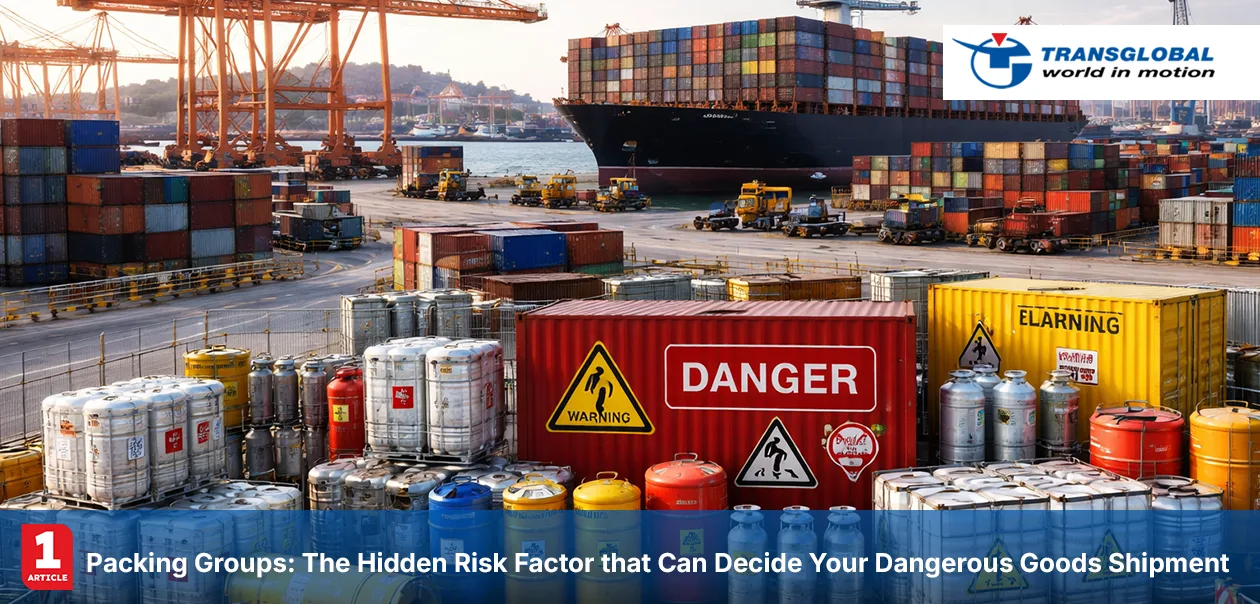
Dangerous Goods shipments rarely fail because of dramatic mistakes. More often, they stall, get rejected, or incur penalties because of one quiet detail that sits deep inside the regulations and is overlooked during planning.
That detail is the Packing Group.
While most logistics professionals immediately recognise hazard classes, flammable, corrosive, toxic, and explosive, the degree of danger within those classes is what truly controls how a shipment moves. In today’s compliance-driven supply chain environment, misunderstanding Packing Groups can mean rejected cargo, rework costs, missed sailings, or worse, regulatory exposure.
Understanding Packing Groups is no longer optional. It is a commercial and operational necessity.
Why Hazard Class Alone is Not Enough?
Hazard Class tells authorities what type of danger a substance presents. Packing Group answers a more critical question:
How severe is that danger?
Two products can sit under the same hazard class and yet require completely different packaging, handling, quantity limits, and transport approvals. Treating them as equals is where many shipments fall apart.
Think of it this way:
Hazard Class defines the category of risk
Packing Group defines the intensity of that risk
In a global logistics environment where carriers, ports, airlines, and regulators are under increasing scrutiny, that intensity matters.
What Exactly is a Packing Group?
A Packing Group (PG) is a regulatory classification used in international Dangerous Goods regulations such as IMDG, IATA DGR, and ADR. It indicates the degree of danger posed by a substance within its hazard class.
There are three Packing Groups:
- PG I – High danger
- PG II – Medium danger
- PG III – Low danger
This single classification affects far more than many shippers realise.
How do Packing Groups Directly Control Your Shipment?
Packing Groups influence almost every operational decision made after booking. They determine:
- The strength and type of packaging required
- Maximum quantity per package
- Whether the cargo is allowed on passenger aircraft
- The type of UN-approved packaging
- Carrier acceptance criteria
- Storage and segregation requirements
- Emergency response instructions
A mismatch between the declared Packing Group and the actual product properties is one of the fastest ways to trigger rejection at acceptance or inspection.
The Operational Difference Between PG I, II, and III
Understanding the real-world impact of each Packing Group helps explain why this detail carries so much weight.
Packing Group I: High Danger
These substances present the highest level of risk.
- Require the strongest UN-approved packaging
- Have the lowest quantity limits per package
- Face the most restrictions for air transport
- Trigger stricter segregation and stowage rules
- They are often subject to enhanced scrutiny by carriers and authorities
Even minor documentation or packaging errors at this level can stop a shipment entirely.
Packing Group II: Medium Danger
This is where many industrial chemicals fall.
- Moderate packaging strength required
- Quantity limits are higher than PG I, but still controlled
- Some flexibility in transport modes, with conditions
- Compliance checks remain strict, especially for air freight
PG II shipments are often delayed, not because they are banned, but because they are incorrectly prepared.
Packing Group III: Low Danger
Still regulated, but more forgiving.
- Lower packaging performance requirements
- Higher allowable quantities per package
- Greater acceptance across transport modes
- Fewer operational restrictions, but still no margin for incorrect declaration
“Low danger” does not mean “low compliance.” It simply means the consequences of error are less severe.
A Critical Compliance Reality: Not All Dangerous Goods Use Packing Groups
One of the most common mistakes in Dangerous Goods logistics is assuming that every hazard class includes a Packing Group.
It does not.
For example:
- Class 3 (Flammable Liquids) usually uses Packing Groups
- Class 8 (Corrosives) usually uses Packing Groups
- Class 6.1 (Toxic Substances) usually uses Packing Groups
However:
- Class 1 (Explosives) is classified by divisions and compatibility groups, not Packing Groups
- Class 7 (Radioactive Material) follows category and package-type rules instead of Packing Groups
- Some self-reactive or temperature-controlled substances follow specialised frameworks
This is where theoretical knowledge breaks down, and real logistics expertise becomes essential.
Why are Packing Groups Causing More Delays Than Ever?
In today’s supply chain environment, Dangerous Goods shipments face pressure from multiple sides:
- Airlines are tightening acceptance rules
- Ports enforcing stricter IMDG checks
- Insurers scrutinising declarations
- Regulators are increasing penalties for misclassification
At the same time, supply chains are moving faster, documentation windows are tighter, and tolerance for rework is shrinking.
Packing Group errors now result in:
- Last-minute cargo rejection
- Repacking at origin or destination
- Missed flights or vessels
- Escalated costs for storage and handling
- Compliance investigations
What used to be a technical detail has become a shipment-critical risk factor.
Sea Freight and Air Freight: Same Product, Different Reality
One of the most misunderstood areas in Dangerous Goods logistics is assuming that packaging rules remain the same across transport modes.
They do not.
Even for the same:
- UN number
- Hazard class
- Packing Group
Sea freight and air freight operate under very different risk models.
- Air freight prioritises vibration, pressure, and altitude risk
- Sea freight focuses on stacking, humidity, long transit times, and fire containment
A package accepted for IMDG may be rejected under IATA, even when the product details are identical. This is where many shippers lose time and money by switching modes without reassessing compliance.
Why Experienced Freight Forwarders Treat Packing Groups as a Planning Tool?
Professional Dangerous Goods forwarders do not look at Packing Groups as a line item on a document. They use them to:
- Select the correct packaging strategy from the start
- Advice on viable transport modes
- Prevent rework before cargo reaches the terminal
- Align documentation, labels, and handling instructions
- Reduce inspection and rejection risk
This approach turns compliance from a last-minute hurdle into a competitive advantage.
Conclusion
Packing Groups may not grab attention like hazard classes or UN numbers, but they quietly dictate how your entire shipment moves, or doesn’t.
In a logistics environment where delays are expensive, compliance penalties are rising, and customer tolerance is low, understanding and applying Packing Groups correctly is no longer optional. It is a requirement for safe, compliant, and predictable Dangerous Goods transport.
Need a Freight Partner Who Gets Dangerous Goods Right?
If your business handles Dangerous Goods, compliance should never be a guessing game.
At Transglobal Cargo, we manage Dangerous Goods shipments with a compliance-first mindset, from correct classification and packaging guidance to transport planning across sea and air freight.
If you’re looking for the best freight forwarder to handle complex, high-risk cargo with confidence, contact us today and let our expertise keep your shipments moving safely and smoothly.
Stay Tuned for the Next Article in This Series: Why “It’s Fine for Sea” does Not Mean “It’s Fine for Air” in Dangerous Goods Logistics?
Frequently Asked Questions
What happens if the wrong packing group is declared for a Dangerous Goods shipment?
Declaring an incorrect packing group can lead to shipment rejection, repacking at the terminal, regulatory penalties, insurance issues, and delays across the supply chain. In some cases, carriers may blacklist repeat non-compliant shippers, making future bookings more difficult.
Do packing group requirements differ between sea freight and air freight?
Yes. Even for the same UN number and packing group, sea freight (IMDG) and air freight (IATA) have different packaging, quantity limits, and acceptance rules. A package approved for ocean transport may still be rejected for air shipment if it does not meet IATA standards.
Are packing groups required for all Dangerous Goods classes?
No. Not all hazard classes use packing groups. For example, explosives (Class 1) are classified by divisions and compatibility groups, while radioactive materials (Class 7) follow package type and category rules. Understanding when packing groups apply is a key part of Dangerous Goods compliance.
Comments