

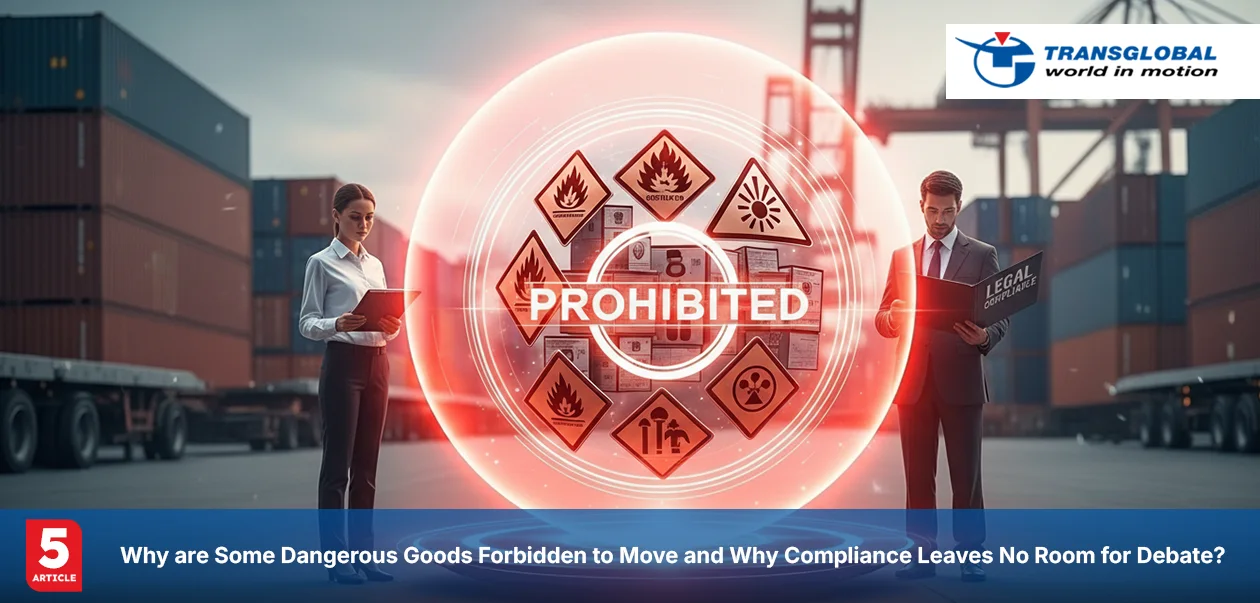
Every experienced Dangerous Goods professional learns this lesson sooner or later, usually the hard way:
Just because a shipment moved once does not mean it is allowed to move again.
In today’s logistics environment, compliance rules are tighter, enforcement is sharper, and tolerance for risk is shrinking fast. Dangerous Goods that were once accepted under older practices are now restricted, heavily limited, or completely forbidden, depending on mode of transport, quantity, packaging, aircraft or vessel type, and documentation accuracy.
This is not an inconsistency.
It is the natural result of safety-driven regulation evolving in response to real incidents.
And for anyone moving DG globally, this reality cannot be ignored.
What does “Forbidden” Really Mean in Dangerous Goods Logistics?
A forbidden shipment is not always illegal in absolute terms. More often, it is non-permissible under specific conditions.
Dangerous Goods may be:
- Allowed by sea but forbidden by air
- Allowed on cargo aircraft but forbidden on passenger aircraft
- Allowed only below strict quantity limits
- Allowed only with specific packaging and approvals
When any one of these conditions is missed, the shipment becomes non-compliant, and therefore non-movable.
This is why “we’ve shipped this before” is one of the most dangerous assumptions in DG logistics.
Why Dangerous Goods Get Rejected by Air Transport?
Air freight has the smallest margin for error. Aircraft safety standards are uncompromising, and DG rules under IATA are enforced at acceptance, not after departure.
Common reasons DG becomes forbidden or rejected by the air include:
- Incorrect passenger vs cargo aircraft classification
- Applying the wrong packing instruction
- Packaging not performance-tested or not approved
- Evidence of leakage, staining, or weak closures
- Missing or incorrect marks and labels
- Misdeclared lithium battery configurations (still one of the biggest global risk areas)
- Errors in the Dangerous Goods Declaration
Airlines are not allowed discretion in these cases. If the risk threshold is exceeded, the shipment stops, no exceptions.
Why Sea Freight Rejections Still Happen, Even Though It’s “More Flexible”?
Sea freight is often seen as more forgiving, but that assumption leads to costly mistakes.
IMDG rejections commonly occur due to:
- Incorrect segregation between incompatible cargoes
- Poor container packing practices
- Missing or incorrect IMDG documentation
- Incompatible goods shipped together
- Incorrect UN number, Packing Group, or class entry
- Failure to meet stowage category requirements
Sea transport focuses on long-duration containment and compatibility. When these fundamentals are ignored, ports and carriers will refuse the shipment, often after the container has already incurred costs.
Why Specialist Cargo Has Zero Tolerance for Error?
Some Dangerous Goods are not just regulated, they are controlled at the highest operational level.
Explosives (Class 1)
Explosives are governed by:
- Division (1.1, 1.2, 1.3, etc.)
- Compatibility group
- Approved packaging types
- Quantity and routing limitations
Every movement requires disciplined documentation, verified packaging, and controlled handling. Any deviation is treated as a serious safety breach.
Radioactive Medical Shipments (Class 7)
These shipments involve:
- Package category and design compliance
- Radiation exposure controls
- Strict labelling and declaration accuracy
Even when compliant, routing options are limited, and acceptance depends on absolute precision.
In both cases, the consequence of failure is not just delay, it is safety exposure and regulatory escalation.
The Compliance Truth Nobody Likes to Hear
Dangerous Goods compliance is not a department.
It is a core competency.
Treating DG as a paperwork function instead of an operational discipline leads to:
- Rejections at acceptance points
- Delays that cascade across supply chains
- Increased scrutiny on future shipments
- Insurance and liability exposure
- Reputational damage with carriers and regulators
DG does not forgive shortcuts. It exposes them.
How Experienced Forwarders Prevent Forbidden Shipments?
A compliance-first freight forwarder works backwards from acceptance, not from convenience.
This means:
- Verifying permissibility before booking
- Matching packaging to mode and aircraft/vessel type
- Validating quantities against current regulations
- Aligning documentation exactly with the physical cargo
- Anticipating inspection points and rejection triggers
This approach protects not only the shipment, but the shipper’s long-term ability to move regulated cargo.
Conclusion
Global trade depends on trust between shippers, carriers, regulators, and the public.
Forbidden shipments exist because the consequences of failure are too high to accept risk.
If you work in freight forwarding, transport, warehousing, or procurement, the rule is simple:
Do not treat Dangerous Goods as a task.
Treat them as a responsibility.
Need Expert Support with High-Risk or Regulated Cargo?
At Transglobal Cargo, Dangerous Goods compliance is built into how we operate, not added later.
If you’re looking for the best freight forwarder to manage complex DG shipments across air and sea with confidence, contact us today. We help you move what is allowed and prevent costly mistakes before they happen.
Frequently Asked Questions
Can a shipment be forbidden even if it moved successfully in the past?
Yes. Regulations, aircraft types, carrier policies, and risk thresholds change. Past movement does not guarantee current compliance.
Who decides whether Dangerous Goods are forbidden?
Regulatory frameworks (IATA, IMDG), airlines, shipping lines, and port authorities all enforce acceptance rules. None can override safety limits.
What is the most common reason DG shipments get rejected?
Incorrect packaging, misdeclared quantities, and documentation mismatches are the most frequent causes.


Comments