

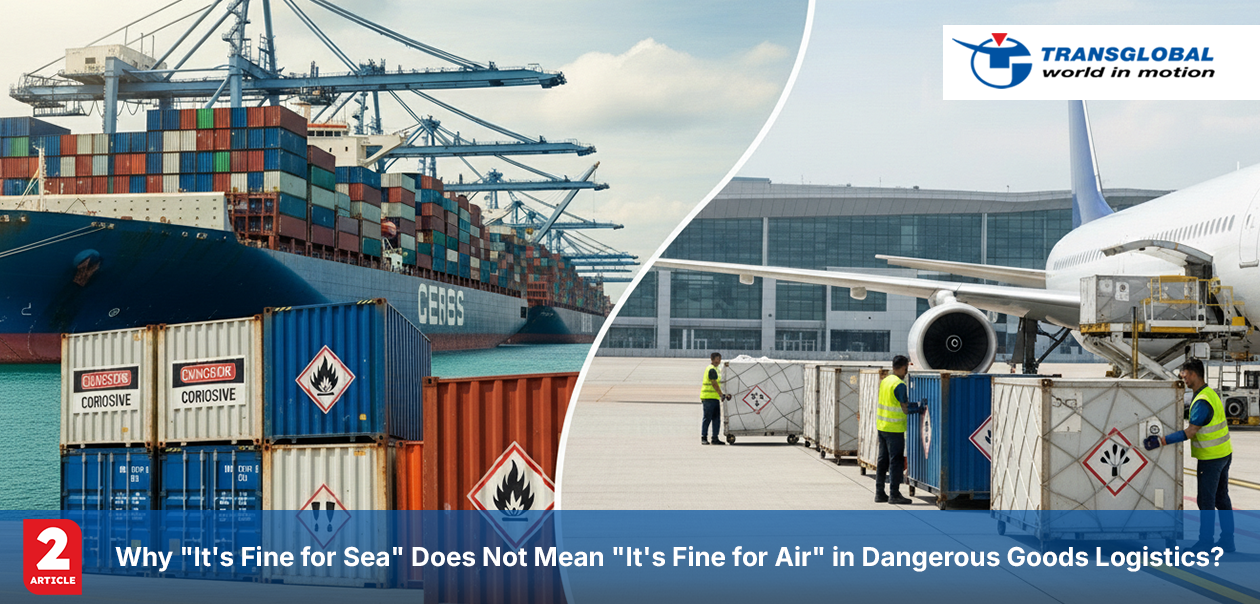
One of the most common conversations in Dangerous Goods logistics starts with a frustrated question:
“But this product ships by sea all the time… why can’t it go by air?”
It sounds reasonable. The UN number hasn’t changed. The product hasn’t changed. The shipper has moved it before.
Yet in practice, this assumption is one of the leading causes of Dangerous Goods rejections, delays, and last-minute repacking.
The reason is simple but often overlooked: sea freight and air freight are governed by completely different safety philosophies, risk tolerances, and regulatory frameworks. Compliance in one mode does not automatically translate to compliance in another.
Two Modes, Two Risk Models, Two Rulebooks
Dangerous Goods do not move under a single universal set of rules. Instead, each transport mode applies its own regulatory framework, designed around the specific risks of that environment.
- IMDG Code governs sea transport
- IATA Dangerous Goods Regulations (DGR) govern air transport
Both are international standards. Both are detailed. Both are strict.
But they are not interchangeable.
Understanding the difference between these frameworks is critical for anyone planning Dangerous Goods movements across multiple modes.
Sea Freight: Designed for Endurance and Containment
Sea transport is built around long exposure and physical resilience. Cargo may spend weeks in containers, exposed to constant motion and environmental stress.
The main risks at sea include:
- Container shifting and stacking pressure
- Continuous movement and vibration
- High humidity and corrosion
- Long transit times without intervention
- Segregation risks in shared containers or vessel holds
Because of this, sea freight packaging focuses on:
- Structural strength and durability
- Leak containment over extended periods
- Resistance to moisture and corrosion
- Correct IMDG markings, labels, and placards
- Compliance with segregation and stowage rules
If a package can safely endure weeks at sea without leaking, reacting, or degrading, it may be acceptable under IMDG, provided all other requirements are met.
However, endurance alone does not make packaging suitable for air transport.
Air Freight: Designed Around Safety Thresholds, Not Duration
Air transport operates under a fundamentally different risk model. While transit times are shorter, the consequences of failure are immediate and severe.
Aircraft environments introduce risks that do not exist at sea:
- Rapid pressure changes during ascent and descent
- High-frequency vibration
- Temperature fluctuations in cargo holds and on tarmac
- Limited ability to manage incidents mid-flight
- Zero tolerance for leaks, instability, or reactions
Because of this, air transport imposes much tighter controls on Dangerous Goods.
Air freight often requires:
- UN-tested packaging certified for air transport
- Strict adherence to IATA packing instructions
- Smaller maximum quantities per package
- Enhanced closure integrity
- Additional inner packaging layers
- Clear distinction between passenger aircraft and cargo aircraft eligibility
A package that is perfectly acceptable for IMDG can still be rejected outright under IATA.
Same UN Number, Same Product, Very Different Outcomes
This is where many Dangerous Goods shipments break down operationally.
From a shipper’s perspective:
- The product is unchanged
- The UN number is the same
- The cargo has moved successfully before
From an airline or regulator’s perspective:
- The risk profile has changed
- The tolerance for failure is lower
- The regulatory requirements are stricter
- There is no discretion to “make an exception.”
Airlines cannot override IATA DGR rules. If packaging, quantity limits, or documentation do not meet the exact air requirements, the shipment will not fly.
Why does this Misunderstanding Cause Costly Delays?
In today’s supply chain environment, this misconception leads to:
- Cargo rejected at airline acceptance
- Missed flight cut-offs
- Emergency repacking at origin
- Increased storage and handling costs
- Disrupted delivery commitments
- Compliance flags against the shipper
These issues rarely stem from the Dangerous Goods themselves. They stem from planning packaging for sea freight and assuming it will work for air freight.
High-Risk Classes: Where the Margin for Error is Minimal?
The difference between sea and air becomes even more critical for high-risk categories.
For example:
Class 1 Explosives are governed by divisions and compatibility groups, with extremely limited air acceptance
Class 7 Radioactive Material follows package-type and activity rules that are far more restrictive for air transport
In these classes, even small deviations can result in:
- Immediate rejection
- Mandatory regulatory reporting
- Carrier refusal for future shipments
There is no flexibility in these categories, only strict compliance.
Why Transport Mode Must be Decided Before Packaging?
One of the most common operational mistakes is finalising packaging before confirming the transport mode.
Experienced Dangerous Goods professionals reverse this process:
- First, determine whether air, sea, or multimodal transport is viable
- Then, select packaging that meets the strictest applicable requirements
- Finally, align quantities, documentation, and routing accordingly
This approach reduces rework, avoids rejection, and protects schedules.
The Freight Forwarder’s Role in Preventing Mode-Based Failures
In Dangerous Goods logistics, freight forwarders are not simply booking agents. They act as compliance gatekeepers.
A specialist forwarder will:
- Confirm mode eligibility early
- Validate packaging against the correct framework
- Identify passenger vs cargo aircraft restrictions
- Advice on quantity limits and alternatives
- Prevent non-compliant cargo from reaching terminals
This expertise often makes the difference between a shipment moving smoothly or failing at acceptance.
Conclusion
Sea freight and air freight are not two versions of the same journey. They are two entirely different safety environments governed by different rulebooks.
Understanding this distinction is essential for anyone moving Dangerous Goods today.
The real question is not “Has it shipped before?”
It is “Can it ship by this mode, under these rules, with this packaging?”
Need Help Planning Dangerous Goods Across Sea and Air?
At Transglobal Cargo, we support Dangerous Goods shipments with mode-specific planning, ensuring packaging, documentation, and routing are aligned from the start.
If you’re looking for the best freight forwarder to manage complex, high-risk cargo without delays, contact us today and let our compliance-first approach keep your shipments moving.
Stay Tuned for the Next Article in This Series: Why does “Passenger Aircraft vs Cargo Aircraft Only” Decide Everything in Dangerous Goods Air Transport?
Frequently Asked Questions
Can Dangerous Goods approved for sea freight automatically move by air?
No. Sea and air transport follow different regulations. Packaging, quantity limits, and acceptance rules under IMDG do not automatically meet IATA DGR requirements.
Why do airlines reject cargo that has shipped by sea before?
Because air transport has much stricter safety thresholds. Pressure changes, vibration, and aircraft safety rules require higher packaging standards and lower quantities.
When should the transport mode be decided in Dangerous Goods planning?
Before the packaging is finalised. The transport mode determines packaging standards, quantity limits, and documentation requirements. Planning it late often causes rejections and delays.

Comments