

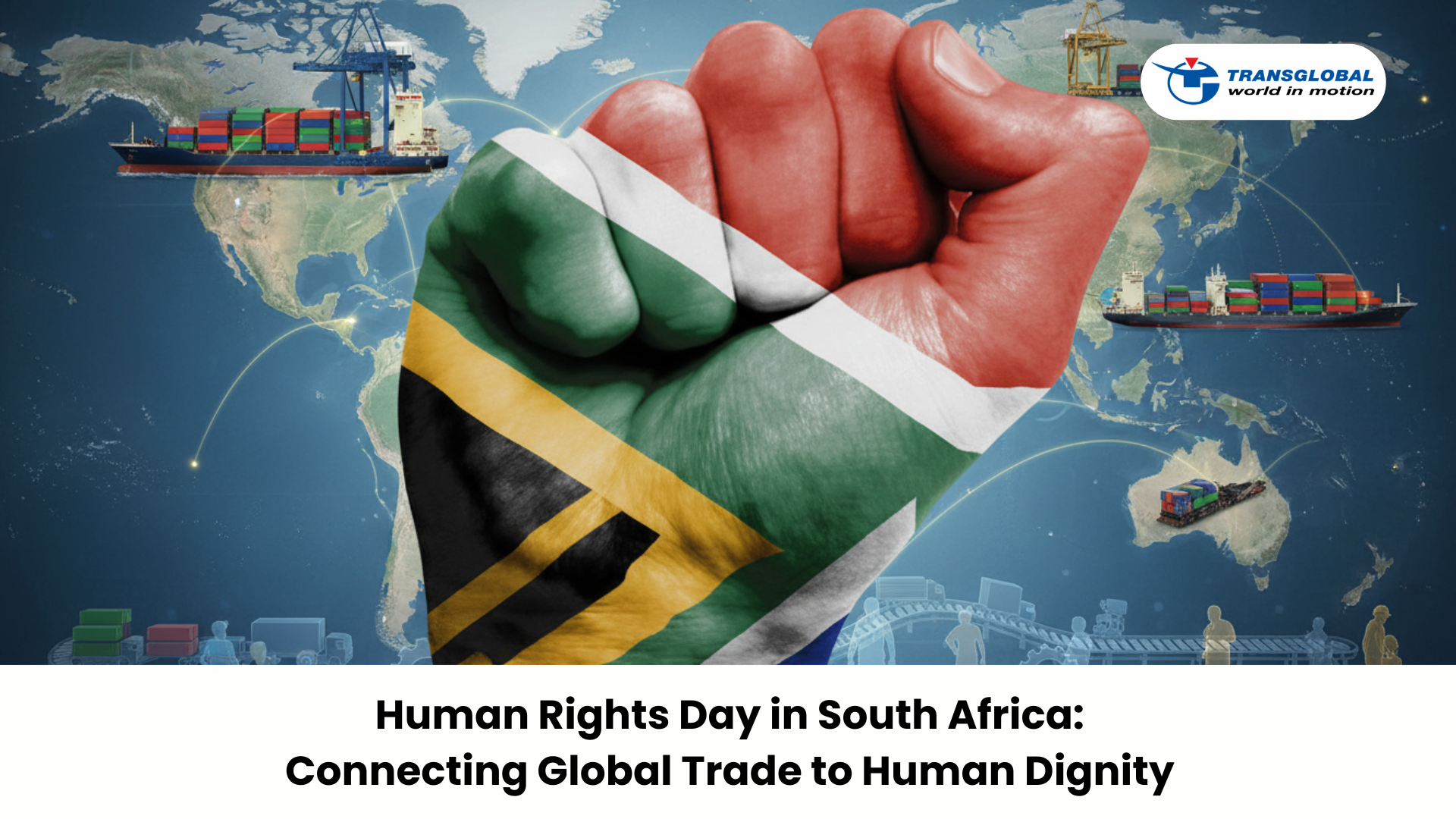
On Human Rights Day, observed every March 21, South Africa reflects on dignity, equality, and justice. The day honours the legacy of the Sharpeville Massacre, a powerful reminder that human rights are not abstract ideals but responsibilities we carry every day.
In today’s interconnected trade environment, every shipment represents more than cargo. Behind every container, every pallet, and every delivery, there are people.
So the real question is, are we only moving goods, or are we also protecting the people behind them?
🌍 Human Rights in a Connected World
Human rights are simple in principle yet complex in practice, especially within global supply chains that span multiple regions, regulations, and labour environments.
At their core, they include:
- Fair wages for work done
- Safe and healthy working conditions
- Equal opportunities for all
However, in modern logistics networks:
- 🌐 Millions of workers remain invisible across extended supply chains
- ⚖️ Labour standards differ significantly from one region to another
- ⏱️ Pressure for speed and cost efficiency can impact safety and fairness
Global data highlights the scale of the challenge:
- 🌐 According to the International Labour Organization (ILO), over 27 million people are affected by forced labour globally
- 👷 Nearly 1 in 10 workers worldwide operate in informal or unregulated environments
- ⚖️ The United Nations estimates that modern supply chains can involve 5–10 tiers, making visibility and accountability increasingly difficult
- 📦 In high-demand industries, pressure for faster delivery continues to increase risks related to worker safety and compliance
As supply chains grow more complex, the human element can easily be overlooked.
🚢 Freight Forwarding: Where Trade Meets Human Responsibility
Freight forwarding sits at the center of global trade. It connects suppliers, manufacturers, transport networks, and end markets, bringing together multiple human touchpoints across borders.
Consider a single shipment journey:
- 👷 Factory workers producing goods
- 📦 Warehouse teams managing storage and packaging
- 🚛 Drivers ensuring timely transportation
- ⚓ Port operators and customs officials coordinating movement
At every stage, people are involved.
Even indirectly, freight forwarding influences human rights by
- Connecting regions with different labour and safety standards
- Operating under timelines that may affect working conditions
- Coordinating complex processes involving multiple stakeholders
This makes logistics not just an operational function but also a human responsibility.
⚖️ Responsibility in Everyday Decisions
Protecting human rights in logistics does not always require large-scale transformation. It usually starts with small, thoughtful decisions.
Simple actions can make a meaningful difference:
- Understanding where goods originate
- Working with partners who follow ethical practices
- Prioritizing safety and well-being over speed when necessary
- Asking how each process impacts the people involved
These steps may seem small, but across a global supply chain, their impact can be significant.
💡 Visibility Creates Accountability
One of the biggest challenges in protecting human rights is visibility. If parts of the supply chain remain hidden, risks often go unnoticed.
Modern logistics systems and digital tools now allow businesses to:
- 📡 Track shipments across their full journey
- 🔍 Identify risks and inefficiencies in operations
- 📊 Improve transparency across partners and regions
- 🤝 Build accountability at every stage of the process
When supply chains become more visible, they also become more responsible.
👷 Keeping People at the Centre of Logistics
At its core, global trade is powered by human effort. From warehouses to ports, from production lines to delivery networks, people keep the system moving.
Ensuring their well-being is not just ethical; it is essential for long-term sustainability.
This includes:
- Safe and secure working environments
- Fair and equitable treatment
- Respect for every role within the supply chain
When people are valued, operations become stronger, more reliable, and more resilient.
🌐 Reflection: Balancing Efficiency with Responsibility
As logistics continue to evolve, it is worth pausing to reflect.
- Are supply chains just operational systems, or are they people-driven networks?
- Are we prioritizing speed and cost at the expense of human welfare?
- How can fairness become part of everyday logistics decisions?
These are not theoretical questions; they are practical considerations that shape how global trade operates.
🚚 Conclusion: Moving Cargo with Responsibility
Global trade will keep expanding, changing, and getting more intricate. However, one thing never changes: people are at the core of everything.
As freight forwarders and logistics specialists, we are responsible for both the efficient and responsible transportation of goods. Real progress in logistics is determined by how well we safeguard the workers behind each shipment, not just by cost or speed. In light of this, selecting the appropriate logistics provider becomes vital.
Transglobal Cargo, a trusted freight forwarder, understands one simple truth: behind every shipment, people matter.
Comments