

Global trade is adapting fast.
As instability around the Strait of Hormuz continues to disrupt traditional shipping routes, a new alternative is gaining serious traction. Egypt is stepping forward with a strategic Europe–Gulf corridor, offering a safer and more controlled path for cargo movement.
But this is not just a temporary workaround.
👉 It could signal a long-term shift in how goods move between Europe, the Gulf, and Africa.
So the real question is: Are supply chains ready to adapt to new trade corridors, or still relying on old routes?
🌍 The Trigger: Hormuz Disruption is Changing Trade Patterns
Recent developments around the Strait of Hormuz have created one of the most severe disruptions in global shipping flows.
📊 The numbers highlight the scale of the impact:
- 🚢 Daily vessel traffic dropped from 140–178 ships to just 5–7 vessels
- ⛽ Over 230 oil tankers were stranded, with dozens rerouted
- 💰 War-risk insurance surged from 0.15% to as high as 5–10% of vessel value
👉 The result?
Shipping costs have risen sharply, and operational uncertainty has become the new normal.
For importers and exporters, especially those relying on Gulf trade lanes, this has translated into:
- Higher freight costs
- Longer transit times
- Increased exposure to risk
🚢 Egypt’s Response: A New Europe–Gulf Corridor
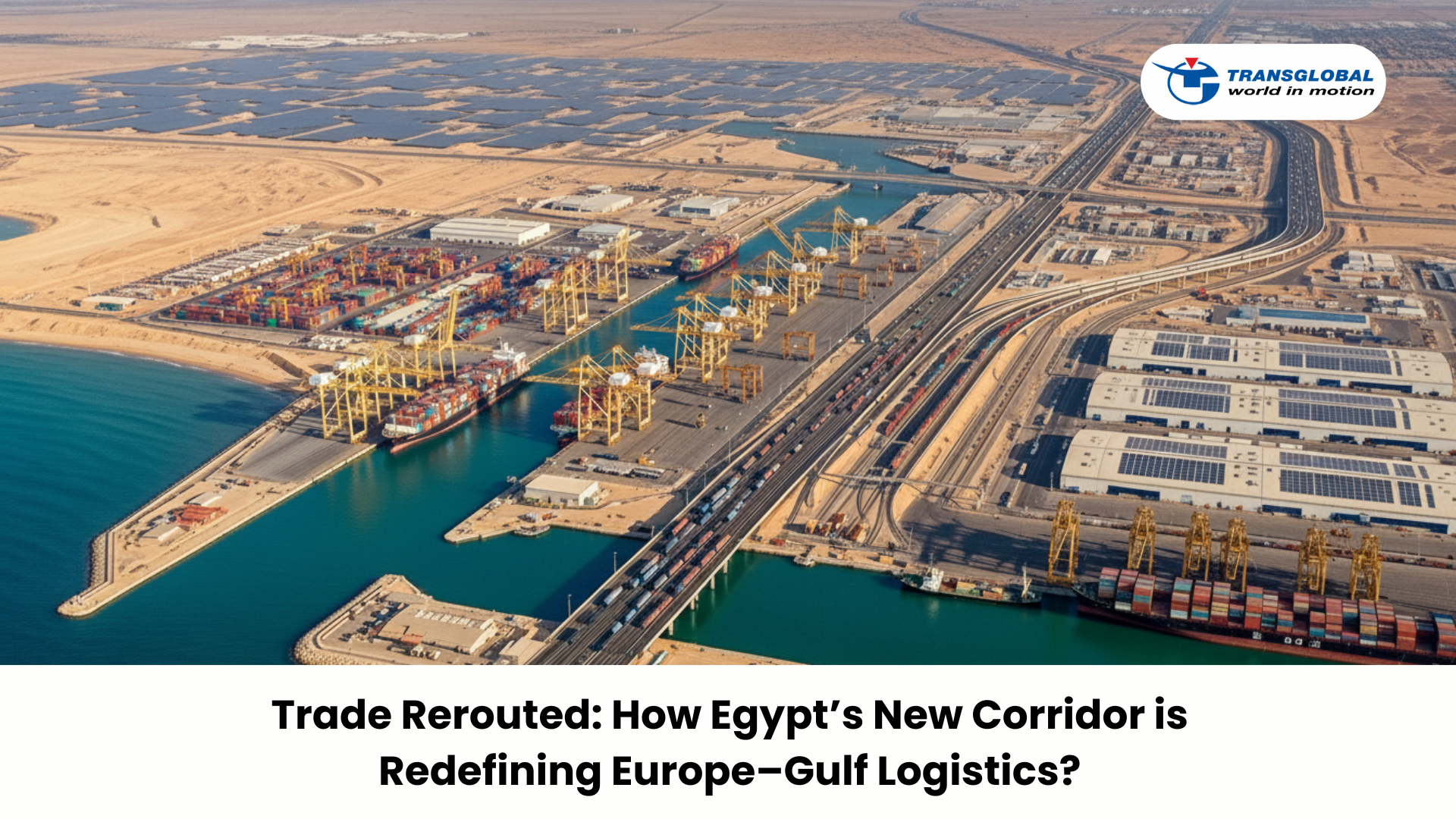
In response to these challenges, Egypt is accelerating the development of an alternative logistics corridor linking Europe to the Gulf via North Africa.
At the centre of this strategy is a Ro-Ro (Roll-on/Roll-off) shipping route connecting:
- ⚓ Damietta Port (Egypt)
- ⚓ Trieste Port (Italy)
From there, cargo is transported across Egypt to:
- ⚓ Safaga Port (Red Sea)
- 🚢 Then shipped onward to Gulf markets, including the UAE, Kuwait, Oman, Iraq, and Qatar
👉 This creates a hybrid sea–land–sea logistics bridge, bypassing high-risk maritime zones.
📦 Why this Corridor is Gaining Attention?
The new route is not just about avoiding risk, it offers several operational advantages.
- 🚛 Weekly capacity of 420 trucks between Damietta and Trieste
- ❄️ Suitable for both reefer (temperature-controlled) and dry cargo
- ⏱️ Faster transit for time-sensitive shipments
- 🔄 Reduced exposure to high-risk shipping zones
For industries dealing with perishable goods or urgent deliveries, this corridor is becoming an attractive alternative.
👉 In simple terms:
It offers reliability when traditional routes cannot.
⚠️ The Cost Pressure Driving Change
The shift toward alternative corridors is also being driven by rising cost pressures across global logistics.
- 💰 War-risk insurance premiums are increasing dramatically
- ✈️ Shift from sea to air freight, driving up logistics expenses
- ⛽ Higher fuel costs due to rerouting and delays
- 📉 Currency pressure, including Egypt’s currency weakening by around 7%
Major logistics providers are already reporting increased freight costs and supply chain disruptions.
👉 Businesses are now making decisions not just based on cost, but on risk and continuity.
🌐 Egypt’s Bigger Vision: Becoming a Logistics Hub
Beyond short-term disruption, Egypt is positioning itself for a larger role in global trade.
With its strategic location connecting:
- Europe
- Africa
- The Middle East
Egypt is aiming to become a central logistics gateway.
Key developments include:
- Strengthening Ro-Ro connections with Europe
- Leveraging the Suez Canal as a global trade artery
- Expanding multimodal logistics capabilities
- Supporting both industrial and agricultural exports
📊 Projections suggest that this corridor could increase Mediterranean container traffic by up to 35% annually through 2027.
🔄 A Structural Shift in Global Logistics
What we are seeing is not just a temporary rerouting, it is a structural shift in how supply chains operate.
Traditionally, logistics was built on:
- Fixed routes
- Predictable costs
- Stable corridors
Today, the model is changing toward:
- Flexible routing strategies
- Risk-aware planning
- Multi-corridor supply chains
👉 The focus is shifting from efficiency alone to resilience and adaptability.
🔍 What does this Mean for Your Business?
For importers, exporters, and freight forwarders, this development carries important implications.
- 📦 Traditional routes may no longer be the most reliable option
- 💰 Cost structures are becoming more dynamic and unpredictable
- 🔄 Alternative corridors must be evaluated as part of planning
- 📊 Real-time visibility and decision-making are now essential
👉 The companies that succeed will not be those waiting for stability, they will be those adapting to change early.
🔮 Looking Ahead: More Corridors, More Competition
As disruptions continue to reshape global trade, alternative routes like Egypt’s corridor will become more important.
We can expect:
- Increased investment in regional logistics hubs
- Greater competition between trade corridors
- Continued volatility in traditional shipping lanes
👉 The logistics landscape is becoming more complex, but also more opportunity-driven.
🚚 Conclusion
In today’s environment, moving cargo is no longer just about choosing the shortest route, it is about choosing the smartest and safest route.
Egypt’s emerging corridor is a clear example of how global trade is evolving in response to disruption.
Working with the best freight forwarder ensures that your supply chain is not only efficient but also flexible, resilient, and prepared for changing global conditions.
Because in modern logistics, success is not just about reaching your destination, it is about navigating the journey, no matter how the route changes.
Comments