

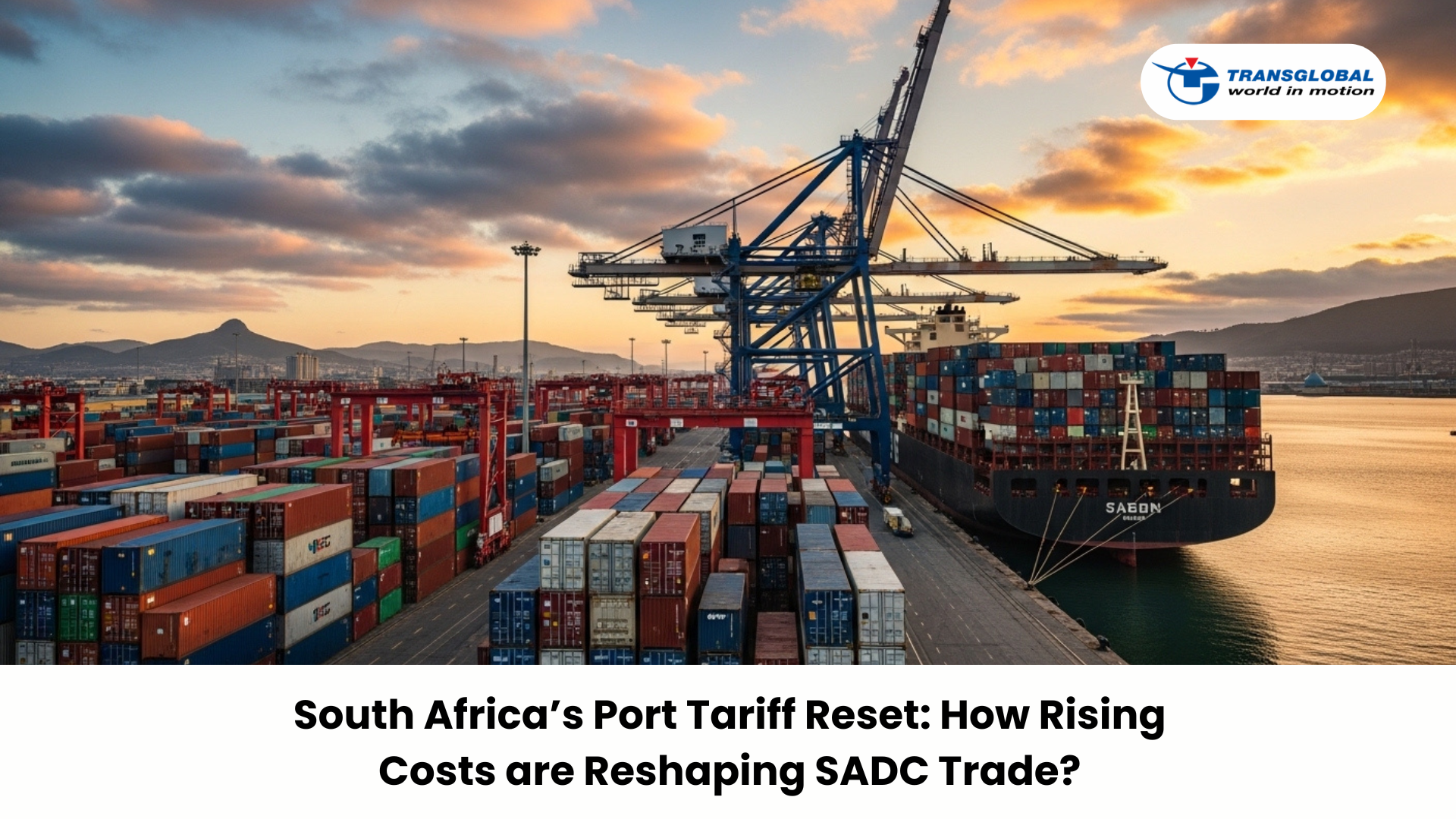
From 1 April 2026, something shifted across Southern Africa’s logistics landscape, and many businesses are only now starting to feel the impact.
At first glance, the annual tariff update by Transnet National Ports Authority (TNPA) may seem routine. But this year’s adjustment has triggered a much broader impact, setting off a chain reaction across ocean carriers, inland logistics, and ultimately, the landed cost for importers and exporters across the SADC region.
What makes this situation critical is not just the increase itself, but the speed and scale at which costs are cascading through the supply chain.
So here’s the key question every logistics operator should be asking right now: Are your current cost models still aligned with reality, or already outdated?
🌍 April 2026: A Structural Cost Shift, Not Just an Annual Adjustment
Every year, TNPA publishes a revised tariff book, approved by the Ports Regulator of South Africa. This tariff structure defines the baseline cost for vessel operations and cargo handling across the country’s ports.
However, the April 2026 revision stands out due to its broader commercial impact.
Revised cargo dues have been implemented across South Africa’s four major container ports:
- ⚓ Durban handles approximately 60% of South Africa’s container throughput
- ⚓ Cape Town
- ⚓ Gqeberha (Port Elizabeth)
- ⚓ East London
📊 Collectively, these ports handle over 5 million TEUs annually, making TNPA tariffs one of the most influential cost drivers across the SADC logistics ecosystem.
Because of this scale, even a marginal adjustment at the port level quickly translates into significant cost implications across inland supply chains.
⚠️ The Real Impact: A Multi-Layered Surcharge Cascade
What makes the April 2026 update particularly impactful is not the tariff increase alone, but the multi-layered surcharge effect triggered by carriers.
Leading shipping lines, including Maersk, have already rolled out a series of cost adjustments, which are now appearing simultaneously on shipment invoices.
These include:
- 📦 Cargo Dues Recovery Fees (FIO/FID) applied to Store Door (SD) shipments
- 📄 Revised Destination Handling Charges (DHC) for all import cargo
- ❄️ Updated Reefer Monitoring & Plug-in Fees (effective mid-April 2026)
- ⏱️ Higher Late Gate Charges for cargo missing terminal cut-offs
Unlike previous adjustments where costs were introduced gradually, this time multiple charges have been revised at once, creating an immediate spike in total logistics costs.
👉 For SADC-bound cargo, especially inland shipments routed via South African ports, these charges are directly passed through, leaving little room for cost absorption.
📈 Cost Pressure is Being Amplified by External Factors
The timing of the tariff revision has further intensified its impact.
The logistics environment is already under pressure from several external variables:
- ⛽ Fuel cost increases across Southern Africa
- 💱 Currency volatility, particularly the weakening of the South African rand
- ❄️ Increased demand and cost for temperature-controlled logistics
- 🚢 Ongoing global freight rate fluctuations
For sectors such as fresh produce exports, seafood, and pharmaceuticals, these combined pressures are creating a compounding effect on operational costs.
📊 In practical terms, many operators are now experiencing double-digit increases in cost per container, not from a single change, but from multiple overlapping adjustments.
🔍 The Hidden Risk: Cost Models that No Longer Reflect Reality
One of the most critical risks in the current environment is not the increase itself, but the gap between expected and actual costs.
Many importers, exporters, and even freight forwarders are still operating based on:
- Pre-April 2026 rate agreements
- Static pricing assumptions
- Outdated surcharge structures
This creates exposure in several areas:
- 💰 Unexpected invoice discrepancies
- 📄 Disputes with carriers and clients
- 📉 Reduced profit margins on fixed-price contracts
This risk is particularly high for Store Door shipments, where carriers manage port-related charges and pass them directly to customers without prior visibility.
👉 In simple terms: If you haven’t reviewed your pricing since April 2026, your numbers are already behind.
🧭 Immediate Actions for SADC Importers and Exporters
In this rapidly evolving cost environment, waiting is no longer an option. Businesses need to take structured, proactive steps to regain control.
The most important first step is a full cost-per-container audit.
This should include:
- 📊 Repricing all shipments against the updated TNPA tariff book
- 📄 Reviewing all carrier surcharge notifications (DHC, FIO/FID, reefer, gate fees)
- 💱 Factoring in current exchange rate movements
- ⛽ Including updated fuel and inland transport costs
Beyond this, companies should:
- 🤝 Renegotiate contracts signed before April 2026
- 📈 Build flexible pricing models that can adapt to changes
- 🔍 Increase visibility into cost components across the supply chain
This is no longer about cost optimization, it is about cost control and transparency.
🌐 A Long-Term Shift: Tariff Growth is Not Temporary
The April 2026 adjustment is part of a broader transformation within South Africa’s port infrastructure.
Through its “Reinvent for Growth” programme, Transnet is investing heavily in:
- Durban Pier 2 upgrades
- Ngqura Container Terminal expansion
- Richards Bay terminal improvements
These developments require sustained funding recovery, which means:
👉 Port tariffs are expected to continue increasing through 2027 and 2028.
For SADC operators, this signals a permanent shift in logistics economics, from stable pricing to dynamic, evolving cost structures.
🔄 The New Reality: Tariff-Aware Logistics Planning
The logistics landscape is changing. Cost planning can no longer rely on static assumptions or annual reviews.
Instead, businesses must adopt a tariff-aware and forward-looking approach.
This includes:
- 📊 Dynamic cost modelling instead of fixed rate cards
- 🤝 Long-term agreements with clear escalation clauses
- 🔍 Continuous monitoring of port and carrier updates
- 📈 Real-time visibility into shipment cost drivers
Because in today’s environment, the biggest risk is not rising costs, but anticipating them early enough.
🚚 Conclusion
South Africa’s April 2026 port tariff reset has made one thing clear, logistics costs are no longer predictable. They are layered, dynamic, and increasingly complex.
For SADC importers and exporters, staying competitive now depends on how well these costs are understood, managed, and anticipated.
Working with the best freight forwarder ensures that your shipments are not only moved efficiently but also priced accurately, planned strategically, and aligned with real-time market conditions. Because in today’s logistics environment, success is not just about moving cargo, it is about staying ahead of the cost curve before it moves against you.
Comments