

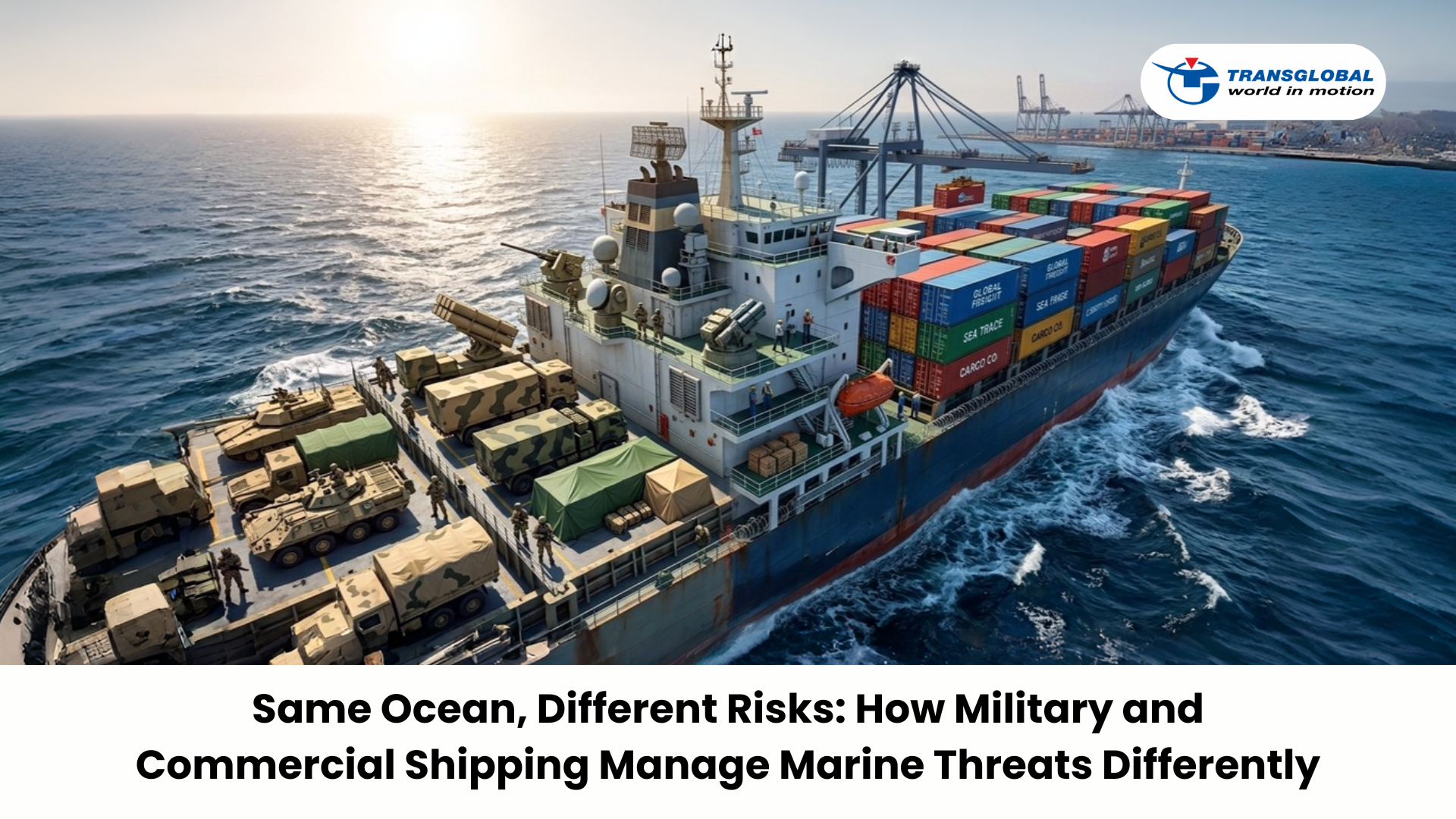
Two vessels can sail through the same waters, face the same storms, and dock at the same ports, yet the way risk is managed onboard can be completely different.
That is the reality of military and commercial shipping.
In today’s maritime environment, risk management is no longer just about avoiding delays or protecting cargo. It has become a strategic function shaped by geopolitical instability, piracy threats, hazardous cargo regulations, cyber risks, and increasing pressure on global trade corridors.
But while both military and commercial shipping operate in high-risk conditions, the way they approach risk could not be more different.
And for logistics professionals handling defence cargo, dangerous goods, project cargo, or sensitive shipments, understanding these differences is becoming increasingly important.
🌍 Why Marine Risk Management Matters More than Ever?
Global shipping has entered a period where volatility is becoming part of everyday operations.
Recent disruptions across the Red Sea, Strait of Hormuz, Black Sea, and other major trade corridors have shown how quickly maritime risk can escalate. At the same time, stricter compliance regulations, rising insurance costs, and increased cargo security concerns are forcing operators to rethink how risk is managed.
In this environment, marine logistics is no longer built purely around speed and efficiency.
👉 It is now built around resilience, visibility, and preparedness.
The challenge is that military and commercial shipping define “risk” very differently.
⚓ Military Shipping: Security Before Efficiency
For military logistics operations, the primary objective is mission success and national security.
Risk is evaluated through a highly structured framework based on:
- Real-time intelligence
- Threat assessments
- Security exposure
- Geopolitical conditions
- Operational secrecy
Cargo may include:
- Defence equipment
- Armaments
- Hazardous military materials
- Sensitive project cargo
Because of this, military shipping focuses heavily on eliminating threats rather than simply managing them.
Routes are selected not just for transit efficiency, but for security control. Vessel movements may involve restricted routing, armed protection, enhanced surveillance, and tightly controlled communication protocols.
Operational flexibility is often limited once a plan is approved because consistency and control take priority.
👉 In military logistics, predictability is considered a form of protection.
🚢 Commercial Shipping: Flexibility and Cost Control
Commercial shipping operates under a very different mindset.
Here, the focus is usually on:
- Cost efficiency
- Delivery performance
- Operational continuity
- Compliance management
- Customer expectations
Risk is evaluated based on:
- Freight rates
- Transit time
- Port congestion
- Fuel costs
- Carrier availability
- Regulatory requirements
Unlike military operations, commercial shipping relies heavily on adaptability. Routes may change quickly based on weather conditions, market rates, congestion, or geopolitical developments.
This flexibility allows operators to optimise costs and maintain cargo flow, but it also creates greater exposure to operational volatility.
👉 Commercial logistics manages risk rather than eliminating it completely.
🔒 Security Measures: Two Completely Different Worlds
One of the biggest differences between the two sectors lies in security strategy.
Military shipping operates under strict security frameworks that may include:
- Armed escorts
- Restricted access zones
- Continuous vessel monitoring
- Classified routing plans
- Multi-layered operational clearance
Commercial shipping balances security with commercial practicality.
Standard measures may include:
- GPS vessel tracking
- Marine insurance coverage
- Port security inspections
- Cargo screening procedures
- Regulatory compliance checks
However, commercial operators handling dangerous goods, explosives, or high-value cargo often need additional protection measures that begin to resemble military-level risk management.
This is especially true for specialised freight involving:
- Hazardous materials
- Defence-related cargo
- Explosives logistics
- Project cargo movements
⚠️ Compliance has become a Major Risk Factor
Another major difference lies in compliance management.
Military shipping often operates within government-controlled frameworks and may involve classified documentation, special permits, or strategic exemptions.
Commercial shipping, meanwhile, functions within transparent international regulations such as:
- IMO standards
- SOLAS regulations
- Customs requirements
- Dangerous goods protocols
The challenge is that compliance complexity in commercial logistics is growing rapidly.
For operators moving sensitive cargo, compliance failures can now lead to:
- Cargo detention
- Financial penalties
- Insurance complications
- Delays at ports
- Reputational damage
In today’s environment, compliance itself has become a critical part of marine risk management.
🌐 The Real Difference: Control vs Adaptability
At its core, the difference between military and commercial risk management comes down to one thing:
👉 Military logistics prioritises control.
👉 Commercial logistics prioritises adaptability.
Military operations reduce uncertainty through rigid planning and security structures.
Commercial operations survive uncertainty through flexibility and rapid decision-making.
Neither approach is inherently better. The right strategy depends entirely on:
- The nature of the cargo
- The level of risk exposure
- The operational objective
For businesses moving high-risk or specialised freight, finding the right balance between security and efficiency is critical.
🚚 Why this Matters for Modern Freight Forwarding?
As global trade becomes more volatile, freight forwarders are being forced to think beyond transportation alone.
Today’s logistics providers increasingly need to manage:
- Geopolitical exposure
- Security risks
- Route vulnerability
- Compliance complexity
- Insurance considerations
For sensitive cargo, risk management can no longer be reactive.
It must be built into the shipment strategy from the beginning.
That means:
- Detailed route assessment
- Regulatory alignment
- Real-time visibility
- Contingency planning
- Strong communication across stakeholders
The companies that navigate disruption successfully are often the ones that prepare for risk before cargo moves.
🚢 Conclusion: The Future of Marine Logistics is Strategic Risk Management
Military and commercial vessels may operate on the same oceans, but they navigate risk in fundamentally different ways.
One relies on security, structure, and control.
The other depends on flexibility, speed, and operational agility.
As global trade becomes more unpredictable, businesses moving dangerous goods, defence cargo, project freight, or high-value shipments need logistics strategies that combine both worlds.
Working with the best freight forwarder ensures that cargo moves with the right balance of compliance, visibility, operational efficiency, and strategic risk management.
Because in modern shipping, success is no longer just about reaching destination ports.
👉 It is about navigating uncertainty before it becomes disruption.

Comments