

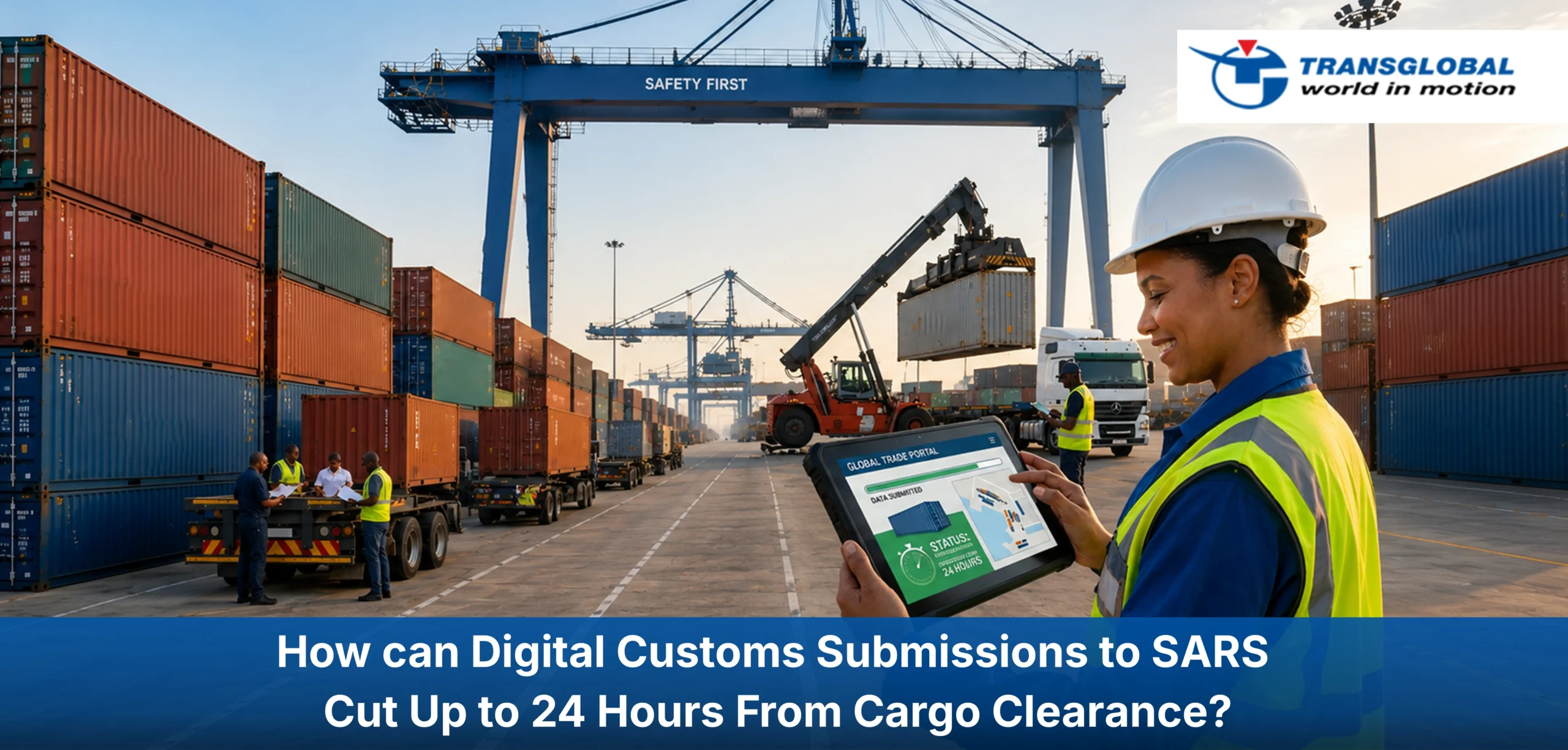
A shipment arrives on schedule. The vessel berths on time. The cargo is ready for release.
Yet the container still sits at the port.
Not because of congestion. Not because of customs inspections. But because paperwork is still moving between systems, emails, and manual approval processes.
For many importers and exporters, this remains one of the biggest hidden delays in international trade.
In a logistics environment where every hour affects inventory availability, customer commitments, and freight costs, customs efficiency has become a competitive advantage. That is why businesses across South Africa are increasingly adopting digital customs submissions and Electronic Data Interchange (EDI) integration with SARS.
The goal is simple: move information faster so cargo can move faster.
And in many cases, digital customs submissions are helping businesses reduce clearance times by up to 24 hours compared to traditional manual processes.
Why Customs Speed Matters More than Ever?
Global supply chains are operating under increasing pressure.
Businesses are dealing with tighter delivery expectations, fluctuating freight schedules, rising storage charges, and growing customer demand for faster cargo visibility. At the same time, customs authorities are processing larger volumes of trade while maintaining strict compliance requirements.
In this environment, delays in customs clearance can quickly create wider operational challenges.
A shipment delayed at customs can lead to:
- Port storage costs
- Demurrage charges
- Inventory shortages
- Production interruptions
- Missed customer deadlines
- Increased supply chain costs
For importers and exporters, customs efficiency is no longer simply about compliance. It is directly linked to business performance.
What is EDI and How does it Work with SARS?
Electronic Data Interchange, commonly known as EDI, allows logistics providers, customs brokers, freight forwarders, and importers to exchange customs information electronically with SARS.
Instead of manually submitting paperwork through multiple channels, shipment data is transmitted digitally in a standardized format.
This enables customs information to move directly between systems, reducing manual intervention and minimizing processing delays.
Through EDI integration, businesses can submit:
- Customs declarations
- Import and export entries
- Cargo manifests
- Supporting documentation
- Shipment updates
- Compliance information
The result is a faster and more streamlined customs process.
Why do Manual Customs Processes Create Delays?
Many customs delays do not happen because of compliance failures. They happen because of administrative inefficiencies.
Traditional customs processes often involve:
- Manual data entry
- Repeated document handling
- Email exchanges
- Paper-based verification
- Delayed information sharing
Every manual step introduces the possibility of errors, duplication, or processing delays.
Even a simple typo in a customs declaration can trigger additional reviews and slow down cargo release.
When businesses are moving multiple shipments daily, these small delays quickly become significant operational obstacles.
How Digital Customs Submissions Improve Clearance Speed?
Digital customs submissions eliminate many of the delays associated with traditional processing.
Because information is submitted electronically, customs authorities can begin reviewing shipment data much earlier in the process. This often allows potential issues to be identified before cargo physically arrives.
The benefits include:
- Faster customs processing
- Reduced manual errors
- Improved data accuracy
- Earlier compliance verification
- Better cargo visibility
- Quicker shipment release
For businesses importing high volumes of cargo, even a few hours saved on every shipment can create substantial operational improvements over time.
In some cases, businesses report reducing customs clearance delays by as much as 24 hours through effective EDI integration and digital processing.
Why Accuracy Matters Just as Much as Speed?
While digital systems accelerate customs processes, they also increase the importance of data quality.
Modern customs platforms use automated validation tools to compare shipment information across multiple documents. Inconsistent or incorrect declarations can be flagged instantly.
This means businesses must ensure that:
- HS codes are accurate
- Cargo descriptions are consistent
- Values are correctly declared
- Supporting documents are aligned
- Compliance requirements are met
Digital customs systems reward accuracy and transparency. Errors that might once have been corrected manually are now often identified immediately.
That is why customs expertise remains just as important as technology itself.
How EDI Supports Better Cargo Visibility?
One of the biggest advantages of digital customs integration is visibility.
Businesses no longer need to wait for manual updates or rely on multiple parties to track customs progress. EDI systems allow shipment information to move in real time between logistics stakeholders.
This helps importers and exporters gain greater insight into:
- Customs status updates
- Cargo release timelines
- Documentation requirements
- Clearance milestones
- Potential compliance issues
Better visibility enables faster decision-making and improves overall supply chain planning.
Why is Digital Customs Especially Valuable for Specialized Cargo?
The benefits of EDI become even more important when handling regulated or high-risk cargo.
Shipments involving:
- Dangerous goods
- Hazardous materials
- Explosives logistics
- Military cargo
- Defence equipment
- Armaments transport
- Specialized project cargo
often require additional compliance checks and documentation controls.
Digital customs systems help manage these requirements more efficiently by ensuring information is submitted accurately and reviewed earlier in the process.
This reduces the likelihood of costly delays caused by missing permits, incorrect declarations, or incomplete supporting documentation.
How Digital Customs Supports Supply Chain Resilience?
Supply chain resilience is no longer just about transportation capacity. It is increasingly about information flow.
Businesses that can exchange customs information quickly and accurately are better positioned to respond to disruptions, changing regulations, and customer demands.
Digital customs submissions help create more resilient operations by:
- Reducing administrative bottlenecks
- Improving customs predictability
- Enhancing cargo visibility
- Supporting faster decision-making
- Lowering operational risk
In a competitive logistics environment, these advantages create measurable business value.
Transglobal’s Role Goes Beyond Moving Cargo
At Transglobal, customs management is viewed as a critical part of overall supply chain performance.
Whether supporting sea freight, air freight, or road freight operations, the focus is on ensuring cargo moves efficiently through customs while maintaining full compliance with SARS requirements.
The team works proactively to:
- Manage electronic customs submissions
- Coordinate EDI-based processes
- Verify declaration accuracy
- Align supporting documentation
- Reduce customs delays
- Improve cargo visibility
For specialized cargo such as dangerous goods, hazardous materials, explosives, military logistics, defence equipment, and armaments transport, this compliance-driven approach becomes even more important.
By combining customs expertise with digital processes, Transglobal helps businesses move cargo faster while reducing operational risk.
Why Businesses should Embrace Digital Customs Today?
The future of customs clearance is digital.
As customs authorities continue investing in automation and electronic processing, businesses that rely on manual systems will increasingly face disadvantages in speed, accuracy, and operational efficiency.
Digital customs submissions are no longer simply a technology upgrade. They are becoming a key component of modern supply chain management.
Businesses that embrace digital customs processes today are better positioned to improve clearance times, reduce costs, and maintain stronger control over their cargo movements.
Conclusion: Faster Information Means Faster Cargo Movement
In modern logistics, customs delays are often information delays.
The faster accurate data reaches customs authorities, the faster cargo can move through the supply chain.
Digital customs submissions and EDI integration with SARS are helping businesses reduce processing times, improve visibility, and create more efficient logistics operations.
For importers and exporters operating in competitive markets, these improvements can translate directly into better supply chain performance.
If your business wants to improve customs efficiency, reduce clearance delays, and strengthen supply chain visibility, partner with a leading freight forwarder that combines customs expertise with modern digital processes. Choose a logistics team that delivers compliant, efficient, and technology-driven freight solutions across sea, air, and road transport.
Frequently Asked Questions
What is EDI in customs clearance?
EDI (Electronic Data Interchange) allows customs declarations and shipment information to be exchanged electronically between businesses and SARS.
How does digital customs submission reduce clearance time?
It eliminates manual paperwork, improves data accuracy, and allows customs authorities to review shipment information faster.
Can EDI be used for dangerous goods and specialized cargo?
Yes. EDI supports customs processing for dangerous goods, hazardous materials, explosives, and other regulated cargo while helping improve compliance and visibility.


Comments