

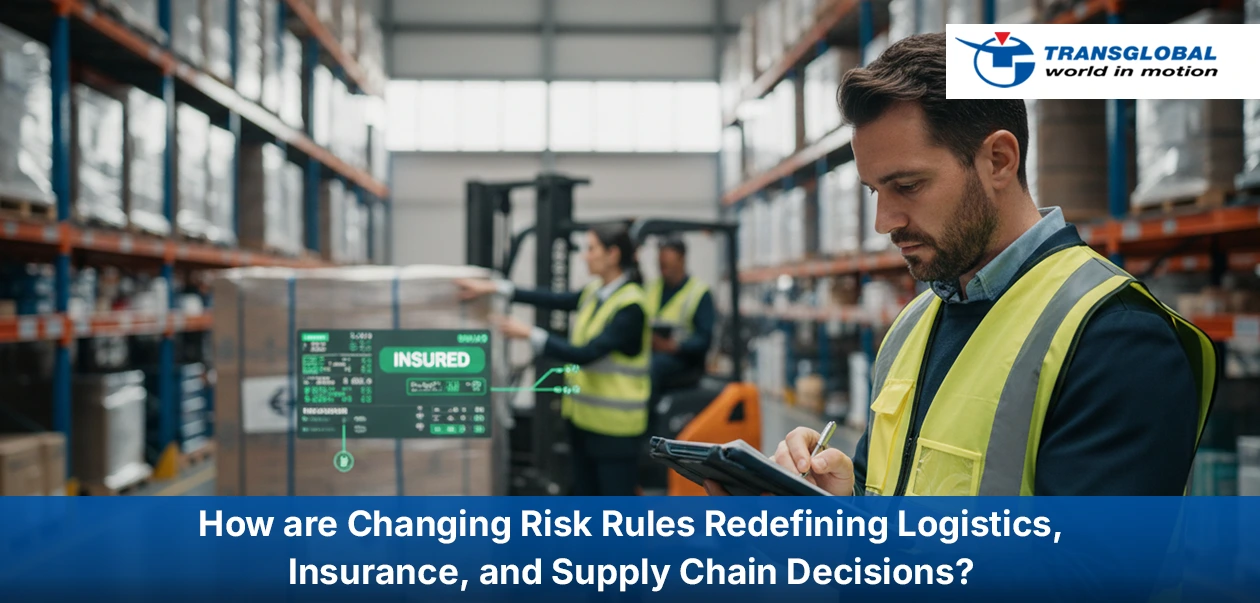
A quiet shift is happening, and most supply chains haven’t caught up yet.
When insurers begin declining personal travel cover to certain regions unless pre-approved, it signals something deeper. Risk is no longer theoretical. It is being recalculated in real time.
Now consider this: if human movement is being restricted based on risk exposure, what does that mean for cargo moving through the same regions?
Yet across global trade lanes, shipments continue to move through high-risk corridors with limited scrutiny of the insurance frameworks behind them.
This gap between movement and risk awareness is where the real problem begins.
The New Reality: Risk is No Longer Static
For years, logistics planning focused on cost, transit time, and efficiency. Risk was considered, but often as a secondary factor.
That model is no longer sufficient.
Today’s supply chains are influenced by:
- Geopolitical instability in key trade corridors
- Increasing insurance restrictions and exclusions
- Sudden route disruptions due to conflict or security threats
- Port accessibility issues and emergency rerouting
- Rising costs linked to uncertainty and volatility
Risk is no longer a background factor. It is a direct input into logistics decision-making.
And more importantly, it is changing faster than traditional planning models can keep up.
The Hidden Exposure in Cargo Insurance
Many businesses assume that having marine cargo insurance means they are fully protected.
In stable environments, this may appear true.
But in high-risk or conflict-affected regions, the reality is very different.
Standard marine cargo policies often exclude or limit coverage for:
- War and conflict-related incidents
- Political instability or civil unrest
- Route deviations due to security risks
- Government actions such as seizure or detention
- Certain high-risk zones, unless specifically endorsed
This means cargo can be moving through vulnerable regions without adequate protection, simply because the policy was never reviewed in detail.
Insurance becomes a problem only when a claim is needed. By then, it is often too late.
The Questions Businesses Should Be Asking
In today’s environment, risk management starts with asking the right questions.
Before moving cargo through sensitive regions, businesses should evaluate:
- Does your insurance cover high-risk or war-affected areas?
- What happens if the discharge port becomes inaccessible?
- Are you prepared for General Average contributions?
- Where does liability sit if cargo is delayed or stranded?
- What is your exposure to demurrage, detention, and storage costs?
These are not edge-case scenarios anymore. They are real possibilities in current trade conditions.
Ignoring them can lead to significant financial and operational impact.
Understanding General Average and Financial Exposure
One of the most misunderstood aspects of shipping risk is General Average.
In simple terms, if a vessel faces a serious threat and sacrifices part of the cargo or incurs extraordinary costs to save the voyage, all cargo owners share the loss.
This means even if your cargo is not directly damaged, you may still be required to contribute financially before your goods are released.
At the same time, disruptions can lead to additional costs such as:
- Demurrage charges due to the delayed container return
- Detention fees for extended equipment use
- Storage costs at ports or terminals
- Rerouting expenses and additional freight charges
These costs can escalate quickly, especially in volatile regions.
Understanding these exposures is essential for proper planning.
Why Logistics Must Now Be Risk-Driven?
Logistics is no longer just about moving cargo efficiently. It is about moving cargo intelligently.
This means evaluating every shipment not just on:
- Cost
- Transit time
but also on:
- Route risk
- Insurance coverage
- Regulatory exposure
- Operational flexibility
A cheaper route may not be the best route if it carries a higher risk.
A faster transit may not matter if the cargo cannot be discharged safely.
This shift requires a more strategic approach to logistics planning.
The Role of Compliance, Certifications, and Expertise
Handling cargo in today’s environment requires strict adherence to international standards and regulatory frameworks.
Professional logistics providers operate under:
- IMDG regulations for sea transport of dangerous goods
- IATA standards for air freight compliance
- Customs and trade compliance laws across multiple regions
- Sanctions screening protocols (UN, EU, OFAC, HMT)
- Security and documentation requirements for high-risk cargo
These frameworks ensure that cargo is not only moved efficiently but also legally and safely.
Without proper compliance, shipments can face delays, penalties, or even seizure.
Expertise in these areas is critical, especially when dealing with sensitive or high-value cargo.
Moving from Reactive to Proactive Risk Management
The biggest change in logistics today is the move from reactive to proactive thinking.
Instead of responding to disruptions after they occur, businesses must:
- Assess trade routes beyond cost and speed
- Review insurance coverage in detail
- Plan for multiple scenarios, including worst-case outcomes
- Build flexibility into supply chain strategies
- Work closely with logistics partners to manage risk
Preparation is no longer optional. It is a competitive advantage.
Transglobal Cargo: Navigating Risk with Clarity and Control
At Transglobal Cargo, we approach logistics with a clear understanding that risk is now central to every supply chain decision.
Our role goes beyond execution. We support clients in navigating complex and changing environments with confidence.
We provide:
- Strategic route and risk assessment
- Guidance on insurance and contractual exposure
- Compliance-driven logistics planning
- Real-time visibility and proactive communication
- Expertise in handling high-risk and specialized cargo
Operating across the Middle East, Europe, and Africa, we ensure that every shipment is aligned with regulatory requirements and risk considerations.
We do not just move cargo, we help our clients move with certainty.
Conclusion
The rules of risk in logistics have changed.
Insurance is no longer a formality. Routes are no longer predictable. And disruptions are no longer rare.
In this environment, success depends on understanding the full risk landscape, not just the physical movement of goods.
Working with an expert freight forwarder ensures that your supply chain is not only efficient but also protected, compliant, and prepared for uncertainty.
If you are planning shipments through high-risk or sensitive regions, contact us today. Our team will help you assess, plan, and move your cargo with confidence.
Frequently Asked Questions
Does standard cargo insurance cover high-risk regions?
Not always. Many policies exclude war or high-risk zones unless additional coverage is arranged.
What is the General Average in shipping?
It is a principle where all cargo owners share losses if part of the cargo is sacrificed to save the vessel.
How can businesses reduce logistics risk?
By reviewing insurance, choosing safer routes, planning ahead, and working with experienced logistics partners.
Comments