

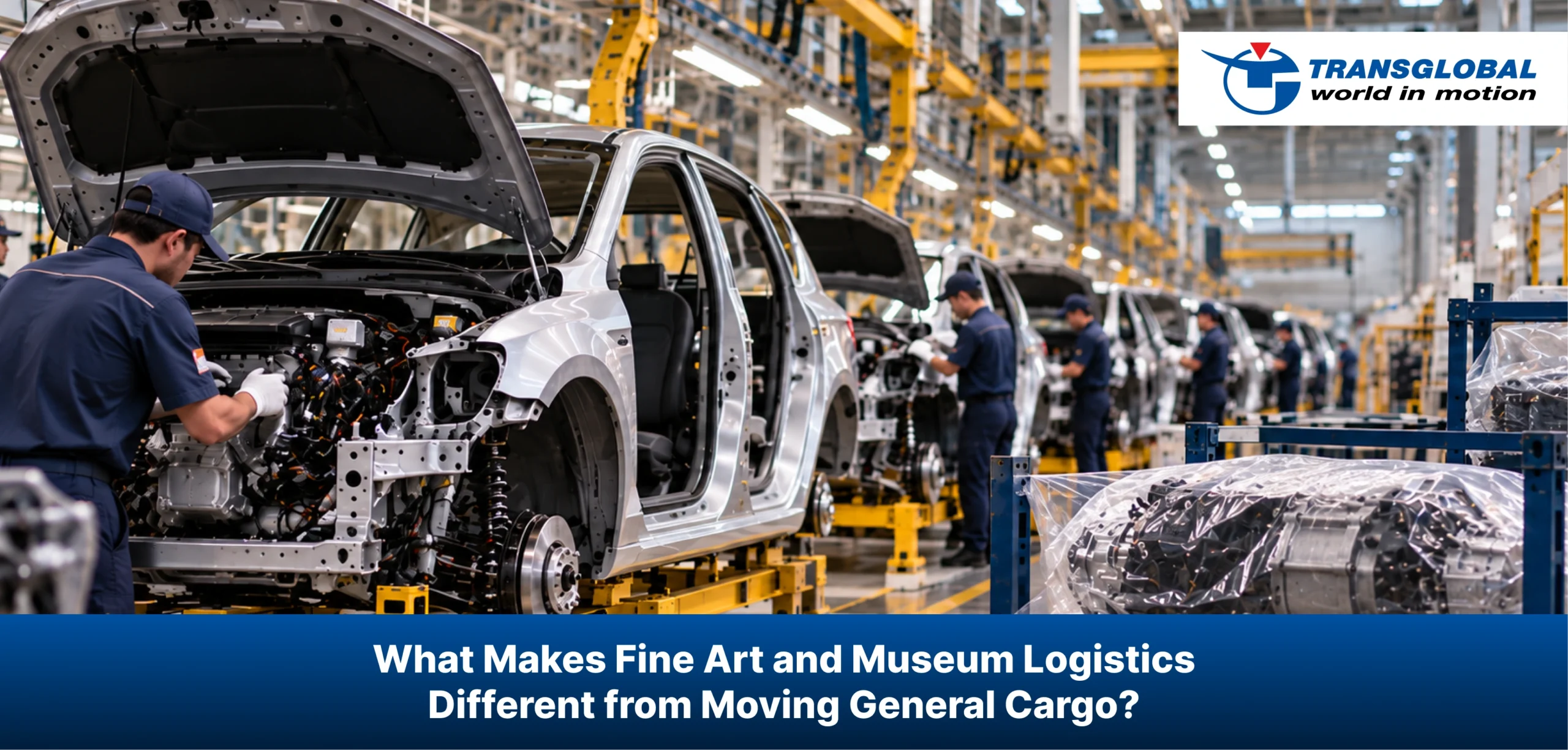
A vehicle plant does not stop only because a large part is missing.
Sometimes, the part that creates the pressure is small.
It may be a sensor, chip, wiring harness, brake component, seal, control module, lighting part, fastener, trim item, battery component, or safety-critical assembly.
The part may fit in one box.
But if it is needed at the wrong moment, it can affect an entire production schedule.
That is what makes the automotive supply chain different from many other industries.
Vehicle manufacturing depends on timing, sequence, part availability, and line-side accuracy. A component does not only need to arrive. It needs to arrive before the exact point where the vehicle build depends on it.
When a critical component arrives late, the effect moves quickly.
The line may slow down. Vehicles may be built out of sequence. Incomplete units may be parked aside. Labour plans may change. Finished vehicle dispatch may shift. Customer delivery dates may come under pressure.
That is why automotive logistics is not only about transporting parts.
It is about protecting production flow.
Why can a Missing Part Break the Build Sequence?
Vehicle production works around planned build sequences.
The plant knows which vehicle is being built, which parts are needed, where they must be delivered, and when they must reach the line.
A critical component is different from ordinary stock because production cannot easily continue without it.
If the part is missing, the plant may need to change the build order, hold certain vehicles, or move incomplete units away from the line.
This can create what many automotive teams recognise immediately: disruption that is bigger than the part itself.
A missing component can affect:
- the next vehicle in sequence,
- the line-side picking plan,
- the assembly station,
- quality release,
- yard space,
- rework planning,
- dealer allocation, and
- customer delivery timing.
This is why automotive supply chain planning depends on more than stock quantity.
It depends on the part being available at the exact production point where it is needed.
A delayed component can turn a planned build into a recovery exercise.
How Late Parts Create Hidden Costs Inside the Plant?
A late component does not only create a transport problem.
It creates cost inside the operation.
If vehicles cannot be completed in sequence, the plant may need to hold them in a yard, bring them back for rework, reassign labour, revise production reports, and manage additional quality checks.
Those costs are not always visible in the freight invoice.
The shipment may only show as a small urgent consignment, but the operational impact can be much larger.
A delayed automotive part can create cost through:
- line interruption,
- overtime,
- premium freight,
- rework handling,
- extra yard movement,
- missed dispatch slots,
- supplier escalation, and
- delayed vehicle release.
This is why an urgent part is not judged only by its freight cost.
It is judged by the production risk it helps reduce.
For urgent inbound components, air freight can be useful when the part is small, critical, and needed quickly to protect production continuity.
But premium transport only works if the cargo is ready, correctly documented, accepted by the carrier, and moved through the full route without avoidable delay.
Why Supplier Readiness Decides the Recovery Plan?
When a critical part is late, the first question is not always which transport mode to use.
The first question is what the supplier can actually release.
Is the full quantity ready? Is only a partial quantity available? Is the part still in production? Is it packed? Are labels and part numbers correct? Are documents ready? Can the cargo be split between urgent and normal movement?
These answers decide the recovery plan.
An automotive supplier may be able to release enough parts to keep production running for one shift, one day, or one build batch while the balance follows later.
In some cases, splitting the shipment can protect the line better than waiting for the full order.
For cross-border or international automotive parts, imports and exports planning helps show why the transport mode, documents, clearance process, and delivery point must be aligned before the cargo moves.
Supplier readiness also affects communication inside the plant.
Production teams need to know whether to slow the line, resequence units, use buffer stock, or prepare for a stop.
A clear supplier update can be as important as the transport booking.
How Logistics Teams Choose the Fastest Practical Recovery Route?
When production is at risk, the fastest-looking option is not always the best recovery route.
The logistics team must compare the full movement.
That includes supplier pickup time, packing status, airport or border access, carrier cut-off, customs clearance, onward delivery, and plant receiving time.
Air freight may be the right choice for smaller urgent parts moving across long distances.
Road freight may be better when the supplier is regional, when direct delivery to the plant is possible, or when airport handling would add unnecessary time.
For regional automotive parts movement, cross-border freight can support recovery planning when suppliers, hubs, or plants are connected across Southern Africa.
The best route is the one that brings usable parts to the plant soonest.
Not the route that only looks fastest on one section of the journey.
Recovery planning should consider:
- part urgency,
- available quantity,
- production cut-off time,
- supplier location,
- carrier acceptance,
- customs risk,
- delivery access, and
- plant receiving readiness.
In automotive logistics, speed matters.
But speed only creates value when the part reaches the line in time to protect production.
Why Documents Can Decide Whether the Part Reaches the Line?
Urgent automotive parts still need clean documents.
A shipment can move quickly from the supplier and still lose time at the airport, border, or clearance point if the paperwork is weak.
The document file should match the part exactly.
Part description, HS code, value, origin, quantity, package count, consignee details, and shipment reference should be clear before dispatch.
This matters even more for electronic components, safety-related parts, warranty parts, production samples, testing parts, or controlled items.
Accurate shipping documentation helps reduce avoidable questions when the cargo reaches a carrier, border, airport, or clearance point.
For imported automotive parts, customs brokerage also becomes important because release timing can decide whether the recovery plan works.
A late part creates pressure.
A late part with unclear documents creates a bigger problem.
That is why documentation should be reviewed before the urgent shipment leaves the supplier, not after it reaches destination.
Why Every Late Component Should Improve the Next Response?
Once the part arrives and production recovers, the shipment should not be forgotten.
A late component can reveal weak points in the automotive supply chain.
The same supplier may be creating repeated shortages. The same route may be unreliable. The same part may have too little buffer stock. The same document issue may delay clearance more than once.
This information should feed back into the next plan.
Automotive teams can review:
- which component caused the risk,
- how early the shortage was visible,
- how quickly the supplier responded,
- which route worked,
- where time was lost,
- what the plant had to change, and
- what should be pre-planned next time.
A mature recovery process does not only solve today’s shortage.
It improves the response to the next one.
That may include pre-approved carriers, emergency supplier contacts, standard document templates, agreed escalation rules, preferred routes, or safety stock changes for production-critical parts.
In automotive logistics, the best urgent shipment is not only the one that arrives fast.
It is the one that teaches the supply chain how to react better next time.
Conclusion: A Late Component can Change the Whole Production Plan
When a critical component arrives late, the impact can move far beyond one missing part.
It can affect build sequence, line-side stock, labour planning, rework, quality release, finished vehicle dispatch, dealer commitments, and customer delivery.
That is why automotive supply chain teams treat critical parts differently.
The part must be tracked from supplier readiness through collection, transport, documents, customs clearance, plant receiving, and line-side availability.
Fast transport can help, but it is only one part of the response.
The real value comes from knowing what the part protects, how soon the plant needs it, what quantity is available, which route can work, and what must be done to prevent the same shortage from becoming a repeat disruption.
A late component is a logistics issue, but it is also a production issue.
Managing urgent automotive parts or production-critical cargo? Contact us to review supplier readiness, transport options, documents, customs requirements, and plant delivery timing.
Move automotive cargo with leading freight forwarders who understand automotive supply chain pressure, production delays, urgent parts movement, and manufacturing logistics.
Frequently Asked Questions
What happens when a critical automotive part arrives late?
A late part can affect build sequence, assembly timing, line-side stock, rework planning, finished vehicle release, and customer delivery commitments.
Why can a small component delay vehicle production?
A small part can delay production if it is needed at a specific assembly point and the vehicle cannot be completed, tested, or released without it.
How can logistics reduce automotive supply disruption?
Logistics can reduce disruption by confirming supplier readiness, choosing the fastest practical route, preparing documents early, clearing cargo quickly, and delivering the part to the plant on time.



Comments