

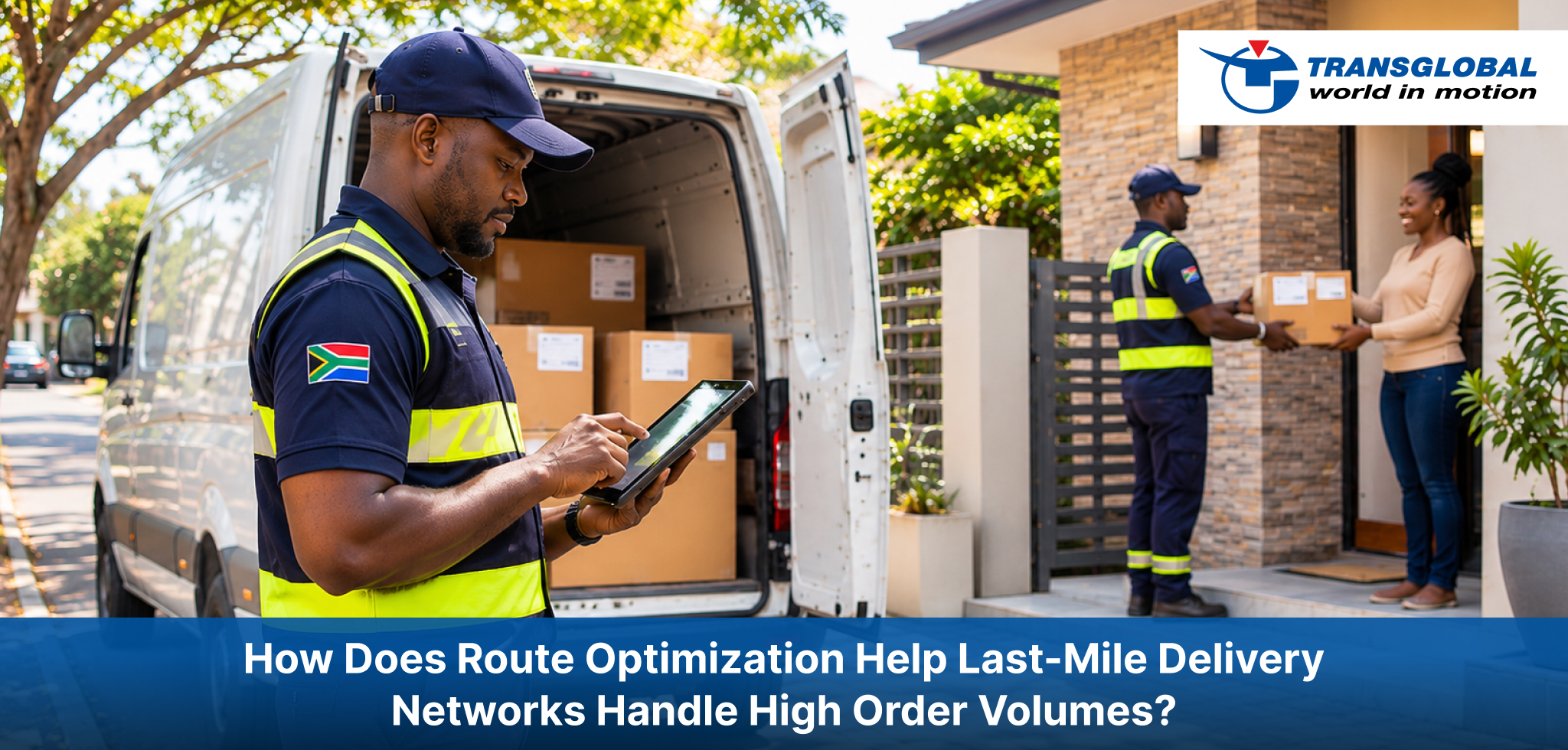
Two delivery vehicles leave a distribution centre in Johannesburg on a Monday morning. Each carries 60 customer orders, covers a similar distance and operates within the same working hours.
By the afternoon, one driver has completed almost every delivery, while the other still has several stops remaining.
The difference lies in how those orders are distributed.
The first driver serves customers concentrated within a few neighbouring suburbs. The second travels between residential areas, commercial premises and industrial parks, where individual deliveries take considerably longer.
Although both vehicles carry the same number of orders, the workload associated with each route is different.
This is an important consideration in route optimization, particularly for businesses experiencing growth in e-commerce orders, retail distribution and scheduled customer deliveries.
Increasing the number of orders assigned to a vehicle does not necessarily increase its delivery capacity. Businesses must first understand how much work a route can realistically accommodate.
Why Does Delivery Density Matter More Than the Number of Orders?
A route containing 80 orders is not necessarily more demanding than one containing 50.
The geographical distribution of those orders makes a considerable difference.
For example, a driver delivering 80 parcels to customers within neighbouring suburbs may complete more orders per hour than a driver serving 50 customers spread across Gauteng.
The distance between consecutive stops determines how much of the working day is spent travelling rather than completing deliveries.
Delivery density becomes particularly valuable when several orders are destined for the same building, shopping centre or office complex. Multiple consignments can sometimes be delivered during a single vehicle stop.
However, increasing order volumes across a wider geographical area may require additional routes, even when the existing vehicles have sufficient loading space.
Businesses experiencing growth should examine where their orders originate geographically rather than relying solely on total daily order volumes.
Effective last-mile delivery arrangements consider the distribution of receiving locations alongside the characteristics of the consignments.
Grouping nearby destinations into manageable delivery zones allows businesses to make better use of available transport capacity.
How Much Time Does Each Delivery Actually Require?
Delivery route planning often begins with estimating travel time between destinations. However, a vehicle spends a considerable portion of its working day stationary while deliveries are completed.
At a residential property, handing over a parcel may take three minutes. At a commercial building, the driver may need to register at reception, locate the receiving department and obtain a signature before leaving.
A retail outlet receiving several cartons could require additional unloading and quantity verification.
These activities form what transport planners refer to as stop service time.
Consider a simplified route with eight available operating hours, after allowing for loading and required breaks.
If driving takes three hours, five hours remain for completing deliveries.
At an average service time of five minutes per stop, the theoretical capacity is 60 stops. If that average increases to eight minutes, capacity falls to approximately 37 stops.
The vehicle, distance and available working hours remain unchanged.
This illustrates why delivery capacity should be calculated using actual operating conditions instead of standard order targets.
As discussed in Transglobal’s insights on last-mile delivery challenges, receiving conditions can vary considerably across South African delivery environments.
Historical arrival and departure records can help planners establish more realistic service-time estimates for different customer locations.
How Does Vehicle Loading Influence Multi-Stop Delivery Performance?
A driver reaches the first customer on a planned route, only to discover that the required cartons are positioned behind goods intended for the final deliveries.
Retrieving the order requires moving several other packages before unloading can begin.
Repeating this process throughout the day consumes time that was never included in the original route calculation.
For multi-stop delivery operations, the warehouse loading sequence should reflect the planned delivery sequence wherever practical and safe.
Goods intended for earlier stops should be readily accessible, while later deliveries can occupy deeper sections of the vehicle.
Weight distribution, load stability and cargo protection must still take priority when determining the final loading arrangement.
Vehicle capacity also needs to be assessed according to the physical characteristics of the orders.
A vehicle may accommodate 100 small parcels but reach its volumetric limit with 30 bulky consignments.
As order profiles change, the same vehicle may require a different delivery allocation.
Well-coordinated warehousing services can support route-specific picking, sorting and dispatch preparation.
Aligning warehouse handling activities with the delivery schedule reduces unnecessary cargo movement during the journey and helps drivers work through their assigned stops more efficiently.
Why Should Delivery Routes Be Planned Around Customer Receiving Hours?
The geographically shortest delivery sequence may not be the most workable one.
For example, a retailer in Sandton accepts deliveries before 11 am, while a nearby commercial customer receives goods only after 2 pm.
Although both destinations are located within the same area, visiting them consecutively may involve considerable waiting time.
A planner may instead schedule other deliveries between these two appointments.
This is particularly relevant for businesses serving a combination of residential customers, retail stores, healthcare facilities and industrial premises.
Each receiving location operates according to its own schedule.
When order volumes increase, fixed delivery appointments can limit the number of stops available within a particular route, even when those locations are geographically close.
Businesses should distinguish between customers requiring fixed appointments and those offering flexible receiving hours.
Flexible deliveries can fill the available periods between scheduled stops, allowing the route to accommodate additional work without compromising existing commitments.
The relationship between distribution locations, stock availability and delivery scheduling is also explored in Transglobal’s article on smart warehousing.
For last-mile routing, the objective is to create a sequence that matches the availability of both the transport provider and the receiving customer.
How Can Businesses Determine When a Delivery Route has Reached Its Capacity?
A route may appear to be performing well because most orders are delivered by the end of each day.
However, the way those deliveries are completed can reveal whether the route has room for further growth.
Drivers may regularly return later than planned, require additional working hours or carry undelivered consignments back to the depot.
Businesses can assess route capacity by comparing planned operating hours with actual route duration, completed stops, outstanding deliveries and transport costs.
Consider a route originally designed for 60 daily orders.
Over several weeks, demand increases to 75 orders. The vehicle can physically carry the additional parcels, but completing the route now requires an extra hour each day.
Before assigning another 15 orders, the planner should determine whether those deliveries can be absorbed by adjusting delivery boundaries, reallocating neighbouring stops or introducing another dispatch.
A smaller additional route may offer better delivery efficiency than continually extending an existing one.
Businesses should also account for normal variations in traffic, unloading and customer handover times rather than allocating every available minute.
Understanding where these capacity limits occur allows delivery networks to expand in line with demand while maintaining realistic service commitments.
Conclusion: Route Optimization Must Reflect Actual Delivery Capacity
As businesses receive more orders, the ability to distribute them efficiently becomes increasingly important.
A route that performs well at 40 deliveries per day may require a different operating arrangement when demand reaches 80.
Before allocating additional orders, businesses should establish how much capacity exists within their current network and whether geographical coverage, receiving hours or vehicle utilisation needs to change.
These decisions help determine whether growth can be accommodated through existing transport resources or requires additional distribution capacity.
Planning to expand your distribution network or accommodate increasing customer order volumes? Contact us to discuss your delivery locations, order profiles and distribution requirements.
Strengthen your distribution network with leading freight forwarders who understand the connection between warehousing, transport coordination and final-mile delivery.
Frequently Asked Questions
What is route optimization in last-mile delivery?
Route optimization is the process of allocating and sequencing deliveries based on factors such as distance, available operating time, vehicle capacity and customer receiving requirements.
What is the difference between delivery orders and delivery stops?
An order represents an individual customer consignment, while a stop represents a location visited by the delivery vehicle. Several orders may be completed at one stop.
Should the shortest delivery route always be selected?
No. A slightly longer route may be more efficient if it accommodates customer receiving hours and reduces unnecessary waiting time.

Comments