

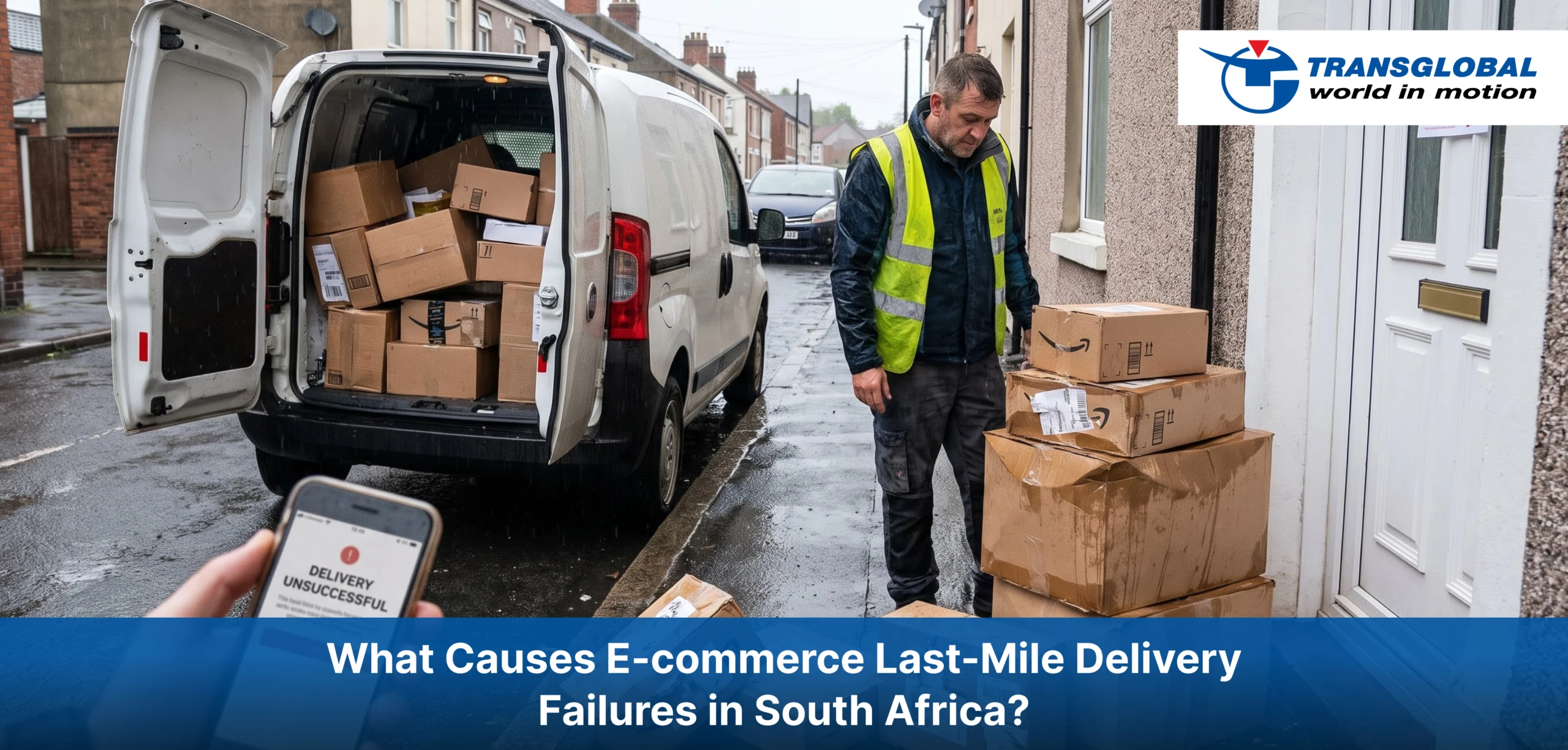
An e-commerce order can move perfectly through the first stages.
The customer places the order. Stock is available. The parcel is picked, packed, labelled, and released for dispatch. The delivery update shows that the order is on its way.
Then the final stage creates the problem.
The driver cannot find the address. The customer is unavailable. The delivery area has access restrictions. The parcel is delayed at a local hub. The delivery attempt fails, and the order moves into exception handling.
For the customer, it feels like the whole order has failed.
That is why last-mile delivery is one of the most important parts of e-commerce logistics in South Africa.
The final mile may be the shortest physical distance in the delivery journey, but it carries the highest customer visibility. A failed delivery can affect customer trust, repeat orders, service ratings, and operational cost.
Last-mile delivery failures are rarely caused by one issue alone. They often happen when fulfilment, address quality, route planning, customer communication, delivery capacity, and handover control do not work together.
Why Address Quality Creates Last-Mile Delivery Problems?
Many failed deliveries begin before the driver reaches the delivery area.
The address may be incomplete, incorrectly typed, outdated, or difficult to locate. In some cases, the delivery point may be inside a gated estate, business park, informal settlement, rural area, apartment block, campus, mine site, or restricted-access location.
South Africa has a wide mix of delivery environments.
A delivery address in central Johannesburg, a township area, a coastal suburb, a remote farm, or an industrial zone will not carry the same access requirements.
If the address does not include the right unit number, gate code, contact number, landmark, receiving instruction, or delivery window, the driver may not be able to complete the handover.
This is where e-commerce delivery needs stronger data before dispatch.
The order should not only show where the parcel is going. It should help the delivery team understand how the receiver can actually be reached.
For businesses trying to improve last-mile delivery, address accuracy is one of the first areas to control because it affects route planning, delivery success, and customer communication.
When address details are weak, the delivery team starts the final mile with unnecessary risk.
How Fulfilment Issues Lead to Failed Delivery?
Last-mile delivery does not start when the driver leaves.
It starts in the fulfillment process.
If the wrong product is picked, the parcel is packed poorly, the label is unclear, or the order is released late, the final delivery team inherits the problem.
A parcel may reach the driver, but the delivery can still fail if the package is damaged, the label is unreadable, the contact number is missing, or the customer receives the wrong item.
Good order fulfilment supports successful final-mile movement.
Warehouse teams should confirm product details, order reference, package condition, delivery label, customer information, courier handover, and dispatch timing before the parcel leaves the facility.
For e-commerce businesses, warehouse support helps connect stock control, picking, packing, dispatch readiness, and delivery handover.
This becomes even more important during high-volume periods.
Sales campaigns, month-end promotions, festive demand, product launches, and seasonal peaks can create pressure in the warehouse. When fulfilment accuracy drops, delivery exceptions increase.
A last-mile failure may appear at the customer’s door, but the cause may have started much earlier inside the warehouse.
Why Route Planning and Delivery Capacity Matter?
Delivery failures also happen when route planning does not match real operating conditions.
A route may look efficient on a screen, but the driver still has to manage traffic, parking, roadworks, security checks, customer availability, distance between stops, parcel size, and delivery priority.
In South Africa, last-mile logistics can be affected by urban congestion, long travel distances, access-controlled areas, rural delivery routes, weather disruption, and local operating conditions.
If too many deliveries are assigned to one route, some parcels may not be attempted within the promised window.
If the delivery zone is too wide, drivers may spend more time travelling than delivering.
If the vehicle is not suitable for the route or parcel type, handling can become slower.
For local and regional e-commerce movement, road freight planning helps connect delivery routes, vehicle suitability, timing, access requirements, and proof of delivery.
The delivery plan should match the order volume and the destination profile.
Same-day, next-day, scheduled, business-to-business, and remote deliveries all need different planning.
When route planning is weak, the final mile becomes reactive instead of controlled.
How Poor Communication Creates Delivery Exceptions?
Customers usually judge delivery by what they can see.
If they do not know when the parcel will arrive, who is delivering it, or what to do when they are unavailable, the risk of failed delivery increases.
A parcel may be out for delivery, but the customer may be at work, away from home, unable to answer the phone, or unaware that a signature is required.
Clear communication can reduce delivery exceptions.
Customers should receive useful updates at the right time. These may include dispatch confirmation, out-for-delivery alerts, estimated delivery windows, driver contact options, failed delivery reasons, and reattempt instructions.
For businesses managing e-commerce orders, smart warehousing can support better coordination between stock availability, dispatch timing, delivery visibility, and customer updates.
Communication also helps internal teams.
Customer service should know when a delivery has failed, why it failed, and what the next action should be. The delivery team should know whether to reattempt, redirect, hold, or return the parcel.
A delivery exception becomes harder to manage when no one has the right information at the right time.
Why Failed Delivery Needs a Clear Recovery Process?
Even with good planning, some deliveries will fail.
The customer may not be available. The address may be wrong. Access may be denied. The parcel may be refused. Payment or identification may be missing. The receiver may request another delivery date.
The difference lies in how the business responds.
A failed delivery should not disappear into uncertainty.
The reason should be recorded. The customer should be updated. The parcel should be moved into the correct next step.
This may include reattempting delivery, contacting the customer, correcting the address, redirecting to a pickup point, holding at a depot, or returning the parcel to the seller.
For wider e-commerce logistics South Africa requirements, freight forwarding support can help connect inbound cargo, storage, fulfilment, delivery, exception handling, and returns movement.
Failed delivery management is part of last-mile logistics.
It protects the customer experience after the first attempt does not go as planned.
Without a clear recovery process, one failed attempt can turn into repeat calls, extra transport cost, delayed refunds, stock confusion, and poor customer reviews.
Conclusion: Last-Mile Delivery Failures Start Before the Final Doorstep
E-commerce last-mile delivery failures in South Africa are usually caused by several connected issues.
Incomplete addresses, weak fulfilment checks, poor route planning, limited delivery capacity, unclear customer communication, access restrictions, and weak exception handling can all affect the final delivery result.
The failure may happen at the customer’s doorstep, but the cause often starts earlier.
It can begin with poor order data, warehouse pressure, unclear labels, unrealistic delivery windows, or missing receiver instructions.
For e-commerce businesses, improving last-mile delivery means looking at the full process, not only the driver’s final attempt.
The order must be prepared correctly, routed properly, communicated clearly, delivered with control, and recovered quickly when something changes.
Planning e-commerce deliveries or final-mile distribution? Contact us to review your storage, fulfilment, delivery, and exception-handling requirements.
Move e-commerce orders with specialist freight forwarders who understand last-mile delivery, e-commerce logistics South Africa, delivery challenges, and final-mile control.
Frequently Asked Questions
What causes failed delivery in e-commerce?
Failed delivery can happen because of incomplete addresses, customer unavailability, access restrictions, poor route planning, parcel issues, weak communication, or unclear delivery instructions.
Why is last-mile delivery difficult in South Africa?
South Africa has varied delivery environments, including urban congestion, gated areas, rural routes, informal addresses, business parks, and restricted sites, which can make final delivery more complex.
How can businesses reduce delivery exceptions?
Businesses can reduce delivery exceptions by improving address checks, fulfilment accuracy, route planning, customer updates, proof of delivery, and failed-delivery recovery processes.

Comments