

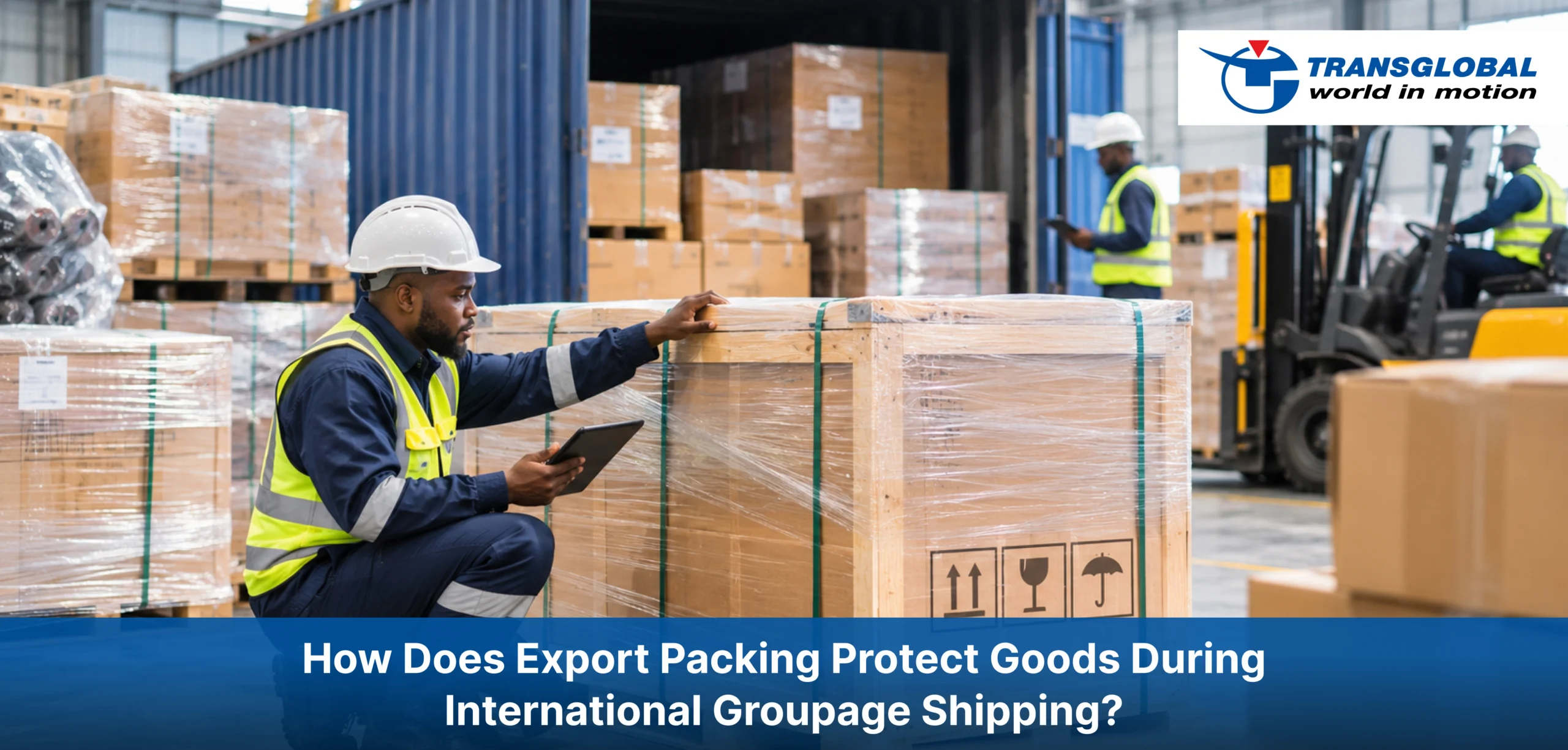
A manufacturer prepares several cartons of electrical components for an overseas customer. The products are packed, labelled, and ready for collection.
However, these cartons will not travel in a container on their own.
At the consolidation warehouse, they may be placed alongside machinery parts, consumer products, and industrial materials belonging to other exporters.
During the journey, the cartons may be lifted, repositioned, stacked, and handled again when the container reaches its destination.
Packaging that works for a local delivery may not provide sufficient protection under these conditions.
This is where export packing becomes an important part of international groupage shipping.
The packaging must protect the goods against movement, pressure, moisture, and repeated handling while keeping each consignment identifiable throughout the journey.
For businesses exporting smaller shipments, understanding these requirements helps reduce cargo damage and avoid unnecessary delays during consolidation.
Why Does Groupage Shipping Require More Careful Export Packing?
In a full container load, one shipper generally has greater control over how goods are arranged within the container.
Groupage operates differently.
Smaller consignments from multiple exporters share transport space. In ocean freight, this arrangement is commonly known as less-than-container-load (LCL) shipping.
The goods are received at a consolidation facility, combined with other consignments, transported internationally, and separated at the destination.
Each handling stage places demands on the packaging.
For example, a carton containing glass components may be suitable for direct delivery between two warehouses but insufficiently protected for repeated handling within a shared freight network.
Exporters must consider the weight, dimensions, fragility, and physical characteristics of their products before choosing the packaging.
The groupage shipping process involves several operational stages where cargo identification and protection become important.
For businesses using LCL and groupage services, preparing goods for shared transport helps consolidators handle and position each consignment appropriately.
The objective is to ensure the packaging remains effective throughout the movement, not only during collection.
How Should Exporters Select the Right Packaging Materials?
Different products require different packing methods.
Lightweight, durable goods may be suitable for strong corrugated cartons. Heavier components may require reinforced cases, while delicate machinery or irregularly shaped equipment may need purpose-built wooden crates.
Palletisation can help keep several cartons together as one handling unit.
However, the pallet must support the total load weight, and the cartons should be arranged without creating an unstable structure.
Consider an exporter shipping automotive components in multiple cartons.
If the cartons extend beyond the pallet edges, they become more vulnerable to impact during forklift handling.
Similarly, a wooden crate carrying heavy equipment must have sufficient structural strength to support the contents during lifting and movement.
Exporters should also consider whether the package can safely support additional cargo above it.
Fragile or unusually shaped consignments may need to be declared non-stackable, subject to the consolidator’s acceptance conditions.
Where solid wood pallets, crates, or dunnage are used, applicable ISPM 15 requirements should be checked for the destination country.
For sensitive or expensive equipment, the export packing of high-value cargo may require additional attention to crate construction and protective materials.
The packaging choice should reflect the actual cargo rather than relying on one standard method for every shipment.
What Protects Goods from Movement, Pressure, and Moisture?
A strong outer carton does not automatically mean the contents are protected.
If products move freely inside the packaging, vibration and repeated handling can cause damage even when the carton remains intact.
Internal protection is therefore essential.
Foam inserts, cushioning materials, dividers, and edge protectors can help prevent items from coming into direct contact with one another.
Heavy machinery components may need to be secured to the base of a crate to prevent movement.
For example, a precision metal component placed loosely inside a wooden case may experience repeated contact with the surrounding structure.
Appropriate internal supports can keep the component stable during transport.
Stacking pressure also needs consideration.
Packages intended to support other cargo must have sufficient strength for the expected loading arrangement. A fragile consignment should not be treated as stackable without confirming its capacity.
Moisture presents another challenge, particularly during ocean transport.
Temperature and humidity changes can lead to condensation inside containers. Products vulnerable to corrosion may require moisture barriers, protective wrapping, or suitable desiccants.
These measures should be selected according to the commodity and expected transport conditions.
Effective cargo protection comes from matching the outer packaging, internal supports, and environmental protection to the product’s characteristics.
Why are Package Markings Important in Groupage Shipments?
A shared container may carry goods from several exporters, sometimes packed in similar-looking cartons or wooden cases.
When the container reaches its destination, warehouse personnel must identify and separate the consignments accurately.
Clear package markings support this process.
Each package should carry the required shipment references, destination information, and package numbering according to the consolidator’s instructions.
For example, a shipment containing five crates may be marked from 1 of 5 through 5 of 5.
This helps warehouse personnel confirm that the complete consignment has been received and allocated correctly.
Handling instructions may also be necessary.
Orientation arrows, lifting-point markings, and centre-of-gravity information can communicate important handling precautions where applicable.
However, markings cannot compensate for inadequate packaging.
A fragile label does not prevent damage if the contents are unsecured.
The information displayed on the packages should also match the packing list and relevant transport records.
Accurate shipping documentation supports package identification and reduces discrepancies during export processing.
For groupage cargo, clear identification helps maintain shipment accuracy as individual consignments move through shared facilities.
What Should Be Checked Before Cargo Enters the Consolidation Warehouse?
Before collection, exporters should confirm that the completed shipment meets the consolidator’s acceptance requirements.
This includes verifying the package count, gross weight, dimensions, and any special handling restrictions.
These details influence how the cargo is received, stored, and positioned within the container.
For example, a crate declared as stackable may create a loading problem if its structure cannot support additional weight.
Similarly, incorrect dimensions can affect the space allocated to the shipment and the applicable freight charges.
Exporters should disclose cargo that is fragile, unusually heavy, non-stackable, or subject to special handling requirements.
Dangerous goods require particular attention because applicable classification, packaging, marking, labelling, documentation, and segregation requirements must be satisfied before acceptance.
Not every dangerous goods consignment is suitable for a particular groupage service.
A final packing inspection can identify damaged cartons, loose straps, exposed components, or unstable pallets before dispatch.
Photographs of the completed packages may also provide useful evidence of their condition before collection.
Appropriate warehousing arrangements support cargo receiving, handling, storage, and preparation for onward transport.
However, goods that arrive with unsuitable packaging may require repacking before they can enter the consolidated shipment.
Completing these checks at origin helps exporters avoid corrective handling and unnecessary interruptions.
Conclusion: Export Packing Supports Safer International Groupage Shipping
International groupage allows businesses to transport smaller consignments without booking an entire container.
However, sharing freight space means that each shipment must be prepared for handling alongside other goods.
Suitable cartons, pallets, and crates provide the foundation for cargo protection. Internal supports help prevent movement, while moisture protection addresses environmental exposure during transport.
Clear package markings support identification, and accurate shipment details help consolidators plan cargo handling and loading.
For exporters, the most important consideration is whether the completed packaging is suitable for the product and the journey it will undertake.
Effective export packing reduces avoidable handling problems and helps goods move through the international groupage process with greater reliability.
Planning an international groupage shipment or preparing goods for export? Contact us to discuss cargo specifications, packing requirements, consolidation arrangements, and suitable freight options.
Move your export consignments with leading freight forwarders who understand export packing, groupage cargo, and international freight handling requirements.
Frequently Asked Questions
Can loose cartons be accepted in an international groupage shipment?
Yes. Some consolidators accept loose cartons when the packaging is strong enough for handling and transport. Palletisation may be required depending on the cargo and service conditions.
Does non-stackable cargo cost more to ship by LCL?
It can. Non-stackable cargo may occupy space that cannot be used for other consignments, which can affect the applicable freight charges.What happens if export packaging is damaged before consolidation?
What happens if export packaging is damaged before consolidation?
The consolidator may request repacking or refuse acceptance until the packaging meets transport requirements. This can affect the planned shipment departure.


Comments