

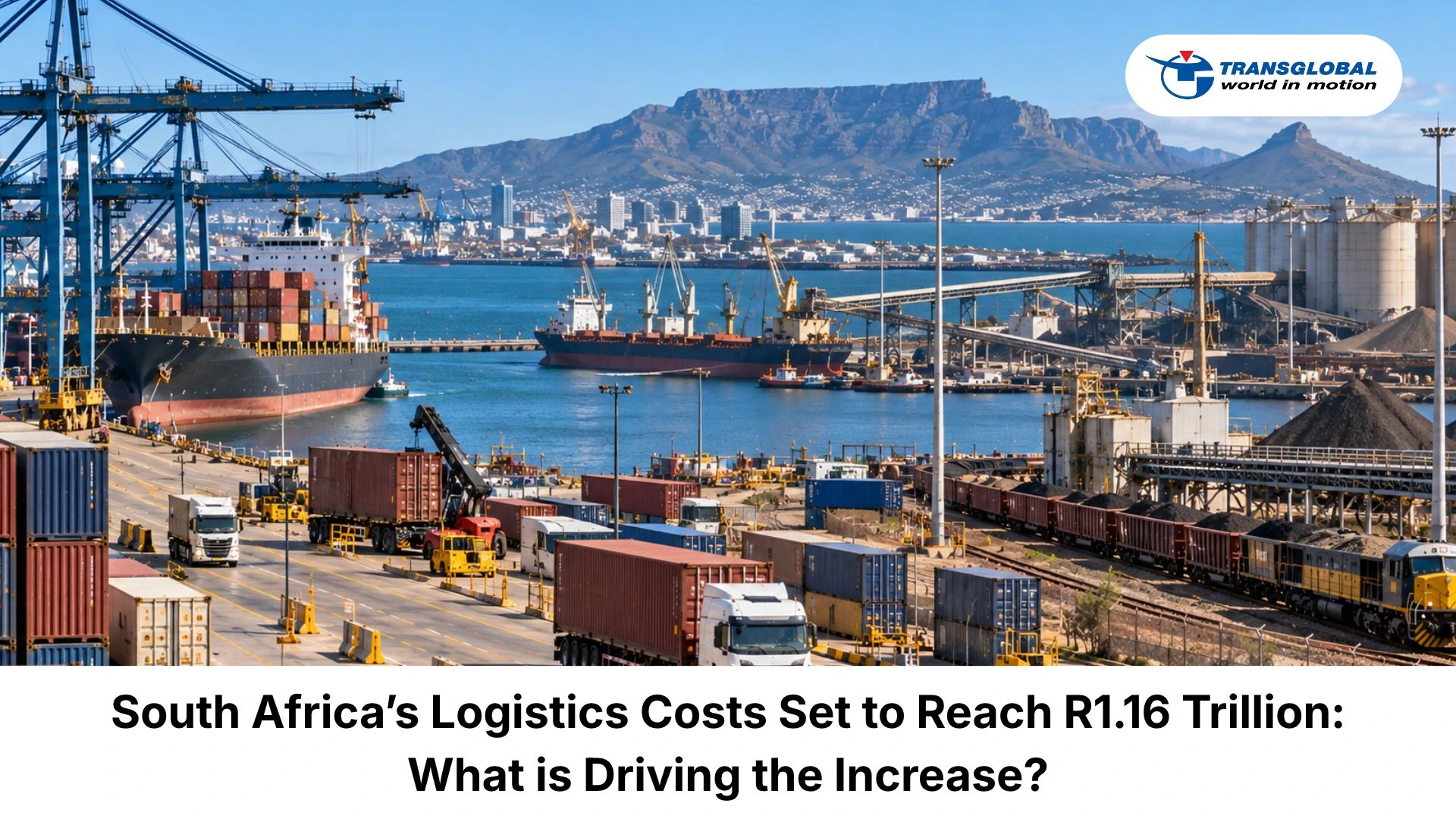
South Africa’s logistics industry is facing a growing cost challenge.
The newly released State of Logistics 2026 report projects that the country’s total logistics expenditure will reach R1.16 trillion in 2026, equivalent to 14.6% of GDP.
This is the highest share of GDP recorded across the report’s 2003–2026 period.
Produced by GAIN Group, with sponsorship from Absa Business Banking and the Western Cape Government’s Mobility Department, the report was released on 22 October 2026.
It estimates that South Africa’s logistics bill exceeded R1 trillion for the first time in 2025, with a further R147 billion increase expected in 2026.
Transport accounts for almost 80% of that projected increase.
However, the report identifies opportunities to reduce avoidable expenditure through better transport choices, improved capacity utilisation and more efficient operations.
👉 South Africa’s challenge is not simply moving more freight. It is moving cargo more efficiently while controlling the cost of doing so.
🚛 Transport Remains the Largest Logistics Expense
Transport is expected to account for approximately R683 billion in 2026, representing 59% of South Africa’s total logistics expenditure.
That is a projected increase of R117 billion from 2025.
These figures highlight the financial importance of moving goods efficiently across the country.
Businesses depend on transport to connect production facilities, suppliers, warehouses, ports and customers.
However, the cost of movement is influenced by more than distance.
Vehicle utilisation, infrastructure reliability, operating conditions and the choice of transport mode all affect the final cost.
For businesses relying on road freight, effective planning means coordinating vehicle capacity, collection schedules, delivery requirements and route conditions.
When transport resources are not used efficiently, the additional expense can spread across the wider supply chain.
📦 Inventory and Warehousing Add to the Financial Pressure
Transport is only one part of the national logistics bill.
The report projects inventory carrying costs will increase from R182.5 billion in 2025 to R191.4 billion in 2026.
Warehousing expenditure is estimated at R151.7 billion, while management and administration account for a further R130.3 billion.
These figures show why logistics performance cannot be measured through transport costs alone.
Inventory carrying costs represent the financial burden associated with holding stock, including the capital tied up in goods before they are sold or used.
When businesses maintain larger inventories or experience longer replenishment cycles, more working capital may remain tied up in stock.
Effective warehousing and inventory planning therefore form an important part of overall supply chain cost management.
The objective is to balance product availability with storage requirements, stock movement and operational expenditure.
🚆 Freight Rail Recovery Shows Progress, but Challenges Remain
The report also identifies improvements in South Africa’s freight rail performance.
Rail volumes recovered from approximately 149.5 million tonnes in 2022/23 to 167.9 million tonnes in 2025/26.
At the same time, the estimated economic cost of rail underperformance declined from R410.7 billion in 2022 to R180.8 billion in 2025.
This represents meaningful progress.
However, the remaining economic burden is still equivalent to approximately R495 million per day.
The report cautions that higher rail volumes alone will not deliver the full economic benefit.
Reliable services, competitive costs and appropriate freight allocation between road and rail remain important.
For sectors such as mining, manufacturing and bulk commodity exports, the relationship between inland transport and port operations is particularly significant.
Understanding how sea freight flows through South Africa’s major ports also highlights why reliable inland connections matter for international cargo movement.
⚖️ Choosing the Right Transport Mode Can Reduce Costs
One of the report’s central recommendations is to move freight using the most suitable transport mode.
Not every shipment has the same operational requirements.
High-volume bulk commodities, time-sensitive products, containerised cargo and specialised equipment may each require different transport arrangements.
The most appropriate option depends on factors such as shipment size, distance, infrastructure availability, delivery urgency and handling requirements.
Choosing a transport mode without considering these factors can create unnecessary expenditure.
The report also identifies better use of existing transport capacity as an opportunity for improvement.
This includes reducing underutilised capacity and improving how available resources are allocated.
For importers and exporters, these considerations are part of effective freight forwarding planning, where cost, timing and cargo requirements must be assessed together.
📈 Better Efficiency Could Unlock Significant Savings
The report estimates that improvements in transport-mode selection, capacity utilisation and operating efficiency could have made a substantial difference to South Africa’s logistics expenditure.
Its modelling suggests that, had these improvements been implemented from 2022, logistics costs could have represented approximately 12.7% of GDP in 2026 instead of the projected 14.6%.
That difference represents potential savings of around R149.3 billion in 2026.
Over the five-year period beginning in 2022, the modelled savings amounted to nearly R667.5 billion.
These are estimated opportunities, not savings already achieved.
Nevertheless, they demonstrate the economic value of more efficient freight operations.
For businesses, the practical implication is clear: improved transport planning, resource utilisation and operational coordination can contribute to stronger cost control.
🌍 Rising Freight Demand Will Test South Africa’s Logistics Capacity
The report also looks beyond current expenditure.
South Africa’s freight demand is forecast to increase from 790.1 million tonnes in 2024 to just over one billion tonnes by 2055.
This expected growth will place greater importance on transport infrastructure, freight capacity and supply chain efficiency.
Simply expanding capacity may not be enough.
Businesses and logistics operators will need to make better use of existing resources while adapting to changing trade volumes and operational requirements.
For South Africa, long-term competitiveness will depend on achieving that balance.
🚚 Conclusion: Lower Logistics Costs Depend on Smarter Freight Decisions
The State of Logistics 2026 report highlights both the scale of South Africa’s logistics expenditure and the opportunities available to improve performance.
With costs projected to reach R1.16 trillion, transport efficiency, inventory management and infrastructure reliability remain important considerations for businesses.
The improvement in rail performance provides encouraging evidence of progress, but significant costs remain across the freight system.
For importers, exporters and manufacturers, reducing avoidable expenditure begins with informed transport decisions and effective coordination across the supply chain.
Working with experienced freight forwarders can support businesses in aligning shipment planning, transport arrangements and cargo requirements with their operational priorities.
South Africa’s logistics challenge is not only about the growing volume of freight.
👉 It is about ensuring that every movement contributes greater value without adding unnecessary cost.
Comments