

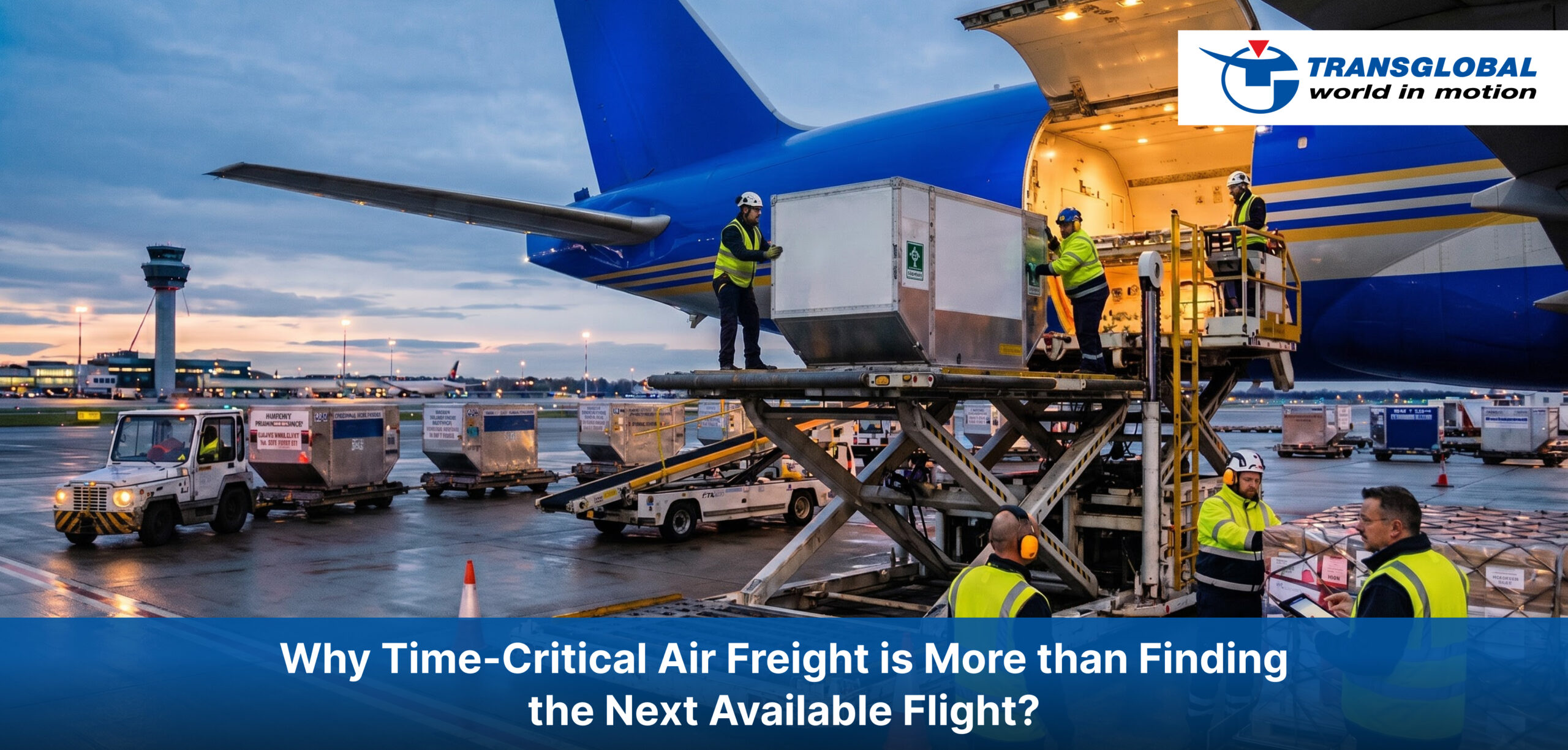
Urgent air freight usually starts with pressure.
A part is missing. A production line is waiting. A customer commitment is at risk. A project deadline is getting closer.
The first reaction is often simple.
Find the next available flight.
But in time-critical logistics, the fastest flight is not always the full answer.
Before the cargo moves, the real question is what the shipment is protecting.
It may be production continuity, a customer delivery, a launch date, a repair schedule, a contract deadline, or stock availability.
Once that risk is understood, the transport plan becomes clearer.
Time-critical air freight is not only about speed. It is about making the right decisions before, during, and after the movement so the impact on the business can be controlled.
Why Urgency must be Understood Before the Route is Chosen?
Every urgent shipment has a reason behind it.
The cargo may be needed to keep a factory running, complete a repair, replace a failed component, support a launch, or protect an important customer order.
That reason should be understood before the route is selected.
If the shipment is protecting a production line, the timeline may be measured in hours. If it is supporting a project, the delivery window may be linked to site readiness. If it is a repair part, the return process may matter as much as the outbound movement.
This is why the first discussion should go beyond origin, destination, weight, and dimensions.
The logistics team should understand what the cargo is, why it is urgent, how much time remains, what happens if it is delayed, and who needs updates during the movement.
For urgent cargo, air freight planning helps match the shipment with the right route, carrier, handling requirement, and delivery expectation.
When the operational risk is clear, the route can be chosen to protect the outcome, not just to catch the earliest departure.
How Clear Information Helps Faster Decisions?
Urgent logistics depends on clear information.
When details are missing, time is lost.
The team needs to know the cargo description, dimensions, weight, value, packing status, collection point, delivery address, readiness time, documents, handling needs, and restrictions.
For some shipments, the team may also need to know whether the cargo can move on a passenger aircraft, whether a freighter is required, whether the shipment can be split, or whether an alternative airport can reduce the total delivery time.
The best option is not always the flight that departs first.
A later flight with better connectivity, faster clearance, easier airport access, or stronger delivery control may protect the operation more effectively.
Accurate shipping documents also help avoid delays when urgent cargo reaches export, carrier acceptance, customs, or final delivery stages.
In time-critical air freight, every early detail supports a faster decision later.
Why Contingency Planning Matters for Recurring Urgent Cargo?
Many urgent shipments are not completely new.
Over time, patterns can appear.
The same supplier may create pressure. The same component may become urgent. The same route may be used repeatedly. The same season, product line, or maintenance cycle may create similar risks.
When this happens, urgent cargo should not always be treated as a one-time exception.
It should be mapped.
A useful contingency plan may include critical parts, regular suppliers, pickup locations, alternative airports, required documents, carrier options, customs needs, site contacts, and approval procedures.
This preparation does not remove risk.
But it reduces the time needed to respond when the next urgent request comes in.
For businesses that regularly move time-sensitive cargo, early freight forwarding support helps turn repeated urgent movements into a clearer logistics plan.
Anticipation gives the team more control before the next disruption becomes visible.
How Control Continues After the Cargo is in Motion?
An urgent shipment is not finished once the flight is booked.
In many cases, the most important control begins after the cargo starts moving.
A connection can change. Capacity can shift. Weather can affect a schedule. Customs may ask for more information. A ground route may need to be adjusted. The receiving site may need a revised delivery time.
When this happens, tracking alone is not enough.
The team needs to understand what has changed, how it affects the plan, and which alternative can be activated.
For urgent shipments, communication should be agreed before the cargo moves.
The team should know who will receive updates, who can approve changes, who will speak to the receiving site, and how often progress should be shared.
For cargo that needs final road delivery after arrival, road freight planning helps connect airport release, vehicle availability, route timing, and handover at destination.
Control is not about holding one plan at all costs.
It is about knowing the next decision before the pressure increases.
Why Urgent Air Freight should Create Useful Learning?
A time-critical shipment leaves behind more than a delivery result.
It also leaves useful information.
The business can learn which supplier created the risk, which component caused the delay, which route worked best, which document slowed the process, which airport performed better, and which decisions protected the operation.
This information should not be lost once the shipment is delivered.
It can help teams prepare better for the next urgent movement.
For example, if the same component is repeatedly needed at short notice, the business may need a stock review, supplier discussion, or pre-planned transport route. If the same customs issue appears again, documents may need to be prepared differently before dispatch.
For urgent imports and exports, early customs brokerage review can help reduce repeat delays linked to classification, values, permits, or supporting records.
The strongest logistics response is not only the one that solves today’s problem.
It is the one that helps the business respond better next time.
Conclusion: Time-Critical Air Freight Protects More than the Shipment
Behind every urgent air freight shipment, there is usually a bigger business risk.
The cargo may be needed to protect production, delivery commitments, customer trust, aircraft availability, project timelines, or operational continuity.
That is why time-critical logistics needs more than speed.
It needs the right information, the right route, clear documents, backup options, active communication, customs readiness, and final delivery control.
The fastest flight may help.
But the best plan is the one that protects what cannot afford to stop.
Planning an urgent air freight shipment? Contact us to review the cargo details, timing, route options, documents, and delivery requirements before the movement begins.
Move urgent cargo with leading freight forwarders who understand time-critical air freight, operational risk, customs coordination, and controlled delivery planning.
Frequently Asked Questions
What is time-critical air freight?
Time-critical air freight is the movement of urgent cargo by air when delivery timing is linked to production, repair, customer commitments, or operational continuity.
Why is the fastest flight not always the best option?
The fastest flight may not provide the best overall result if customs, connections, airport access, delivery timing, or backup options are not properly planned.
What details are needed for urgent air freight?
Cargo details, dimensions, weight, readiness time, documents, delivery deadline, handling needs, route options, and the business impact of delay should be confirmed early.


Comments