

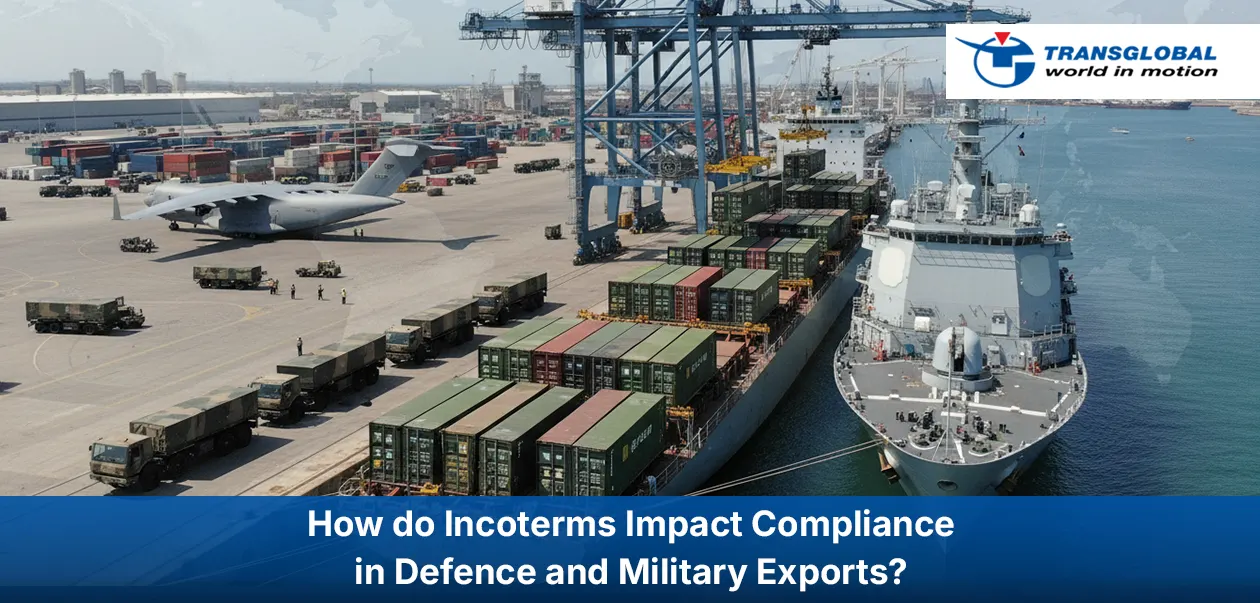
A defence shipment is not just another export. It carries regulatory approvals, national accountability, and international trust.
Every movement is tied to a specific end-user, a defined route, and an approved logistics chain. Yet in practice, certain commercial habits are beginning to blur that control, and that’s where risk enters.
Across defence logistics, the increasing use of Incoterms like EXW (Ex Works) and FCA (Free Carrier) is raising important concerns. While these terms are widely accepted in general trade, their application in defence exports introduces a gap between regulatory intent and real-world execution.
And in a sector where compliance is non-negotiable, even a small gap can become a serious vulnerability.
The Nature of Defence Logistics: Control is Everything
Unlike conventional cargo, defence shipments operate under strict regulatory oversight. In South Africa, the National Conventional Arms Control Committee (NCACC) ensures that exports are aligned with approved end-users, destinations, and logistics participants.
This means every shipment is expected to maintain:
- Full traceability from origin to destination
- Strict adherence to approved routes
- Verified involvement of licensed logistics partners
- Alignment with export permits and compliance conditions
In simple terms, control must remain intact throughout the entire supply chain.
However, this level of control can only be achieved if logistics execution matches regulatory expectations, and this is where Incoterms play a critical role.
Why EXW and FCA Terms can Create a Compliance Gap?
EXW and FCA are designed for commercial efficiency. They allow sellers to transfer responsibility early in the shipping process.
EXW (Ex Works): Responsibility transfers at the seller’s premises
FCA (Free Carrier): Responsibility transfers once goods are handed to a carrier
In standard trade, this approach offers flexibility and simplicity.
But in defence logistics, early transfer of responsibility creates a significant challenge.
Once the exporter relinquishes control:
- Visibility over the shipment reduces
- Control over routing and handling weakens
- Assurance of delivery to the approved end-user becomes harder to maintain
This disconnect creates a risk where the shipment’s actual movement may no longer fully align with the conditions under which the export was approved.
The Regulatory Intent vs Operational Reality
The purpose of defence export regulation is clear: to ensure that controlled goods reach only authorized recipients through approved channels.
However, when Incoterms shift control too early in the process, the ability to enforce that intent becomes limited.
This creates a practical issue:
- The permit may specify a controlled logistics chain
- But the actual execution may diverge after handover
This is not necessarily due to intentional non-compliance. In many cases, it results from commercial decisions that overlook the operational implications of Incoterms in regulated environments.
Still, the outcome remains the same, reduced control in a system designed to prevent exactly that.
Why CFR-Type Terms Offer Better Control?
A more controlled approach in defence logistics is the use of Incoterms, where the exporter retains responsibility for a longer portion of the journey.
Terms such as CFR (Cost and Freight) or similar structures ensure that:
- The exporter maintains oversight until the destination port
- The logistics chain remains aligned with approved participants
- Shipment handling is monitored throughout transit
This approach helps bridge the gap between regulatory intent and operational execution.
By retaining control longer, exporters can ensure that:
- Approved freight forwarders are used
- Routing aligns with permit conditions
- Documentation remains consistent throughout the journey
In high-risk sectors, this level of control is not just beneficial, it is essential.
The Risk of Substituting Approved Logistics Partners
Another growing concern in defence logistics is the substitution of approved participants within the supply chain.
In some cases:
- An export permit specifies a particular freight forwarder or transporter
- But a different logistics provider is used during execution
This creates a direct compliance issue.
The NCACC approval process evaluates all entities involved in the shipment, including:
- Exporters
- Freight forwarders
- Transporters
- End-users
Changing any of these elements after approval undermines the integrity of the entire system.
From a compliance perspective, this introduces risks such as:
- Regulatory violations
- Delays due to inspection or investigation
- Potential suspension of export privileges
- Reputational damage in international markets
Consistency in the approved logistics chain is therefore critical.
The Broader Impact on Global Trade Trust
Defence exports are not only regulated domestically, but they are also closely observed internationally.
Countries importing defence-related goods rely on exporting nations to maintain strict control over their supply chains.
If inconsistencies emerge, it can affect:
- Bilateral trade relationships
- Export approvals in future transactions
- Confidence in regulatory systems
- Industry credibility at a global level
South Africa’s defence sector has built a strong reputation for quality and compliance. Maintaining that reputation requires consistent alignment between policy and practice.
Practical Steps to Strengthen Compliance in Defence Logistics
To reduce risk and maintain regulatory integrity, businesses involved in defence exports should adopt a disciplined approach to logistics planning.
Key measures include:
Selecting appropriate Incoterms: Use terms that maintain control over the shipment for as long as possible
Aligning logistics with permits: Ensure all parties involved match those specified in regulatory approvals
Maintaining end-to-end visibility: Track shipments throughout the supply chain
Ensuring documentation consistency: Avoid discrepancies between permits, invoices, and transport documents
Working with experienced partners: Engage logistics providers with proven expertise in regulated cargo
These are not complex strategies, they are essential practices for operating in a highly controlled environment.
Transglobal: A Trusted Freight Forwarder for Controlled and High-Risk Cargo
At Transglobal, we understand that defence logistics is not just about moving cargo, it is about maintaining control, compliance, and accountability at every stage.
We act not just as a service provider, but as a long-term logistics partner, ensuring that every shipment aligns with regulatory requirements and operational realities.
Our expertise includes:
- Handling regulated and high-risk cargo
- Aligning Incoterms with compliance frameworks
- Maintaining approved logistics chains
- Ensuring accurate documentation and traceability
- Supporting secure, compliant transport solutions
We work closely with exporters, contractors, and global partners to ensure that shipments move exactly as approved, without compromise.
Conclusion
In defence logistics, compliance is not a checkpoint, it is a continuous responsibility.
The choice of Incoterms, the selection of logistics partners, and the execution of shipments all play a critical role in maintaining control over regulated exports.
Using commercial practices without considering their compliance impact can create unintended risks. Aligning logistics execution with regulatory intent ensures that shipments remain secure, traceable, and compliant from origin to end-user.
Working with a trusted freight forwarder helps ensure that every aspect of your supply chain, from Incoterms to delivery, is managed with precision and accountability.
If your organization requires reliable support in managing defence logistics with full compliance and control, contact us today. Our team is ready to support your operations with expertise you can depend on.
Frequently Asked Questions
Are You Seeing Where Your Profit Really Comes From?
These terms transfer responsibility early, reducing control over the shipment and making it harder to ensure delivery to the approved end-user.
Can changing a freight forwarder after permit approval cause issues?
Yes. Substituting approved logistics partners can violate regulatory conditions and lead to compliance risks or shipment delays.
What is the safest approach for managing defence logistics shipments?
Using Incoterms that maintain control (such as CFR-type terms), ensuring alignment with permits, and working with experienced logistics partners helps reduce compliance risks.
Comments