

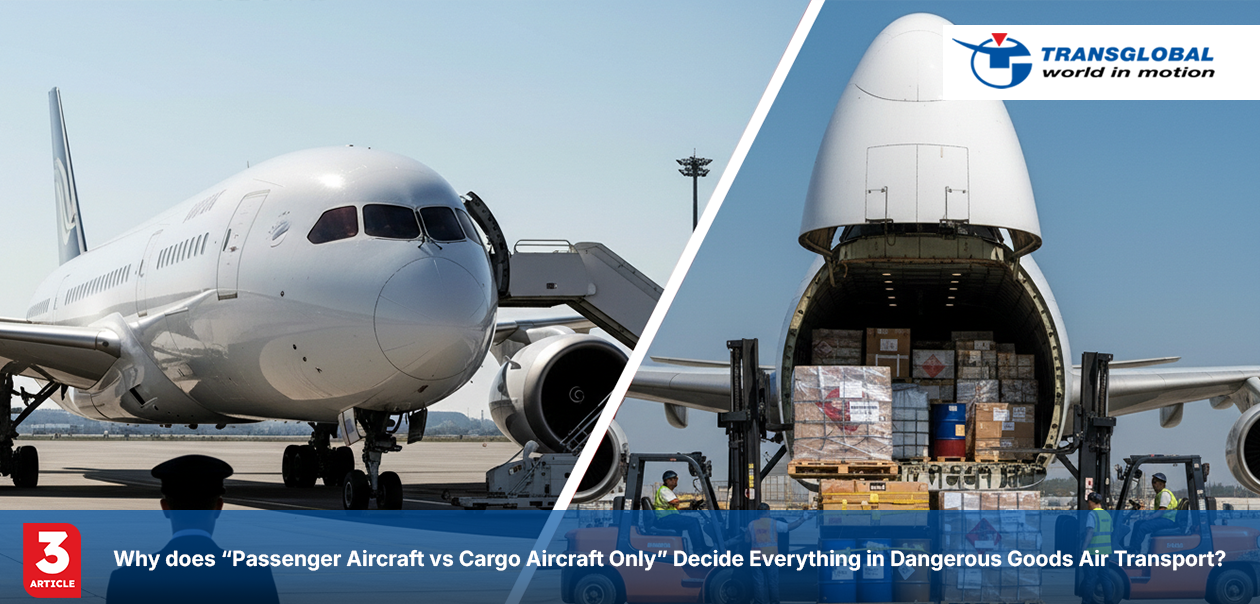
There’s a line in the Dangerous Goods Regulations that looks harmless at first glance.
Just a few words. No warning signs. No bold red text.
Yet in real-world logistics, this single line can determine whether your shipment flies tomorrow or never leaves the ground.
That line is: Passenger Aircraft or Cargo Aircraft Only (CAO).
Many shippers assume that if a Dangerous Good is “allowed by air,” the job is done. In reality, air acceptance is only the first filter. The aircraft type is the real gatekeeper, and misunderstanding this distinction is one of the most common compliance traps in air freight.
“Allowed by Air” Does Not Mean “Allowed on Any Aircraft”
Here’s the reality most people only learn after a rejection:
A Dangerous Good can be fully compliant with IATA regulations and still be forbidden on a passenger aircraft.
IATA Dangerous Goods Regulations clearly separate air shipments into two categories:
- Passenger and Cargo Aircraft
- Cargo Aircraft Only (CAO)
This distinction exists because passenger aircraft are designed around human safety first. When people are onboard, risk tolerance drops to near zero.
Cargo aircraft, on the other hand, are built to carry higher-risk loads under controlled conditions, without passengers.
What “Cargo Aircraft Only” Really Means in Practice?
When a shipment is marked Cargo Aircraft Only, it does not mean:
- The goods are illegal
- The shipper made a mistake
- The documentation is wrong
It means the risk profile exceeds what is acceptable when passengers are onboard.
A shipment may become CAO because of:
- The inherent severity of the hazard
- Packing Group level (where applicable)
- Quantity per package exceeding passenger limits
- Specific IATA special provisions
- Aircraft safety and emergency response limitations
Once a shipment is classified as CAO, it must move on a freighter aircraft. There is no workaround, no “approval request,” and no airline discretion.
Why Airlines Enforce this Without Exception?
Passenger aircraft operate under extremely strict safety constraints:
- Limited access to cargo during flight
- No ability to isolate a dangerous reaction
- Evacuation risks in case of an incident
- Regulatory zero-tolerance policies
If a Dangerous Good were to leak, react, or ignite mid-flight, the consequences would be immediate and catastrophic.
That’s why airlines will reject CAO cargo at acceptance, even if every document looks perfect.
High-Risk Classes Where CAO Becomes Critical
This distinction becomes especially important in specialist Dangerous Goods sectors, where air transport already operates at the edge of acceptability.
Explosives are managed not just by class, but by:
- Division (1.1, 1.2, 1.3, etc.)
- Compatibility group
- Quantity limits
- Route and carrier restrictions
Many Class 1 consignments are automatically Cargo Aircraft Only, regardless of packaging quality.
Even when technically compliant, routing options are limited, carrier availability is reduced, and approvals are tightly controlled.
Radioactive Material (Class 7)
Radioactive medical and industrial shipments introduce a different risk profile:
- Radiation category limits
- Package type requirements
- Strict labelling and handling discipline
- Dose rate controls for crew safety
Certain Class 7 shipments may only be accepted on cargo aircraft due to exposure thresholds, even when packaging is certified.
The Operational Impact Most Shippers Don’t Anticipate
When CAO is discovered late, it creates cascading problems:
- Passenger flights removed from routing options
- Limited freighter schedules
- Higher freight costs
- Longer transit times
- Missed delivery commitments
This often happens because packaging, booking, or quotations were prepared before confirming aircraft eligibility.
By the time the issue surfaces, the shipment is already at the terminal, or worse, already booked on the wrong flight.
Why is this a Compliance Issue, Not a Commercial One?
The biggest mistake shippers make is treating Passenger vs Cargo Aircraft as a commercial decision.
It isn’t.
This classification is:
- A regulatory requirement
- A safety control
- A non-negotiable compliance condition
No amount of urgency, customer pressure, or cost escalation can override it.
That’s why experienced Dangerous Goods forwarders validate CAO status before bookings, not after rejection.
The Freight Forwarder’s Role in Avoiding this Trap
A compliance-first freight forwarder will:
- Confirm aircraft eligibility during planning
- Validate quantity limits against passenger thresholds
- Align packaging with aircraft type
- Select carriers with approved freighter capacity
- Prevent incorrect routing before it reaches the airline
This isn’t about moving cargo faster, it’s about moving it legally and safely the first time.
Conclusion
Passenger Aircraft vs Cargo Aircraft Only is not a technical footnote.
It’s a defining control point in Dangerous Goods air transport.
Understanding it early saves time, cost, and reputational risk. Discovering it late almost always results in rejection.
In air freight, compliance doesn’t fail loudly, it fails quietly at acceptance.
Need Support with Complex DG Air Shipments?
At Transglobal Cargo, we plan Dangerous Goods movements with aircraft eligibility in mind from day one, especially for high-risk and specialist cargo.
If you’re looking for the best freight forwarder to handle DG shipments without surprises, contact us today and let our compliance expertise keep your cargo moving.
Stay Tuned for the Next Article in This Series: Packaging that Passes Inspection: What Compliance Looks Like in Sea and Air Transport?
Frequently Asked Questions
Can a Cargo Aircraft Only shipment ever move on a passenger aircraft?
Can a Cargo Aircraft Only shipment ever move on a passenger aircraft?
What usually triggers a CAO classification?
High hazard severity, larger quantities, specific packing instructions, or aircraft safety limitations commonly trigger CAO status.
When should CAO eligibility be checked?
Before packaging and booking. Aircraft eligibility should be confirmed during planning, not after cargo reaches the airline terminal.


Comments