

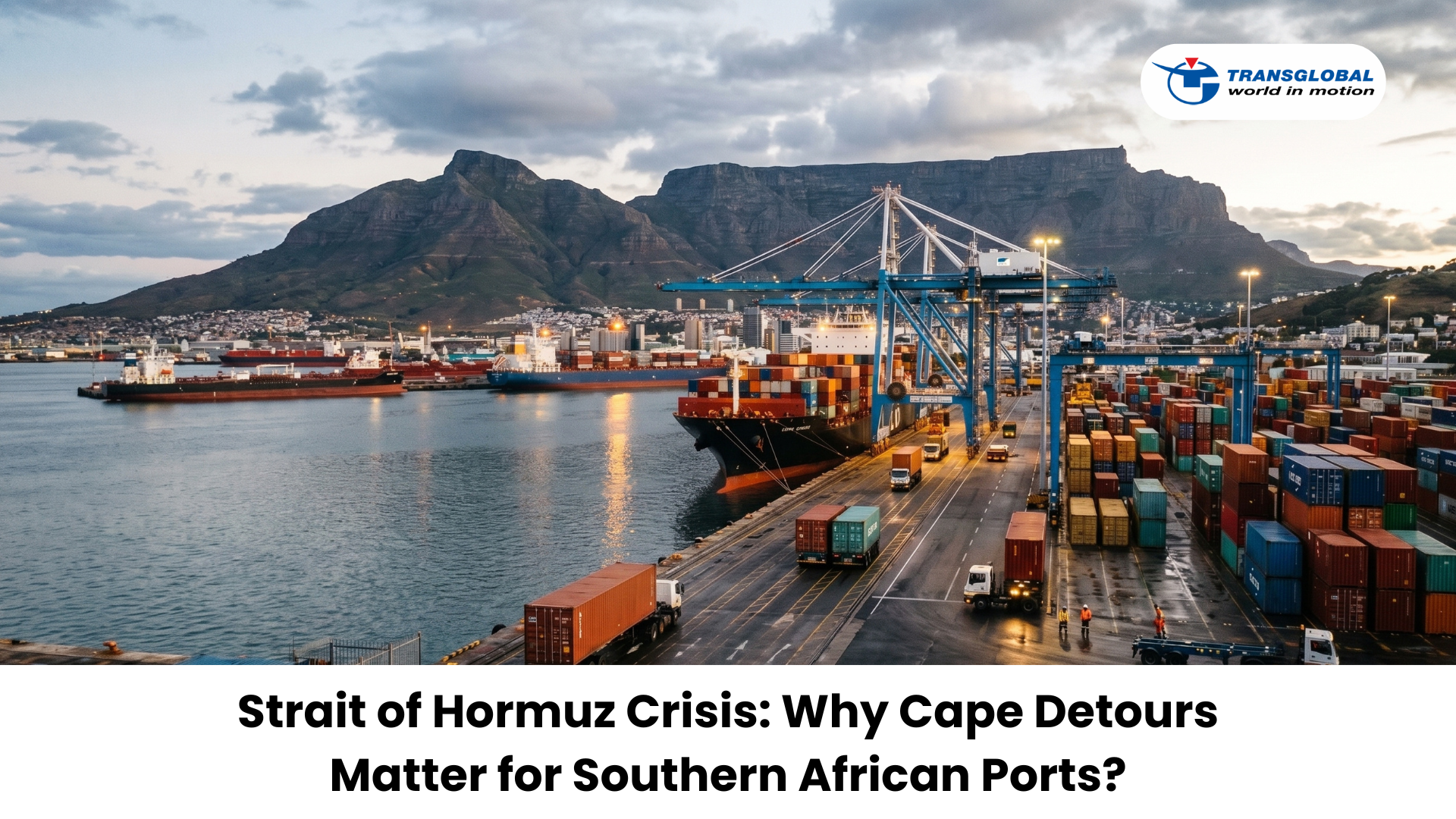
The Strait of Hormuz crisis is not only changing vessel movements in the Gulf.
It is also reshaping the way global shipping lines look at Southern Africa.
With commercial transits through Hormuz falling sharply and the Red Sea route still facing disruption, more vessels are being pushed towards the Cape of Good Hope.
For shipping lines, freight forwarders, cargo owners, and port operators, this is more than a temporary routing issue. It is a major shift in how cargo, fuel, schedules, and risk are being managed across international trade lanes.
The Cape route has always been part of global shipping history.
Now, it is becoming important again for a very different reason.
👉 When key maritime chokepoints become unstable, Southern African ports move closer to the centre of global shipping decisions.
🌍 Why the Cape Route is Back in Focus?
The Strait of Hormuz is one of the world’s most important maritime chokepoints.
It plays a major role in the movement of energy cargo, containerised goods, industrial products, and general commercial freight.
When uncertainty rises in this corridor, shipowners and cargo interests begin reassessing risk, insurance, fuel costs, and voyage planning.
At the same time, the Red Sea and Bab el-Mandeb disruptions have already forced many carriers to avoid shorter routes and sail around the Cape of Good Hope.
This means vessels are spending more time at sea, using more fuel, and requiring stronger schedule planning.
For South Africa, this creates both opportunity and pressure.
The country sits directly along one of the most important alternative maritime routes now being used by global shipping.
🚢 Why South African Ports Matter in this Shift?
Cape detours increase the strategic importance of ports such as Durban, Cape Town, Ngqura, and Port Elizabeth.
These ports are well-positioned for vessels moving around Southern Africa, especially those requiring bunkering, repairs, schedule recovery, cargo handling, or access to regional markets.
However, the opportunity is not automatic.
More vessels passing around the Cape does not always mean more vessel calls, more cargo handled, or higher port revenue.
For ports to benefit from rerouted traffic, they must offer reliability, capacity, turnaround efficiency, and strong landside logistics.
This is where South Africa faces a challenge.
While the country has the geographic advantage, port performance, terminal productivity, congestion, weather delays, equipment availability, and inland transport efficiency all influence whether shipping lines choose to call.
⚠️ Why Durban and Cape Town are Under Pressure?
Durban and Cape Town remain two of South Africa’s most important port gateways.
Durban plays a major role in container, automotive, and regional trade flows, while Cape Town is critical for exports, cold chain cargo, and vessels moving around the southern tip of Africa.
Recent indicators show signs of recovery in South African port volumes, including improvements in container throughput, bulk cargo, and vehicle volumes.
That is positive.
However, the wider Cape rerouting trend is also a stress test.
If vessels are moving closer to South Africa but still not calling in larger numbers, it highlights the gap between location advantage and operational readiness.
Shipping lines need confidence.
They need faster berth access, reliable cargo handling, efficient port services, and predictable inland movement.
Without these improvements, South Africa risks watching rerouted traffic pass by without capturing its full economic value.
📦 What does this Mean for Importers and Exporters?
For cargo owners, Cape detours can affect more than vessel routes.
Longer voyages may influence:
- Freight rates
- Transit times
- Fuel surcharges
- Insurance costs
- Cargo planning
- Inventory timelines
- Delivery commitments
A shipment that previously followed a shorter route may now face additional days at sea.
That can affect production schedules, retail planning, project timelines, and customer delivery expectations.
For exporters, especially those moving time-sensitive cargo, delays can affect competitiveness in overseas markets.
For importers, longer transit times may require better stock planning and stronger communication with suppliers and customers.
The key issue is no longer only whether cargo is moving.
It is whether businesses have enough visibility and flexibility to manage changing route conditions.
🚛 The Role of Inland Logistics
Port performance does not stop at the quayside.
Even if a vessel arrives on time, cargo movement still depends on customs processes, trucking availability, warehouse capacity, rail performance, and final-mile delivery.
This is especially important for Southern Africa, where cargo often moves beyond the port into inland markets and neighbouring countries.
If ports improve but inland logistics remain slow, the full benefit of Cape route traffic may still be lost.
The real opportunity lies in building a connected logistics system where ports, road transport, customs clearance, warehousing, and regional corridors work together.
Understanding how road freight navigates South Africa’s key border crossings also shows why inland movement is central to regional cargo reliability.
📈 The Opportunity Behind the Disruption
The current crisis is creating uncertainty, but it also shows how important maritime resilience has become.
Ports that can offer reliable services during disruption have a stronger chance of becoming preferred points in reconfigured shipping networks.
South Africa has the location, port infrastructure, industrial base, and regional trade connections to play a bigger role.
But capturing that opportunity will require continued investment in port efficiency, terminal productivity, equipment availability, digital systems, and inland cargo movement.
The way sea freight flows through South Africa’s major ports will become even more important as shipping lines review routing, port calls, and schedule recovery options.
🚚 Conclusion: Cape Detours are a Test of Port Readiness
The Strait of Hormuz crisis may feel far from Southern Africa, but its impact is moving closer through the Cape route.
As more shipping decisions are shaped by security, cost, insurance, and route resilience, South African ports have a chance to become more strategically important.
However, geography alone is not enough.
To benefit from this shift, ports must be reliable, efficient, and supported by strong inland logistics networks.
Working with the best freight forwarder helps businesses manage changing routes, port pressures, customs requirements, and delivery planning with greater confidence.
Because in today’s logistics environment, the route may change quickly.
👉 The businesses that plan ahead are the ones that keep cargo moving.
Comments