

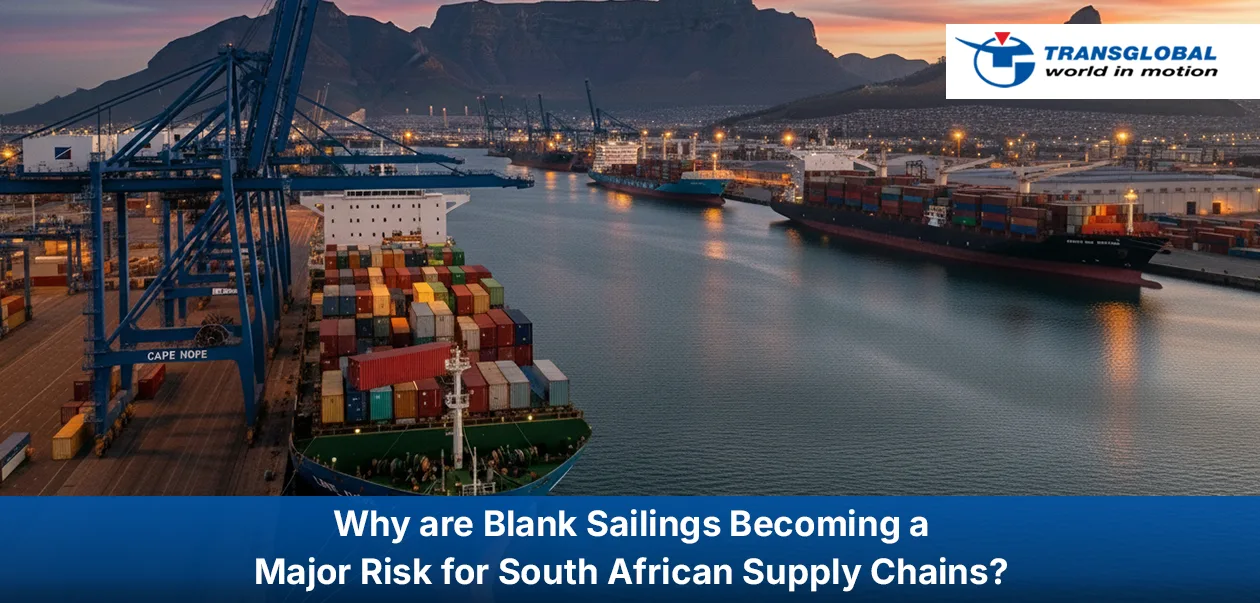
A vessel doesn’t arrive. A port call is skipped. A shipment that was supposed to move this week suddenly has no confirmed schedule.
There’s no accident. No headline-making disruption. Just a quiet update from the carrier: “Blank sailing.”
But for importers and exporters, the impact is anything but quiet.
Blank sailings have become one of the most underestimated risks in global logistics today. And for South Africa, heavily dependent on global trade routes, the consequences are becoming more visible, more frequent, and more costly.
What are Blank Sailings and Why do they Happen?
Blank sailings occur when a shipping line cancels or skips a scheduled port call or voyage. While this may seem like a routine operational adjustment, it is often a strategic move by carriers to manage capacity, recover schedules, or respond to market conditions.
Carriers typically introduce blank sailings to:
- Adjust capacity when demand fluctuates
- Recover delays caused by port congestion
- Manage operational disruptions across trade lanes
- Maintain freight rate stability
From a carrier’s perspective, it is a scheduling decision.
From a cargo owner’s perspective, it is a disruption.
The Real Impact on Cargo Owners
When a vessel skips a port or cancels a sailing, the consequences extend far beyond a simple delay.
Shipments may be rolled to the next available vessel, which could be days or even weeks later. Containers can remain idle at ports, or in some cases, move past the intended destination before being redirected.
This creates a chain reaction across the supply chain.
The most common impacts include:
- Delays in cargo delivery and missed deadlines
- Increased storage, demurrage, and detention charges
- Tightened vessel capacity leading to higher freight rates
- Disruption to production schedules and inventory planning
In certain situations, especially for time-sensitive or lower-value goods, the additional costs can exceed the value of the cargo itself.
Why South Africa Must Pay Attention Now?
South Africa’s trade is closely tied to global shipping routes. Any disruption in major corridors quickly affects inbound and outbound cargo.
What makes the current situation more concerning is the growing influence of geopolitics on shipping patterns.
With rising tensions in key regions such as the Middle East, particularly around critical chokepoints like the Strait of Hormuz, global shipping is entering a period of heightened uncertainty.
If disruptions occur in these regions, carriers are likely to:
- Reroute vessels to avoid risk zones
- Skip certain ports to recover lost time
- Reduce capacity through increased blank sailings
Even if the disruption happens thousands of kilometers away, the ripple effect reaches South African trade lanes.
This means:
- More frequent schedule changes
- Higher probability of cargo rollovers
- Increased cost pressure due to limited capacity
For South African importers and exporters, this is no longer a distant risk, it is a direct operational concern.
The Cost Pressure: More than Just Freight Rates
Blank sailings do not just affect timelines. They significantly impact cost structures.
When cargo is delayed or rolled, businesses face additional expenses such as storage fees at ports, demurrage for containers held beyond free time, and detention charges for delayed returns.
At the same time, reduced vessel capacity often pushes freight rates upward.
This combination creates a difficult situation where businesses are paying more while receiving less certainty.
It also increases the likelihood of contractual disputes, especially when responsibilities and risks are not clearly defined.
Managing the Risk: Why Visibility and Agility Matter?
Blank sailings cannot always be avoided. But their impact can be reduced with the right approach.
The key lies in early visibility and agile decision-making.
Businesses that stay ahead of disruptions focus on:
- Monitoring vessel schedules and carrier behavior
- Identifying potential risks before they affect shipments
- Evaluating alternative routing or carrier options
- Making quick adjustments to logistics plans
Technology plays a major role here. Predictive tracking systems and real-time visibility tools allow logistics teams to act before disruptions escalate.
Instead of reacting to delays, businesses can prepare for them.
The Role of Smart Logistics and Market Intelligence
Modern logistics is no longer just about moving cargo. It is about understanding the environment in which that cargo moves.
Market intelligence helps businesses:
- Anticipate capacity shifts
- Understand rate fluctuations
- Evaluate alternative trade routes
- Plan shipments more strategically
When combined with operational expertise, this creates a more resilient supply chain.
It allows businesses to adapt quickly and maintain control, even when conditions are uncertain.
Transglobal Cargo: Helping You Stay Ahead of Disruption
At Transglobal Cargo, we understand that blank sailings are not just operational challenges, they are strategic risks.
Our approach focuses on anticipation, adaptability, and control.
We support our clients through:
- Proactive monitoring of vessel schedules and global risks
- Early identification of potential disruptions
- Strategic rerouting and carrier selection
- Guidance on cost exposure and contract structures
- End-to-end visibility across the supply chain
With experience across South Africa and global trade lanes, we help businesses navigate uncertainty with confidence.
Our goal is simple, to keep your cargo moving, even when the schedule changes.
A Changing Reality for Global Trade
Blank sailings are no longer occasional disruptions. They are becoming part of how global shipping operates.
Combined with geopolitical uncertainty, capacity shifts, and cost volatility, they represent a new kind of risk that businesses must manage.
The question is no longer whether blank sailings will affect your shipments.
It is whether your logistics strategy is prepared to handle them.
Conclusion
In today’s logistics environment, stability cannot be taken for granted. Supply chains must be built to handle change, not avoid it.
Blank sailings highlight the importance of visibility, planning, and agility in modern logistics.
Working with the best freight forwarder ensures that your business is prepared for these disruptions and able to respond effectively when they occur.
If you want to protect your supply chain from unexpected delays and rising costs, contact us today. Our team is ready to help you stay ahead of disruption and keep your operations moving smoothly.
Frequently Asked Questions
What is a blank sailing in shipping?
A blank sailing occurs when a shipping line cancels or skips a scheduled port call or voyage, leading to delays in cargo movement.
Why are blank sailings increasing?
They are often caused by capacity adjustments, port congestion, and geopolitical disruptions affecting global trade routes.
How can businesses reduce the impact of blank sailings?
By using real-time tracking, planning alternative routes, and working with experienced logistics partners who can respond quickly to changes.
Comments