

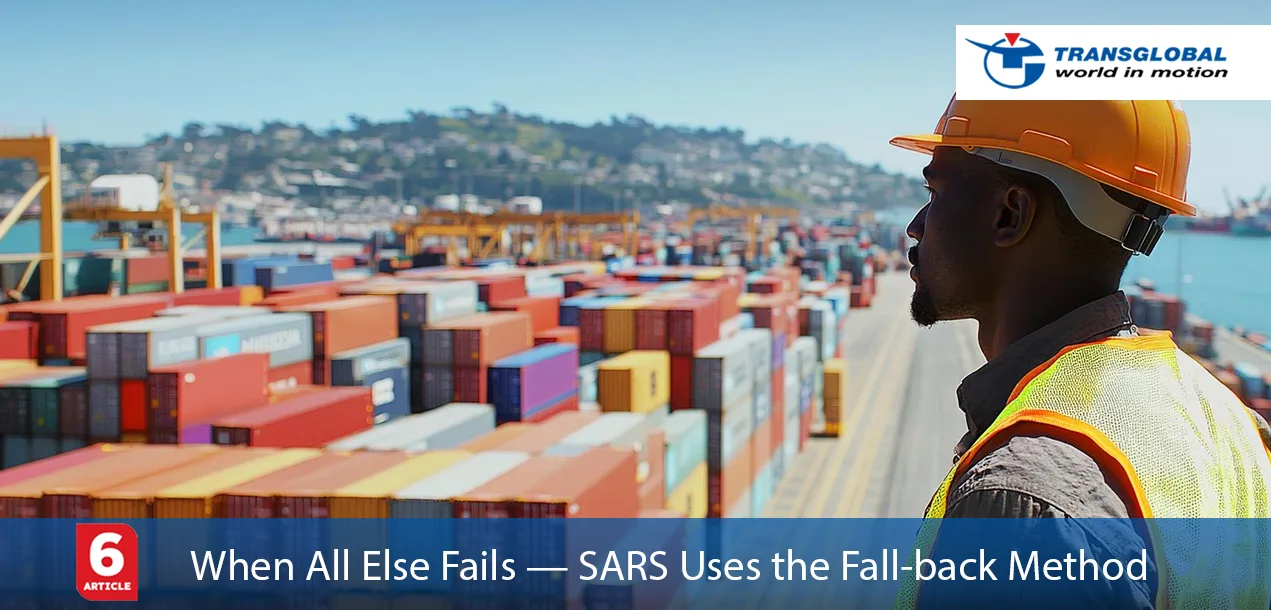
Sometimes, no matter how well you prepare your paperwork or structure your shipment, the declared customs value just won’t meet SARS requirements. Maybe there was no sale. Maybe the goods were samples. Or maybe there’s missing or conflicting documentation. When all standard methods (1 to 5) fail, SARS uses what’s known as the Fall-back Method, also called Method 6, to determine your customs value.
But this doesn’t mean SARS has free rein to make up a number. The fall-back method still follows global WTO valuation principles and must be based on objective data.
Let’s break down how this method works, when it applies, and what importers need to watch out for.
What is the Fall-back Method?
The Fall-back Method is SARS’s last resort, but it’s not a random valuation. It’s a flexible approach that relies on reasonable judgment, as long as the logic behind the valuation is consistent with WTO rules under the Customs Valuation Agreement.
In short, it’s a mix of what’s available, what’s comparable, and what’s reasonable, all within the legal framework of South African customs law.
SARS may look at:
- Market prices for similar goods in South Africa
- Price lists or catalogues from manufacturers or distributors
- Cost models from prior imports or declarations
- Previously accepted customs values
- Industry databases or third-party price benchmarks
But SARS cannot invent a value out of thin air or use arbitrary methods that are inconsistent with international customs principles.
When is the Fall-back Method Used?
SARS turns to Method 6 when none of the other valuation methods (Transaction Value, Identical Goods, Similar Goods, Deductive Value, or Computed Value) can apply.
Common scenarios include:
- Free samples with no declared sale or invoice
- Promotional or bonus goods provided outside the main invoice
- Goods shipped on consignment with no confirmed sale
- Missing or inconsistent documentation
- Uncooperative suppliers, especially in Method 5 cases
- Highly customized or new-to-market products with no comparison
These situations are more common than many importers realise, especially in industries dealing with donations, NGOs, seasonal promotional goods, or government imports.
Real-World Example
Let’s say your company receives 10,000 promotional pens from a supplier abroad, intended for free distribution at a trade expo. There’s no invoice, the shipment is labeled as “free of charge.” SARS can’t use Transaction Value (Method 1) because there was no payment.
Here’s how SARS may proceed:
- They check the same supplier’s online catalogue, which lists the pens at USD 0.25 each.
- That price becomes the basis for the customs value (adjusted for shipping and currency).
- Customs Value = 10,000 units × USD 0.25 = USD 2,500
Even though no money was exchanged, a customs duty and VAT liability still apply, because the goods are entering the country and affecting the local economy.
What SARS Cannot Do?
Importers often worry that Method 6 gives SARS unchecked power. But this is not the case.
Under WTO and local customs laws, SARS is prohibited from:
- Using selling prices in South Africa as a customs value (unless using Method 4)
- Applying minimum or arbitrary values
- Disregarding available factual evidence from the importer
- Penalising the importer simply because the goods were declared as free or a sample
If SARS applies a valuation that seems unreasonable, importers have the right to:
- Request a review or appeal under the Customs & Excise Act
- Provide supporting documents (e.g., catalogue screenshots, shipping contracts)
- Engage with customs brokers or legal experts to contest excessive valuations
How Importers Can Prepare?
Even if you believe your shipment might qualify for a fall-back valuation, being proactive can save you time and avoid disputes.
Here’s what you can do:
🧾 Always ask suppliers for catalogues or price lists (especially for samples)
📦 Clearly label and document “free of charge” shipments
🔄 Record any past customs valuations for similar shipments
🧑💼 Use a qualified customs broker to guide the valuation discussion
📂 Keep internal cost estimates and procurement records to support fallback values
Industries Where Method 6 is Common
Certain sectors see more frequent use of the Fall-back Method, including:
- Pharmaceuticals – free trial batches or donated medicines
- Events & exhibitions – marketing goods with no invoice
- Defence and aid logistics – donated or subsidised equipment
- Consumer electronics – beta products or evaluation units
If your business is active in these sectors, fall-back preparedness should be part of your compliance playbook.
Conclusion
SARS’s Fall-back Method is not a loophole, and it’s definitely not a blank check. It’s a structured, rules-based approach to valuing goods when standard methods don’t apply. The key is transparency, documentation, and comparables.
And remember: undervaluation or vague documentation can raise red flags. It’s always safer to over-communicate with SARS than leave grey areas.
If your business handles complex or non-traditional imports, promotional cargo, defence items, samples, or bundled shipments, make sure your valuation strategy includes Method 6 contingencies.
At Transglobal Cargo, we assist clients with customs compliance across all valuation methods. From declarations to documentation, we simplify the process and reduce your risk.
Looking for a reliable freight forwarder in Africa who understands SARS rules inside and out? Contact Transglobal Cargo today. We help you move faster, safer, and more confidently.
🧭 What’s Next in the Series: Dutiable vs Non-Dutiable Charges and How Buying Commissions Can Trip You Up?
Frequently Asked Questions
Is the Fall-back Method commonly used by SARS?
No, it’s used as a last resort when other methods can’t apply. But it’s crucial in cases like promotional goods, free samples, or missing invoices.
No, it’s used as a last resort when other methods can’t apply. But it’s crucial in cases like promotional goods, free samples, or missing invoices.
Yes. You can request a review, provide additional documentation, or appeal the decision if you believe the valuation is unreasonable.
Do I need to pay duties on free-of-charge shipments?
Yes. Even if there’s no invoice, SARS still requires a customs value. Duties and VAT apply based on that value.
Comments