

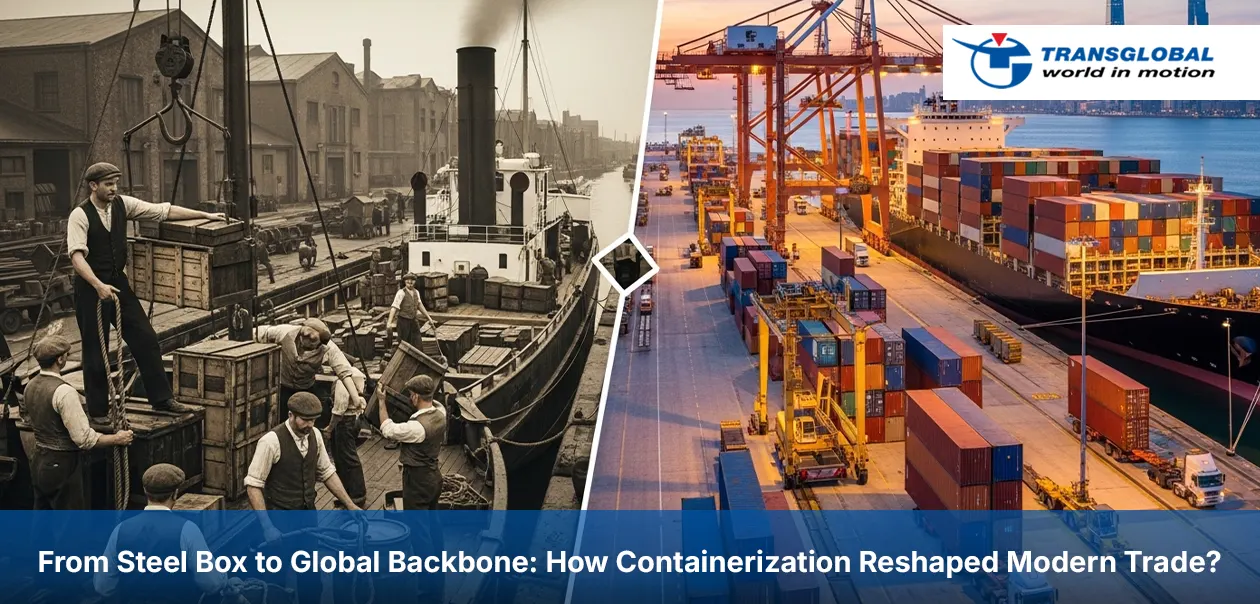
In 1956, a single voyage quietly altered the trajectory of global commerce. When Malcolm McLean loaded 58 standardized containers onto a converted tanker ship, the Ideal X, and sailed from Newark to Houston, it appeared to be a simple operational adjustment. In reality, it marked the beginning of one of the most transformative shifts in economic history.
That steel box did more than move cargo. It reduced transport costs by up to 90 percent, shortened port turnaround times from weeks to hours, strengthened cargo security, and made global manufacturing networks commercially viable. Today, more than 90 percent of global non-bulk cargo travels in containers, with over 800 million TEUs moved annually across international trade routes.
Containerization did not just improve logistics. It reshaped the global economy.
Before the Container: A Slow and Costly System
Before standardized containers, cargo was handled individually. Ships carried breakbulk freight, crates, sacks, barrels, and machinery, all manually loaded and unloaded. The process was labor-intensive, inefficient, and exposed cargo to theft and damage.
Shipping costs averaged around $5.83 per ton. Vessels remained docked for extended periods while cargo was sorted, moved, and secured. Delays were routine, and reliability was uncertain.
The container eliminated these inefficiencies by allowing goods to remain sealed inside a standardized unit from origin to destination.
The result was immediate and measurable:
- Shipping costs dropped dramatically
- Theft and damage declined
- Port congestion reduced
- Predictability improved
The economics were undeniable.
Standardization: The True Breakthrough
The early success of containers depended on one critical factor, global standardization.
In the 1960s, the International Organization for Standardization (ISO) introduced uniform container specifications, including:
- 20-foot and 40-foot container sizes
- Standardized corner castings
- Twist-lock securing mechanisms
- Structural strength guidelines
This alignment allowed ports, rail networks, trucking systems, and shipping lines worldwide to operate seamlessly. Without common dimensions and technical standards, containerization would have remained fragmented and regionally limited.
Standardization gave global trade a universal language.
Military Acceleration and Infrastructure Expansion
Container adoption accelerated significantly during the Vietnam War, when the U.S. military deployed containers to streamline supply movement. The scale of military logistics investment fast-tracked infrastructure development and operational acceptance.
Soon, purpose-built container vessels entered service. Ports such as Rotterdam, Singapore, and Hong Kong expanded rapidly, transforming into global trade hubs.
What began as a cost-saving idea became the backbone of global supply chains.
The Globalization Multiplier
Between the 1980s and early 2000s, containerization enabled the global production networks we recognize today.
It supported:
- Just-in-time manufacturing systems
- International automotive supply chains
- The growth of Asian export economies
- Cross-border retail and consumer markets
Transport costs were no longer a limiting factor in production geography. Manufacturing shifted to regions offering cost advantages, knowing that containerized shipping would maintain economic viability.
The container did not simply move products. It enabled industrial relocation and global integration.
The Structural Impact on Trade Efficiency
Containerization transformed operational performance across the shipping industry.
Before containers:
- Ships waited in port for weeks
- Cargo theft was widespread
- Damage rates were significant
- Labor intensity drove high costs
- Supply chains lacked predictability
After containers:
- Port turnaround reduced to hours
- Cargo security improved
- Damage rates declined
- Labor efficiency increased
- Reliability strengthened
Economists frequently note that containerization may have contributed more to trade expansion than tariff reductions. By lowering logistical friction, it made distance economically manageable.
Lessons for Today’s Supply Chain Environment
While the steel container remains foundational, today’s logistics landscape faces new complexities:
- Port congestion cycles
- Geopolitical route disruptions
- Fuel price volatility
- Customs enforcement intensification
- Sustainability requirements
- Digital compliance mandates
The pattern remains consistent: structural shifts in logistics reshape economic opportunity.
Modern equivalents of containerization include:
- AI-driven supply chain optimization
- Digital trade documentation
- Real-time shipment visibility systems
- Sustainable shipping transitions
- Diversified sourcing strategies
Each innovation reduces friction, standardizes operations, and enhances scale, the same principles that drove containerization’s success.
Why does the Container Still Matter in 2026 and Beyond?
Despite technological advancement, the physical container remains the primary vehicle of global trade. Its standardization allows multimodal transport like sea, rail, and road, without cargo repacking. That interoperability strengthens resilience during disruptions.
During recent global supply chain shocks, container systems demonstrated adaptability. Routes were adjusted, volumes recalibrated, and flows redirected, all because standardized infrastructure existed.
- Resilience depends on structure.
- And containerization provided that structure.
- The Strategic Takeaway for Logistics Leaders
The companies that benefited most from containerization were not those who waited. They were those who:
- Invested in infrastructure early
- Built global partnerships
- Embraced standardized processes
- Recognized logistics as a strategic function
The same mindset applies today. Businesses that integrate digital systems, compliance controls, and multimodal coordination early will shape the next era of trade efficiency.
Logistics is not merely operational execution. It is an economic strategy.
Containerisation: Key Milestones in the Transformation of Global Trade
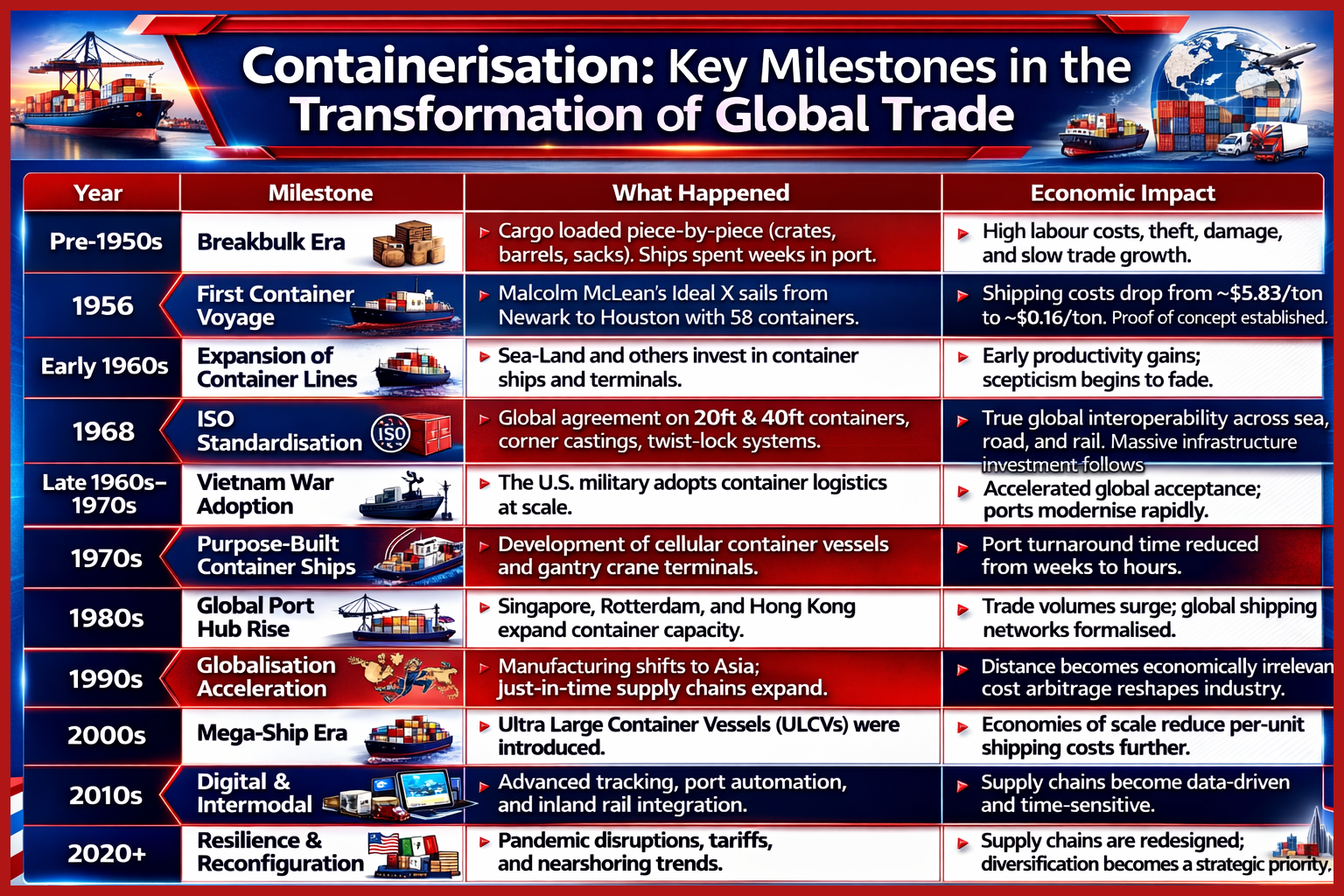
Measurable Structural Impact
Containerization delivered quantifiable transformation:
- Up to 90 percent reduction in shipping costs
- Port turnaround times reduced from weeks to hours
- Over 90 percent of global non-bulk cargo is containerized
- More than 800 million TEUs are handled annually
- Entire port economies are built around container trade
Few innovations in modern history have influenced economic systems so broadly.
Looking Ahead: The Next Transformation
The steel box was simple in concept, yet transformative in impact.
Today, structural shifts are occurring in digitization, sustainability, compliance integration, and geopolitical risk management. These developments may not be as visually obvious as a container ship, but their economic implications are equally significant.
History demonstrates that logistics innovation does not merely increase efficiency.
It redefines competitive advantage.
Conclusion
Containerization changed how the world trades. It reduced friction, standardized movement, and enabled global economic expansion.
As global supply chains evolve, businesses need freight partners who understand both the historical foundation and the modern complexity of international trade.
If you are seeking the best freight forwarder to navigate today’s global logistics environment with precision, resilience, and strategic insight, contact us today. We combine operational expertise with forward-thinking solutions to keep your cargo moving confidently across borders.
Frequently Asked Questions
Why was containerization more impactful than tariff reductions?
Because it lowered the physical cost of moving goods. Reduced transport friction allowed trade to expand independently of policy shifts.
How does containerization support supply chain resilience today?
Standardized containers enable seamless multimodal transfers and flexible rerouting during disruptions, improving adaptability.
Is containerization still evolving?
Yes. While the physical standard remains stable, digital tracking, sustainability initiatives, and smart container technologies continue to enhance operational efficiency.

Comments