

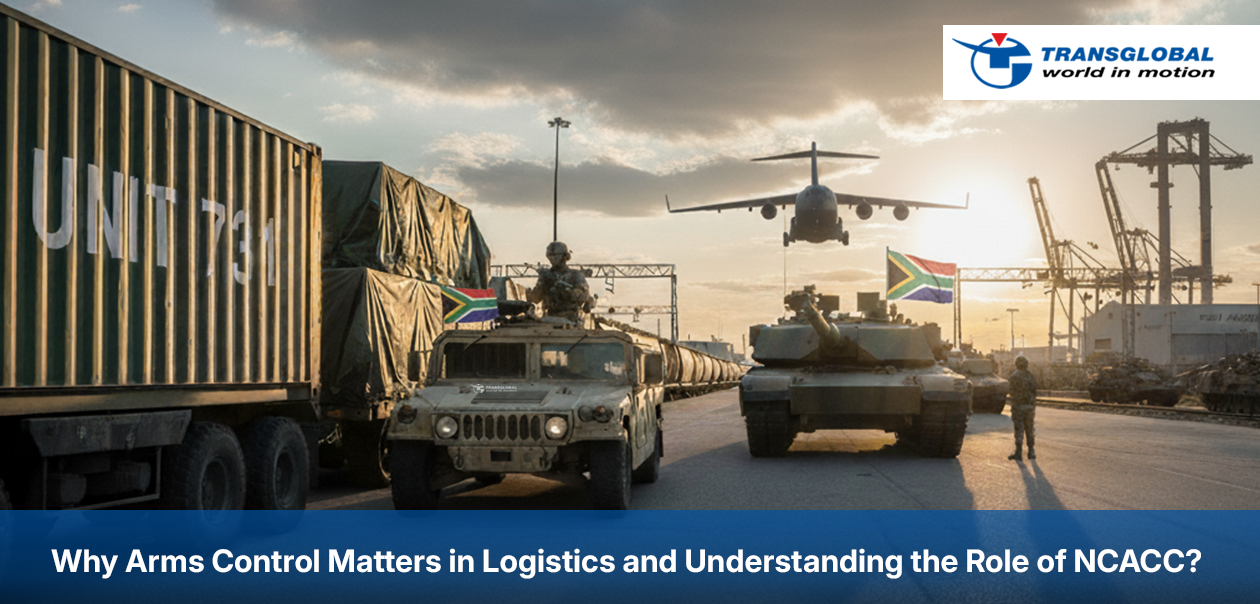
When we talk about logistics in South Africa, the conversation usually centers on cargo volumes, port delays, customs procedures, or road infrastructure. But for those of us operating in specialized sectors, particularly in the movement of military, dual-use, or explosive goods, there’s a silent regulator shaping how, when, and where our cargo moves: the NCACC.
The National Conventional Arms Control Committee (NCACC) may not be a familiar name to most logistics professionals, but its impact on supply chains that involve sensitive or controlled items is profound.
The Unseen Regulator Behind Complex Supply Chains
In the background of many strategic shipments, especially those involving military components, explosives, or dual-use goods, stands the NCACC. Established under the National Conventional Arms Control Act (Act 41 of 2002), this body ensures that South Africa’s role in the global arms trade and movement is responsible, lawful, and transparent.
For companies like Transglobal Cargo (Pty) Ltd and Defenlog (Pty) Ltd, aligning with the NCACC’s expectations is not just a legal requirement, it reflects our duty to protect national security and maintain ethical logistics standards.
What the NCACC Actually Does?
The NCACC regulates more than just weapon sales. Its scope includes the trade, brokering, storage, transit, and transport of conventional arms and controlled dual-use items, many of which are part of everyday logistics operations but require strict oversight when used in specific contexts.
Key functions of the NCACC include:
- Approving or denying permit applications for the import, export, re-export, and transit of controlled goods.
- Ensuring compliance with international arms treaties and South Africa’s foreign policy.
- Preventing transfers that could contribute to regional instability, armed conflict, or human rights violations.
- Promoting ethical and transparent defense trade practices.
In essence, the NCACC ensures that logistics companies are not unknowingly part of illicit supply chains or arms proliferation.
Why Logistics Providers Should Pay Attention?
Even if your company isn’t directly involved in arms manufacturing or defense contracting, you may still be subject to NCACC regulation.
This applies if your business:
- Transports military-grade items, such as firearms, ammunition, or armored vehicles.
- Handles explosives, including those used in mining or construction.
- Moves dual-use goods, like chemicals or electronics that have both civilian and military logistics.
- Offers warehousing or brokering services for controlled items.
Ignoring NCACC registration and permit requirements can lead to:
- Hefty penalties or criminal prosecution.
- Suspension of licenses or transport operations.
- Loss of trust from clients who depend on secure and lawful supply chains.
- International reputational risk, especially if goods cross borders.
How Transglobal Approaches Compliance?
At Transglobal Cargo, we view regulation not as red tape, but as an operational backbone. Our approach to NCACC compliance is proactive, thorough, and embedded across our logistics network.
We maintain:
- NCACC registration and up-to-date transport permits.
- CIE (Chief Inspector of Explosives)–approved handling procedures.
- Secure vehicle tracking, route risk analysis, and vetted transporters.
- Full audit trails for all shipments involving arms or controlled goods.
Whether we’re moving military equipment, museum consignments, luxury armored vehicles, or hazardous cargo, our operations are built to uphold both national regulations and global safety standards.
Conclusion
In sectors where cargo has the potential to cause harm, directly or indirectly, freight forwarders must go beyond delivering goods. We must deliver accountability.
Arms control compliance is not just for defense contractors. It is a shared responsibility that protects communities, preserves peace, and builds long-term credibility for Africa’s logistics industry.
📌 Thanks for Reading, and Stay Tuned for Article 2 in This Series: How Regulated Logistics Keep South Africa Safe — From Permit to Plate?

Comments